🎥 Filmed by Dr. Shah | BiodiversiGrapher® 🇵🇰
About This Video
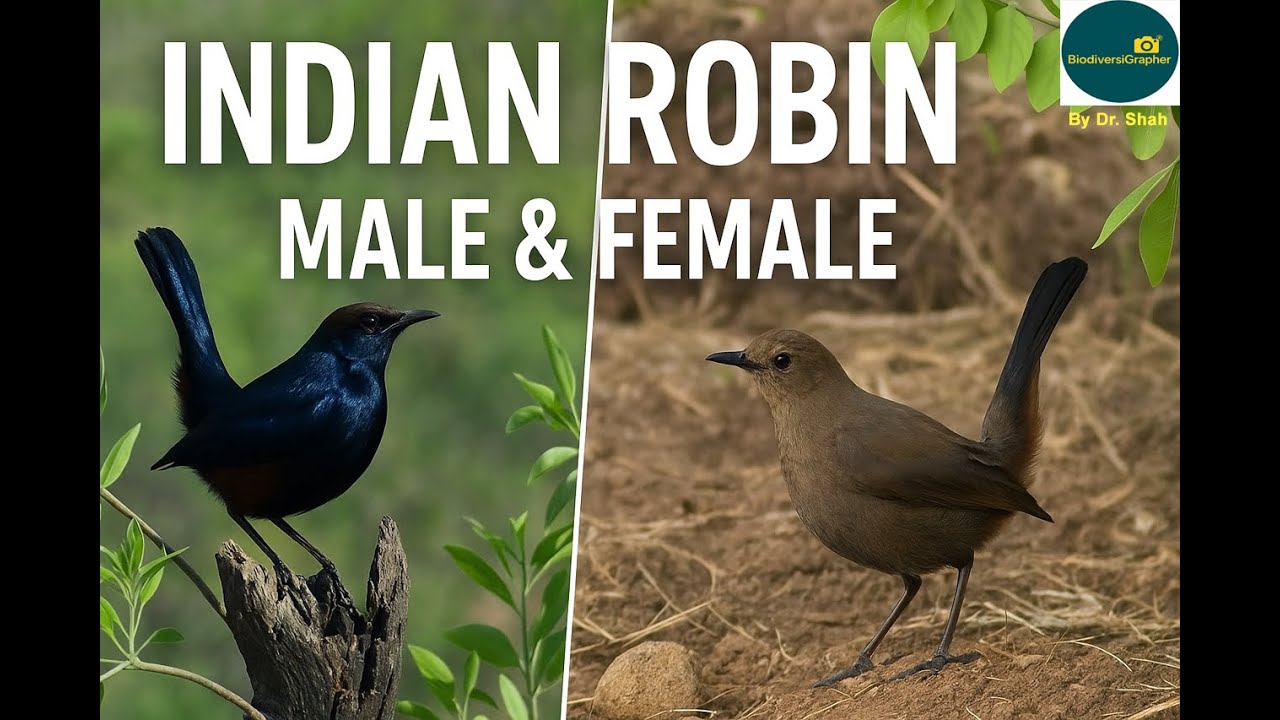
Discover the fascinating male and female Indian Robin (Copsychus fulicatus) in their natural habitat at the Margalla foothills near Quaid-i-Azam University (QAU), Islamabad. Watch their striking plumage differences, active insect-hunting behavior, and hear the female’s distinctive soft “chee chee” call—all captured ethically and in stunning detail. 🌳🦟
📍 Filming Locations & Dates
• Male Indian Robin
📅 16 December 2023
🌾 Open field, Margalla foothills near QAU Islamabad
• Female Indian Robin
📅 7 January, 21 & 27 August 2024
💧 Near flowing Margalla stream and on trees
🐤 Key Features & Behavior
Male Indian Robin:
• Glossy black plumage with bold white shoulder patch 🤩
• Rich chestnut under-tail feathers visible during flight ✨
• Active, upright posture with jumping behavior while foraging for insects 🦗
Female Indian Robin:
• Duller brown-grey plumage with rufous vent area 🍂
• No white shoulder patch
• Frequently seen hunting insects near water and on trees 🌊🌿
• Heard softly calling “chee chee” — a distinctive vocalization 🗣️
🌍 Habitat & Distribution
Native and common across Pakistan, especially northern regions like the Margalla Hills, Potohar Plateau, and Punjab plains. Indian Robins prefer:
• Open scrublands
• Rocky stream banks
• Agricultural fields & gardens
• Urban fringes near Islamabad
They are non-migratory but adapt seasonally to local habitats.
🎯 Why Watch?
✔️ Identify male vs female Indian Robins by plumage & behavior
✔️ Witness natural insect-hunting agility and foraging techniques
✔️ Hear authentic female vocalizations in the wild
✔️ Explore Margalla Hills’ rich avian biodiversity
✔️ Support ethical wildlife filming by a local expert
🎥 About BiodiversiGrapher® & Dr. Shah
BiodiversiGrapher® is Pakistan’s premier wildlife documentation platform, focusing on authentic, ethical recordings of native species.
Dr. Shah is a dedicated wildlife biologist and filmmaker passionate about capturing Pakistan’s natural wonders responsibly. 🌿📹
🔔 Stay Connected
👍 Like if you love Pakistan’s wildlife!
💬 Share your birdwatching experiences or questions below.
🔔 Subscribe and click the bell to follow BiodiversiGrapher® for more amazing wildlife videos!
#IndianRobin #BiodiversiGrapher #MargallaHills #BirdsofPakistan #WildlifeIslamabad #FilmedByDrShah #BirdwatchingPakistan #UrbanWildlife #CopsychusFulicatus #BirdBehavior #NatureDocumentary #PakistanBirds #WildlifePhotography #Birdwatching
📚 References
• 📖 Kumar, C. K., Thind, S. K., & Kaleka, A. P. S. (2021). Some notes on breeding behaviour of Brown-backed Indian Robin Copsychus fulicatus cambaiensis (Latham, 1790) in agricultural landscape of Punjab. Ecol Environ Conserv, 27, 5330-5349.
• 🎶 Nailwal, P., Tapaswini, S., & Kumar, A. (2022). Indian Robin: Song Characteristics and Functions. In Case Studies of Wildlife Ecology and Conservation in India (pp. 101-110). Routledge.
• 🐦 Kumar, A., & Rawal, P. (2025). Subspecies-level variations in song characteristics of Indian robin Copsychus fulicatus across India. Ornithology Research, 33(1), 1-11.
• 🏞️ Wickramasinghe, S., Muthuthanthirige, D. L., & Nandapala, K. M. A. (2019). Breeding and Territorial Behaviour of Indian Black Robin (Copsychus fulicata leucoptera) in Mihintale, Sri Lanka. Research in Ecology, 1(2).
• 🌆 Zaman, A., Rafique, A., Jabeen, F., & Sultana, T. (2023). Diversity, abundance and seasonal assessment of wild birds in urban habitat of district Chiniot, Pakistan. Pakistan Journal of Zoology, 55(2), 525.
• 🌿 Shabbir, K., Sultan, K., Noreen, Z., uz Zaman, Q., Iqbal, M., Nazir, A., ... & Ahmad, N. (2024). Impact of the urban environment on habitat selection of wild avifauna: Center to boundary ecological assessment. Ecological Frontiers, 44(3), 570-579.

Информация по комментариям в разработке