Follow me on instagram,
https://www.instagram.com/ziasafir?ut...
whatsapp number 9790892697
The Courses available at this time are as follows, for the details watch the video links given below.
https://academixedge.rpy.club/courses... - Interview Mentorship Pgm
https://academixedge.rpy.club/course/... - Csat Course
https://academixedge.rpy.club/course/... -IAS Course
https://academixedge.rpy.club/course/... - Sociology course
https://academixedge.rpy.club/course/... - Sociology Notes
Here are the details of various Courses available, watch the videos for more clarity.
• Socio Course details
Sociology Course Details
• IAS Mentorship Explanation
IAS Mentorship
• Sociology Mentorship
Sociology Mentorship
• Sociology Test Series
Sociology Test Series
• IAS Course
IAS Course
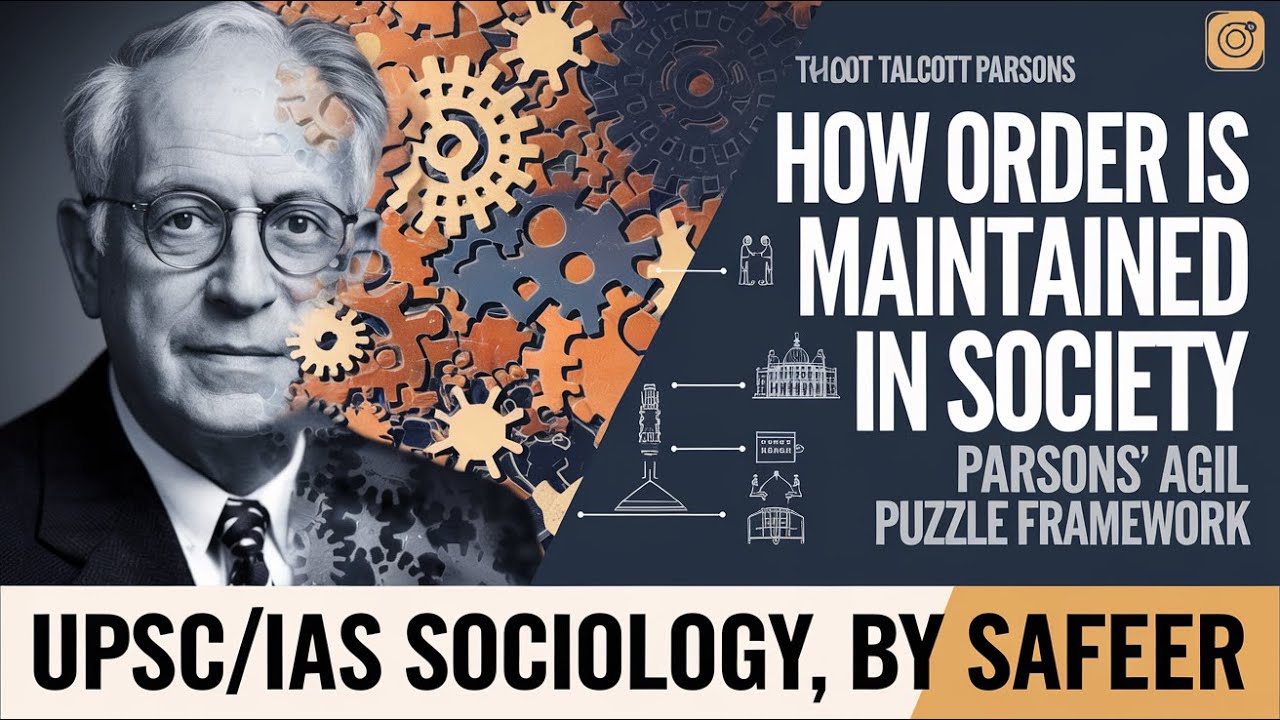
Talcott Parsons, one of the most influential sociologists, offered a comprehensive framework for understanding how societal order is maintained through his structural-functionalism approach. In this video, we delve into Parsons’ theories, focusing on his AGIL framework, the concept of value consensus, and the role of institutions in ensuring stability and harmony in society.
Parsons’ AGIL schema outlines four functional prerequisites essential for societal stability: Adaptation, Goal Attainment, Integration, and Latency. These components highlight how systems like the economy, politics, education, and family work together to maintain equilibrium. For instance, the economic system ensures resource distribution (Adaptation), while the political system sets and achieves collective goals (Goal Attainment). Educational and legal institutions foster social cohesion (Integration), and the family and religion reinforce shared values (Latency).
A cornerstone of Parsons’ theory is value consensus, which emphasizes the importance of shared norms and values in guiding individual behavior and fostering cooperation. Socialization, facilitated by institutions like the family and religion, plays a crucial role in aligning personal behavior with societal expectations. For example, schools not only impart knowledge but also instill discipline and punctuality, ensuring individuals contribute to societal order.
Parsons also likens society to a biological organism, where various subsystems work together to restore balance when disrupted. This homeostatic nature of society explains how institutions respond to challenges like economic recessions or political instability to maintain harmony.
However, Parsons’ theories have faced criticism. Critics argue that he overemphasizes stability and harmony, neglecting the role of conflict, power dynamics, and rapid social changes. Conflict theorists like C. Wright Mills highlight how dominant groups maintain power by imposing their values on others, challenging Parsons’ emphasis on value consensus. Furthermore, his framework is seen as overly abstract, idealistic, and reflective of Western societies, making it less applicable to diverse global contexts.
Despite these critiques, Parsons’ work remains foundational in sociology, offering insights into the interplay between institutions, norms, and societal stability. His emphasis on shared values and the interconnectedness of societal subsystems continues to inform analyses of social cohesion and systemic functionality.
This video provides a detailed exploration of Parsons’ contributions to sociology, making it an essential watch for students, educators, and enthusiasts interested in understanding how societies maintain order. Whether examining the role of socialization, institutions, or the AGIL framework, this discussion offers valuable insights into the complexities of social stability and harmony.
Don’t forget to like, share, and subscribe for more in-depth explorations of key sociological theories and concepts!
#TalcottParsons, #AGILFramework, #SocialOrderInSociety, #ValueConsensus, #StructuralFunctionalism, #ParsonsSociology, #RoleOfInstitutions, #ParsonsAGILSchema, #SocialStability, #ParsonsFunctionalism, #SocializationAndNorms, #SociologicalTheories, #CriticismOfParsons, #HomeostasisInSociety, #SociologyExplained, #EquilibriumInSociety, #ConflictVsStability, #RoleOfFamily, #ParsonsAndOrder, #SociologyForStudents, #SociologicalConcepts, #ParsonsAndSocialization, #SharedNormsAndValues, #InstitutionalRoles, #SocialCohesion

Информация по комментариям в разработке