What if the reason AI investments are not delivering value has nothing to do with the technology itself?
Across industries, organizations are pouring billions into AI tools, rolling out enterprise copilots, and tracking usage metrics that suggest adoption is rising. But the outcomes are not changing. Productivity is not shifting in meaningful ways. Decision making is not improving. And leaders are starting to ask why.
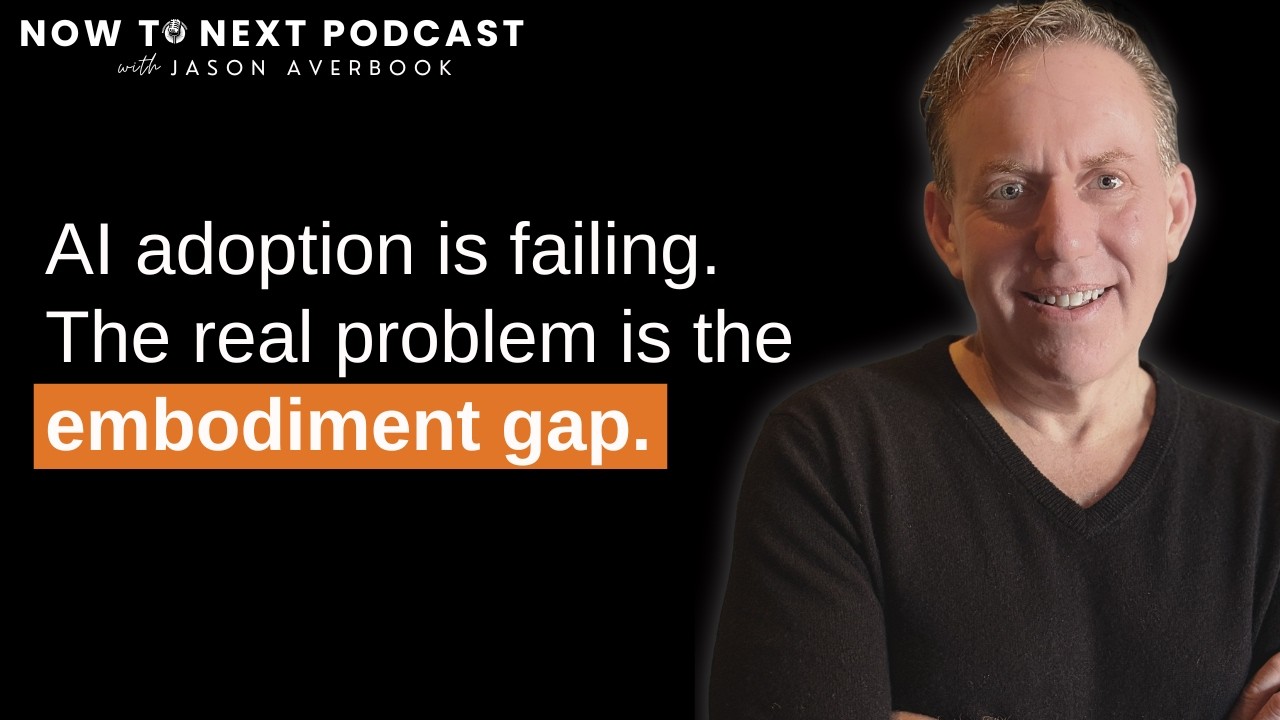
In my sixth solo episode, I unpacked what I call the Embodiment Gap. The growing divide between organizations that are simply adopting AI tools and those that are truly redesigning work so humans and AI become better together.
Drawing on recent research from McKinsey, Forrester, Gartner, BCG, Harvard Business Review, and the Journal of Accountancy, I explore why only a small fraction of AI initiatives are delivering transformative value and why the real barrier is not technology but human design.
This episode reframes the conversation from adoption to embodiment and challenges leaders to rethink how they measure success, build trust, and prepare for the coming wave of agentic AI that will reshape how decisions are made inside organizations.
Highlights:
Why only 1 in 50 AI initiatives are delivering true transformative value
The hidden difference between using AI, adopting AI, and embodying AI
Why tracking prompts and logins tells you almost nothing about real impact
The psychological barriers that cause most AI rollouts to quietly stall
What the “Silicon Ceiling” reveals about the real limits of enterprise AI adoption
Why the coming wave of agentic AI will force organizations to rethink governance and accountability
The dangerous risk of knowledge atrophy as AI begins to replace human judgment development
Why the companies that win with AI will not be the ones that deploy tools fastest but the ones that redesign work first
Host Bio:
Jason Averbook is a globally recognized thought leader, advisor, and keynote speaker focused on the intersection of AI, human potential, and the future of work. He is the Senior Partner and Global Leader of Digital HR Strategy at Mercer, where he helps the world’s largest organizations reimagine how work gets done — not by simply implementing technology, but by transforming mindsets, skillsets, and cultures to be truly digital.
Over the past two decades, Jason has advised hundreds of Fortune 1000 companies, co-founded and led Leapgen, authored two influential books on the evolution of HR and workforce technology, and built a reputation as one of the most forward-thinking voices in the industry. His mission is to challenge leaders to stop seeing digital transformation as an IT project — and start embracing it as a human strategy.
Follow Jason Averbook:
Substack: https://substack.com/@jasonaverbook
X: https://x.com/jasonaverbook
LinkedIn: / jasonaverbook
Instagram: / jasonaverbook
YouTube: / @nowtonextwithjasonaverbook
Facebook: / jasonaverbook
References:
McKinsey AI Research (March 2026)
https://www.mckinsey.com
Forrester AI Usage Findings (February)
https://www.forrester.com
Harvard Business Review (March–April Issue)
https://hbr.org
Journal of Accountancy AI Research (March 1)
https://www.journalofaccountancy.com
Gartner AI Governance Research (March 1)
https://www.gartner.com
BCG AI at Work Report (2026)
https://www.bcg.com
–
Timestamps:
(0:00) Introduction to the episode "The Embodiment Gap"
(1:05) Transformative value of AI initiatives and research sources
(3:19) Understanding AI: Usage, Adoption, and Embodiment
(5:30) The silicon ceiling and its implications for AI adoption
(7:13) Measuring improvements in AI and the importance of embodiment
(11:08) Psychological needs and trust in AI adoption
(15:44) The evolution to agentic AI and its organizational impact
(19:03) AI's role in decision-making, accountability, and knowledge atrophy
(23:13) Comparing future-built companies and laggards in AI adoption
(24:13) Summarizing AI's importance and concluding thoughts
#ai #podcast #interview #technology #hrsolutions #career #innovation














Информация по комментариям в разработке