In the chaotic streets of Philadelphia, Robert Kurzban noticed something peculiar: sometimes, ignorance is a survival strategy. If a driver sees that you’ve seen them, they expect you to stop. But if you cross the street looking confused or distracted—like a tourist lost in thought—the driver is forced to brake. By appearing "ignorant," you’ve won the social game.
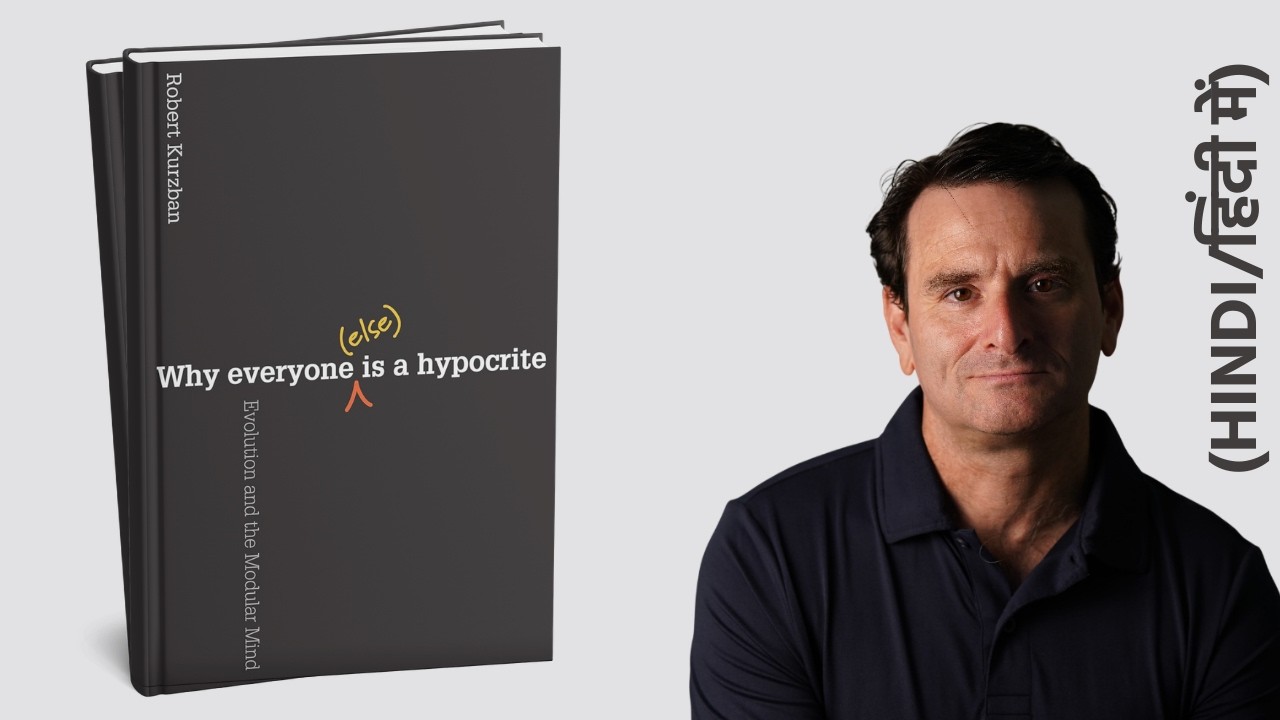
This observation serves as the launchpad for Kurzban’s book, Why Everyone (Else) Is a Hypocrite. As an evolutionary psychologist, Kurzban argues that the human mind isn't a single, unified "self." Instead, it is a collection of specialized modules—think of them as "apps" on a smartphone—each designed by evolution to solve specific problems.
The Modular Mind: A Society of Apps
We often think of our mind as a CEO sitting in a boardroom, making rational decisions. Kurzban suggests it’s more like a noisy committee.
The Split-Brain Proof: Experiments on "split-brain" patients (where the connection between brain hemispheres is severed) show that one side of the brain can act while the other side creates a completely fictional story to explain it.
Encapsulation: Modules are often "walled off." This is why you can know an optical illusion is a trick, yet your visual module continues to see it. One part of your brain has the truth, while the other holds the "wrong" information.
The "Press Secretary" in Your Head
One of the book’s most brilliant insights is the concept of the Internal Press Secretary.
In a government, the Press Secretary’s job isn't to know the top-secret truth; it’s to look the public in the eye and defend the administration’s actions. Our "conscious self" functions similarly. We often don't know why we chose a partner, felt a certain emotion, or bought a specific car. However, our Press Secretary module immediately spins a logical-sounding yarn to make us look consistent and "correct" to others.
Strategic Ignorance: If the Press Secretary doesn't know the truth, they can't be caught lying. By keeping the "conscious" part of our mind ignorant of our darker or more selfish motives, evolution allows us to be much more persuasive.
The Willpower Myth: The Effortometer
Why do we lock the fridge at night? If "we" decided to diet, why is there another "us" trying to eat cake at midnight?
Kurzban rejects the idea that willpower is a "battery" that runs out of juice. Instead, he proposes the Effortometer. The brain is constantly performing a cost-benefit analysis. When you're tired or stressed, the "instant gratification" modules (designed for survival in a resource-scarce past) gain more voting power than the "long-term planning" modules.
"We aren't 'one' person. We are a bundle of contradictions, where different modules take the steering wheel depending on the situation."
The Evolutionary Advantage of Being Wrong
You might think a brain that perceives the world 100% accurately would be the most successful. Evolution begs to differ. Kurzban highlights the Lake Wobegon Effect, where:
94% of professors think they are above-average teachers.
Most people think they are better-than-average drivers, even right after a car accident.
Being strategically wrong—overestimating our own value or health—makes us more attractive as friends, allies, and mates. If you believe your own propaganda, others are more likely to believe it, too.
Morality as a Social Stick
Finally, Kurzban tackles the elephant in the room: Hypocrisy.
We have modules designed to judge and punish others (to keep social order) and separate modules designed to maximize our own benefit. This is why a politician can genuinely believe prostitution should be illegal while secretly visiting an escort. The "Judging Module" is busy scoring points with the public, while the "Gratification Module" is busy pursuing its own goals. They simply aren't talking to each other.
Conclusion: Embracing the "iMind"
Understanding the modular mind changes how we view ourselves and society. We aren't "hypocrites" because we are evil; we are hypocrites because our brains were built to win social games, not to be logically consistent.
By recognizing that our "Press Secretary" is often full of it, we can become a bit more skeptical of our own certainties and perhaps a bit more forgiving of the (inevitable) hypocrisy in everyone else.








Информация по комментариям в разработке