Folk pop version by the Ri Briganti Band on their album Musicultura Suddista. I've translated the lyrics a little liberally in an attempt to retain the spirit of the original Neapolitan. They still use expressions and historical allusions which aren't immediately understandable, so I've written far too much about their meaning below.
In January 1799, the army of the French First Republic invaded the Kingdom of Naples, establishing a client republic. Many nobles and intellectuals defected to the republican cause, but the staunchly Catholic peasants of Naples remained loyal. The Song of the Sanfedists commemorates the eponymous popular peasant uprising led by Cardinal Fabrizio Ruffo against the republican traitors, with the aim of restoring Bourbon rule.
The Carmagnole was a French revolutionary song of the period, mocking King Louis XVI, Queen Marie Antoinette, and monarchists in general. During the French Revolution, alleged counter-revolutionaries, such as priests and nobles, were forced to dance and "sing the Carmagnole" prior to being lynched. It was also often sung by revolutionaries after massacres and battles. Here, the Sanfedists turn it back on the revolutionaries, daring them to try to sing it now. The "councillors" were the Jacobin lawyers, philosophers, nobles, and intellectuals who formed the governing councils and juntas of the republic, here made to praise the King and his family, likely before meeting the same fate as their victims in France.
The "shameless cuckold bastard" is likely Ettore Carafa d'Andria, Count of Ruvo, a famous Jacobin-sympathetic noble. Saint Eremo/Sant'Elmo was used as a prison for republicans. After executing republican nobles or intellectuals, the Sanfedists sometimes mocked them by putting a fake bishop's mitre on their head, a reversal of republican humiliations of the clergy.
The liberation of Naples during the Sanfedist counter-revolution occurred on the 13th of June 1799, on the day of Saint Anthony, a very popular saint in Naples. Here he's invoked as the miraculous deliverer of the city. "To make a bouquet" is a Neapolitan expression implying that the Jacobins of the city were massacred and piled up, like flowers in a bouquet.
The Donna Luisa mentioned is Luisa Molina Sanfelice, a famous noblewoman who betrayed the King in favour of the republicans. She was executed by the King. She attempted to delay her execution by insisting she was pregnant; in the end, the royal physician found that she wasn't.
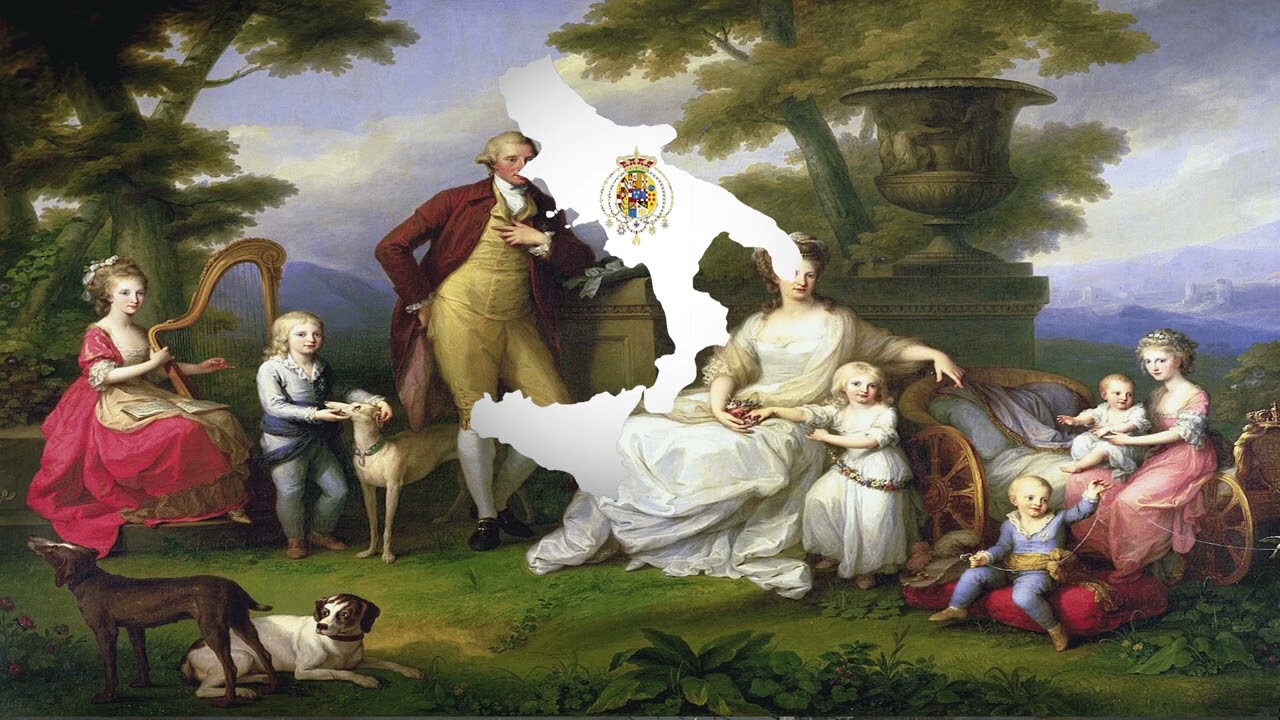
The Tree of Liberty in the harbour of Naples is either a symbolic pole or an actual tree adorned with a Phrygian cap; the republicans erected these in many cities. Its destruction by the Sanfedists is depicted in the painting at the start of the video. Can you spot the British Redcoats on the right? These are Admiral Lord Nelson's marines from HMS Foudroyant. Nelson was acting on behalf of Queen Maria Carolina; they were both more fanatical anti-republicans than Cardinal Ruffo and King Ferdinand, and it was Nelson who escalated the bloody retribution in Naples at the queen's request.
The "month to come" in the final verse refers to September of 1799. From September to December, the trials and executions of hundreds of captured republican nobles and intellectuals took place in Naples. Many of these Jacobins surrendered according to the terms of Cardinal Ruffo's capitulation treaty promising them safe passage back to France. Admiral Lord Nelson, upon arriving in Naples, was furious. He declared the treaty to be illegitimate (arguing that it was signed without royal assent) and captured the Jacobins anyway.
"Tata Maccarone" is Ferdinand IV of Naples, later King Ferdinand I of the Two Sicilies, affectionately nicknamed Father Macaroni by the peasantry because he enjoyed fraternising with peasants and eating macaroni, a traditionally peasant food. He was largely uninterested in matters of state; his wife, Queen Maria Carolina, was the real ruler of his kingdoms. Her sister was Queen Marie Antoinette of France, and the two were very close. Marie Antoinette's execution drove Maria Carolina to extreme grief, and she kept a picture of her murdered sister for the rest of her life, refusing to speak French and vowing vengeance on the Jacobins; she allied Naples with Britain shortly afterwards. It's not unreasonable to view this song as an expression of her revenge.
Why the hell is Nelson here? In 1793, during the French Revolutionary Wars, the monarchists gave the port of Toulon to their British allies. Nelson arrived in Naples under orders to request Neapolitan troops to defend the port. Here he met the British ambassador Sir William Hamilton and his wife Emma. Emma was a close friend of Queen Maria Carolina. When the French invaded Naples in 1799, Nelson and the Hamiltons orchestrated the rescue of the royal family. Emma then acted as a vital intermediary for Nelson and the queen, relaying her orders to him during the counter-revolution.











Информация по комментариям в разработке