Bagatelle No. 25 in A minor (WoO 59, Bia 515) for solo piano, commonly known as Für Elise is one of Ludwig van Beethoven's most popular compositions. It was not published during his lifetime, only being discovered (by Ludwig Nohl) 40 years after his death, and may be termed either a Bagatelle or an Albumblatt. The identity of "Elise" is unknown; researchers have suggested Therese Malfatti, Elisabeth Röckel, or Elise Barensfeld.
The version of "Für Elise" heard today is an earlier version that was transcribed by Ludwig Nohl. There is a later version, with drastic changes to the accompaniment which was transcribed from a later manuscript by the Beethoven scholar Barry Cooper. The most notable difference is in the first theme, the left-hand arpeggios are delayed by a 16th note. There are a few extra bars in the transitional section into the B section; and finally, the rising A minor arpeggio figure is moved later into the piece. The tempo marking Poco moto is believed to have been on the manuscript that Ludwig Nohl transcribed (now lost). The later version includes the marking Molto grazioso. It is believed that Beethoven intended to add the piece to a cycle of bagatelles.
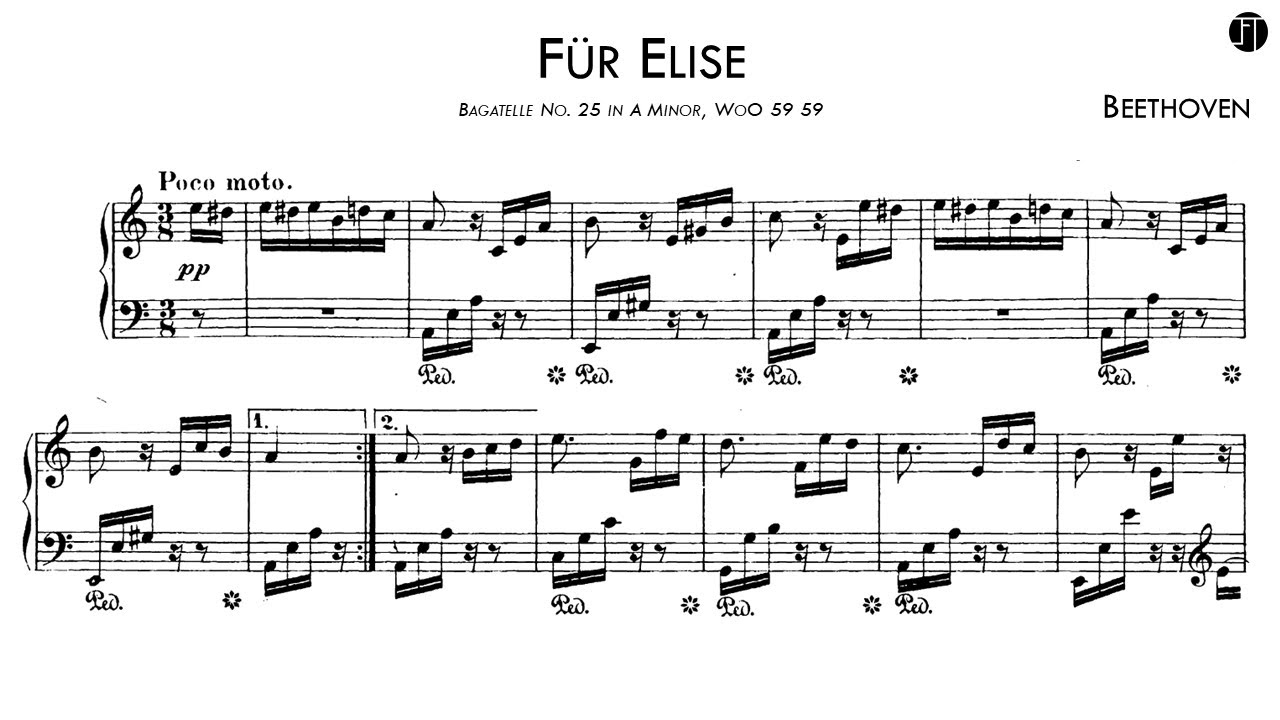
The piece can be heard as a five-part rondo, with the form A-B-A-C-A. It is in A minor and in 3/8 time. It begins with the refrain A, a flowing melody in binary form marked Poco moto (literally "a little motion," a tempo indication that does not appear elsewhere in Beethoven's works), with an arpeggiated left hand accompaniment. The unaccompanied oscillation between the dominant E and its chromatic lower neighbor D-sharp that begins the melody has become one of the most recognizable openings in classical music, but it also serves as a main topic of musical discussion.
The digression at measure 9 glances at the relative major before returning to the original theme and key, preceded by a prolongation of the dominant, E that extends the opening lower-neighbor oscillation. The pitch outline of these bars, E-F-E-D-C-B, i.e. an upper-neighbor ascent to F5 followed by a descending scale, also forms the basis of the two episodes B and C, thus unifying the piece. The B section that begins in bar 23 is in the submediant, F major. Its theme begins by tracing the outline mentioned above in somewhat elaborated fashion and modulates to the dominant, followed by 32nd-note runs repeating a cadential progression in C major in a codetta-like passage. (The chordal three-note upbeats in the left hand have been anticipated by the transition to this episode in bar 22, a clever unifying touch.)
This suggests a rather expansive form, but Beethoven suddenly returns to the dominant of A minor in bar 34, once again lingering on the dominant E and its lower neighbor and leading to an exact repeat of the A section. Although another nominal episode follows (C) at bar 59, it does not leave the tonic and is rather coda-like in feel, unfolding over a dramatic, throbbing tonic pedal in the bass and emphatically cadencing in the home key. Once again, there are unifying relationships with previously heard material. The melody retraces the descending outline alluded to earlier, and the cadence in bars 66-67 is an augmented version of the theme's cadence in bars 7–8. After a glance at a Neapolitan harmony (B-flat major) and a cadence at bar 76 that brings the music to a complete halt for the first and only time, an ascending A minor arpeggio and a chromatic descent over two octaves follows, sort of a cadenza in tempo, leading to a final repetition of the A section. The piece concludes without an added postlude.
Pianist: Eva Sukova
Watch in 1080p (Full High Definition) for best quality.
Like, Comment, Share and Subscribe :)

Информация по комментариям в разработке