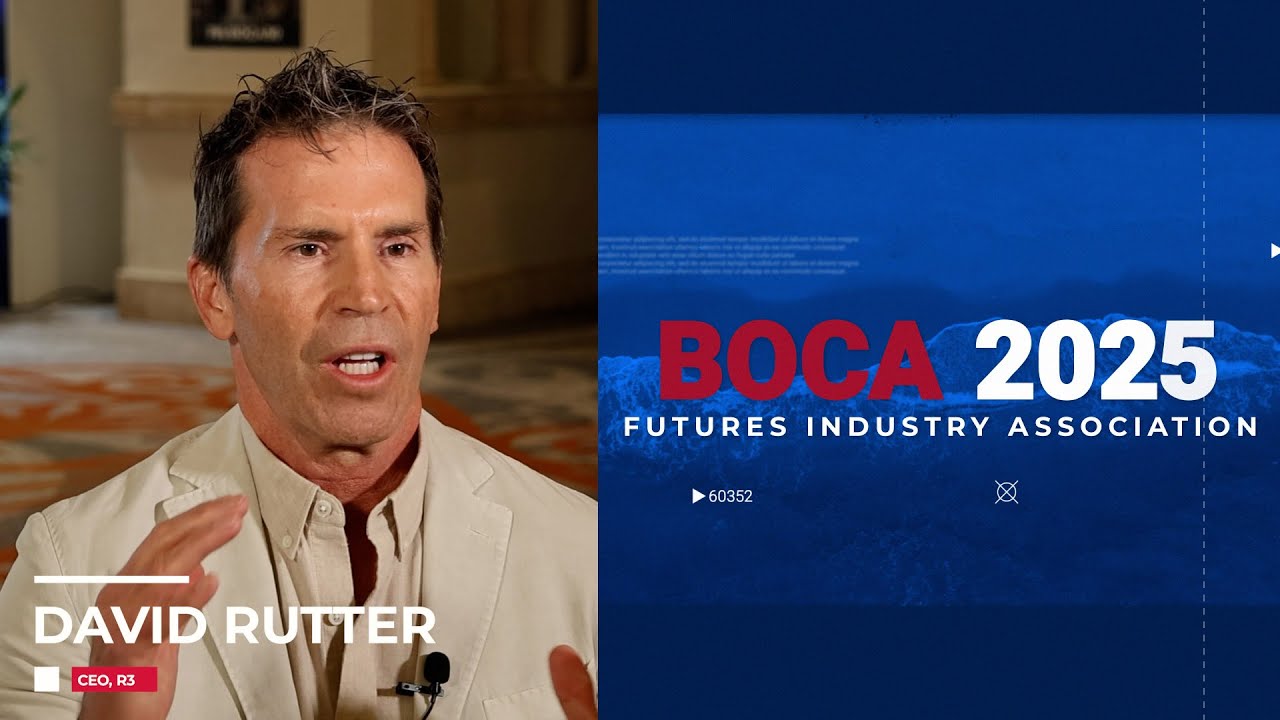
BOCA RATON, Fla. (JLN) - April 21, 2025 - If you want to disrupt Wall Street’s plumbing, David Rutter will be the first to remind you: it’s not just about shiny new technology—it’s about getting centuries-old pipes to move. “Disrupting the status quo is hard in the institutional space,” says Rutter, CEO of the enterprise blockchain company R3, leaning in at FIA Boca as if sharing a conspiratorial secret. “Everything is built to the highest standards and built over decades. The folks that have interests along the way are throwing boulders and rocks in the new path as well… The evidence has to be overwhelmingly clear that the financial outcome is really worth all of the pain.”
Rutter sounds less the starry-eyed disruptor and more the battle-scarred veteran who’s been pelted by enough boulders to know the difference between buzz and bona fide transformation. Infrastructure providers like Clearstream, DTCC, and custodial banks, he observes, “are actually leading the way in some of the thinking around digital custodianship”—but getting everyone to move is, in his words, “not easy.”
From Blockchain Hype to Practical Growth
When R3 was founded, blockchain was a supposed cure-all. “We were caught up in the hype cycle like everyone else,” Rutter admits. “Blockchain seemed to be the cure for just about every ill—and it isn’t.” Over time, R3 recognized the real challenges of adapting distributed ledger technology, focusing on regulated markets and working closely with their toughest clients: the world’s largest banks and central banks.
The hype may have faded, but the problems—like collateral mobility and margin optimization—remain urgent. What’s hot right now is tokenizing underlying collateral so it can move freely about, he says. "Gold and other ledger-based solutions (are) probably the hottest thing right now,” Rutter explains. “Even in the same geography, like in the US, moving collateral from BNY Mellon to JP Morgan—is it easy? No.” Tokenization could change that, unlocking billions in capital that’s now stuck in financial silos.
Herding Cats, Chasing Inevitable Change
The hardest part? Convincing an industry built on caution to take a leap. “Getting industry behind it is like herding cats a little bit,” Rutter shrugs. But he’s now convinced: “The financial gain is so clear now that I think it’s just inevitable. It’s just a matter of time.”
The technology’s first big win is likely to be digitizing financial instruments, making ownership truly portable. “So that I can trade 24 hours a day and the token moves about the globe freely is a huge opportunity,” he says. In the near future, it’s all about “lowering friction so these securities can move about freely, cheaply, and you get rid of a lot of the traditional infrastructure.”
Not Selling, Just Strategizing
Rumors swirl perennially around the potential sale of R3—a rumor Rutter bats away with visible exasperation. “There’s no intention to sell the company. We’re looking at strategic options for the following reason…” he says. On one side, R3 works with over 60 central banks on digital currency projects, which “has to be very protective.” On the other, the asset side “is about half our business, moving towards how can we facilitate that product into the DeFi and crypto space…So how can we interact natively on layer ones?” The result: strategic soul-searching, but not an exit.
From TradFi to DeFi—With a Side of Realism
If R3’s core business is “the really hard work on TradFi”—integrating blockchain with top banks and infrastructure providers—the allure of crypto and DeFi is strong. “The crypto space is completely uninhibited by any of that,” he says with a tinge of envy. “They have done some really cool and innovative things around AI agents and trading modalities that doesn’t exist in traditional finance.”
Rutter’s ambition: bridge the gap, bringing “tradable instruments into that DeFi market within the regulatory constraints, because AML, KYC is not going away.” Despite the promise, he’s pragmatic—“It’s a couple trillion dollars, it’s not huge, but there’s some really innovative stuff going on.” With $10 billion in total value on ledger and a billion transactions a day, R3 feels positioned to push further.
QUESTIONS
How has R3 adapted to the blockchain and DLT industry?
What are your clients' primary concerns?
What is the first big problem blockchain is going to solve?
What is R3’s role in the digital finance space?
What has R3 done to lead the tokenized real-world asset market?
Are the rumors that R3 is looking for a sale accurate?
How are you dealing with geopolitical tensions?
00:00:00 - Introduction
00:01:00 - R3's Adaptation to Blockchain and DLT
00:02:23 - Clients' Primary Concerns
00:03:40 - First Big Problem Blockchain Will Solve
00:05:06 - R3's Role in Digital Finance
00:07:44 - Rumors About R3's Sale
00:08:37 - Dealing with Geopolitical Tensions

Информация по комментариям в разработке