The P8 position, known as Post-Impact Extension, marks the first checkpoint after impact — the instant when the trail arm fully extends, and the club shaft again becomes parallel to the ground on the follow-through side. It reveals how efficiently energy was transferred into the ball and how the body continued to rotate, balance, and extend after contact. Within the BioSwing Dynamics model, each core type expresses this moment differently — through distinct patterns of extension, rotation, and energy release.
Upper Core Golfer
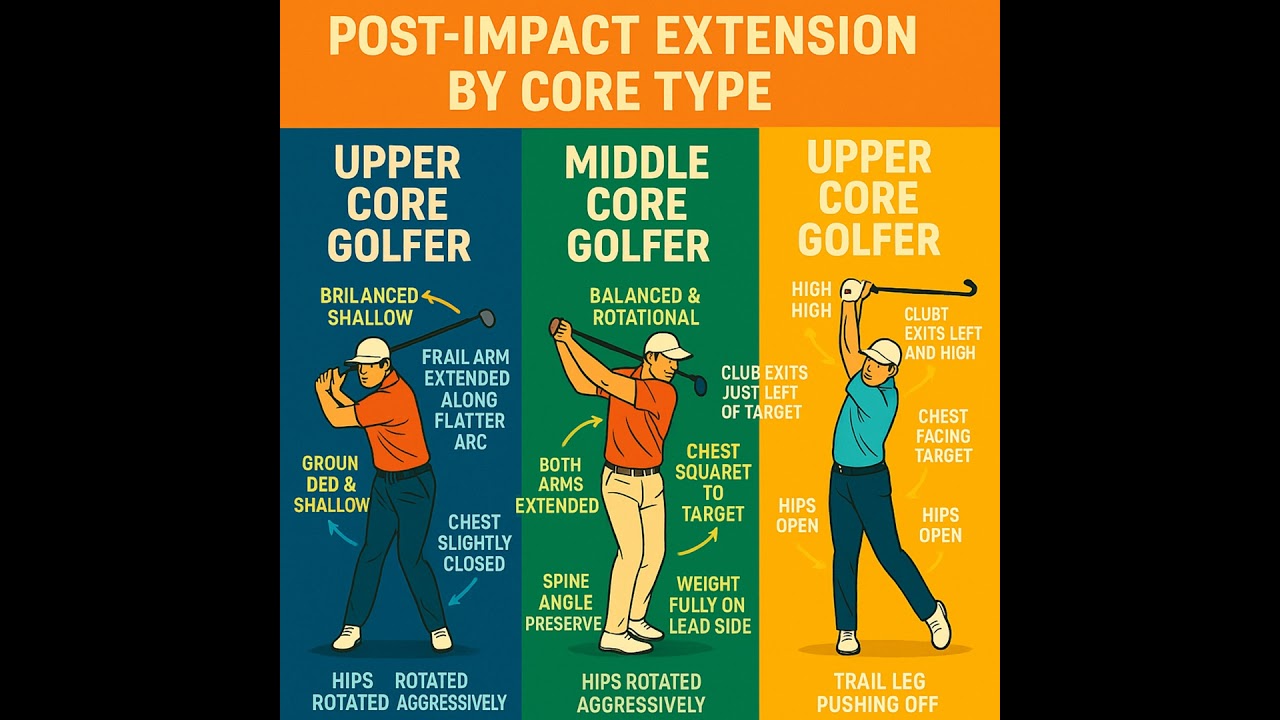
For the Upper Core player, P8 is defined by high extension and upright posture, reflecting an upward energy release. The trail arm is fully extended, the lead arm begins to fold, and the hands finish high, well above waist level. The club exits left and high, matching their steeper swing plane. The spine becomes more upright as the chest faces the target, showing full upper-body rotation with minimal lateral tilt. Vertical ground force remains strong through the lead leg, which stays braced and extended. The hips open but don’t over-rotate, maintaining a tall finish and a vertical strike pattern.
Middle Core Golfer
The Middle Core P8 is balanced and rotational, with energy flowing evenly around the body. Both arms stay extended, connected to the torso, and the hands remain in front of the chest on a gently rising arc. The spine angle is preserved from address through follow-through, and the head releases naturally. The chest is square or slightly open to the target, and the hips continue rotating with the weight fully on the lead side. This harmony of upper and lower rotation produces a centered, efficient finish and consistent direction control.
Lower Core Golfer
The Lower Core golfer demonstrates a grounded, shallow, and rotary P8. Energy travels more around the body than upward. The trail arm extends on a flatter arc, and the hands stay deeper, behind the lead side. The club exits low and left around the torso, confirming a rotational strike pattern. The spine tilt remains, preserving the axis of rotation, while the chest is still slightly closed or square to the target. The trail leg pushes from the ground, and the hips rotate aggressively open, with the pelvis turning deep around a stable lead leg. There’s little vertical lift — control comes from powerful ground interaction and deep rotation.
Functional Meaning of P8
P8 serves as a diagnostic mirror for both energy transfer and swing control.
• Energy: Upper Core players show a vertical energy release; Middle Core players demonstrate rotational flow; Lower Core golfers reveal horizontal, ground-driven power.
• Control: A solid P8 confirms balance, sequence, and direction. The ability to maintain posture, spine angle, and dynamic rotation determines both precision and consistency.
In essence, P8 is not just “after impact” — it is the continuation of impact. It tells the story of how a golfer’s core type shapes extension, rotation, and balance once the ball is gone. Mastering this checkpoint means mastering the truth of your strike.
• 📺 The Explainer: • #384 Golf Swing P8 – Post Impact Extension...
• www.Golf247.eu

Информация по комментариям в разработке