For more cadaveric images and question banks, visit https://bootcamp.com/med-school
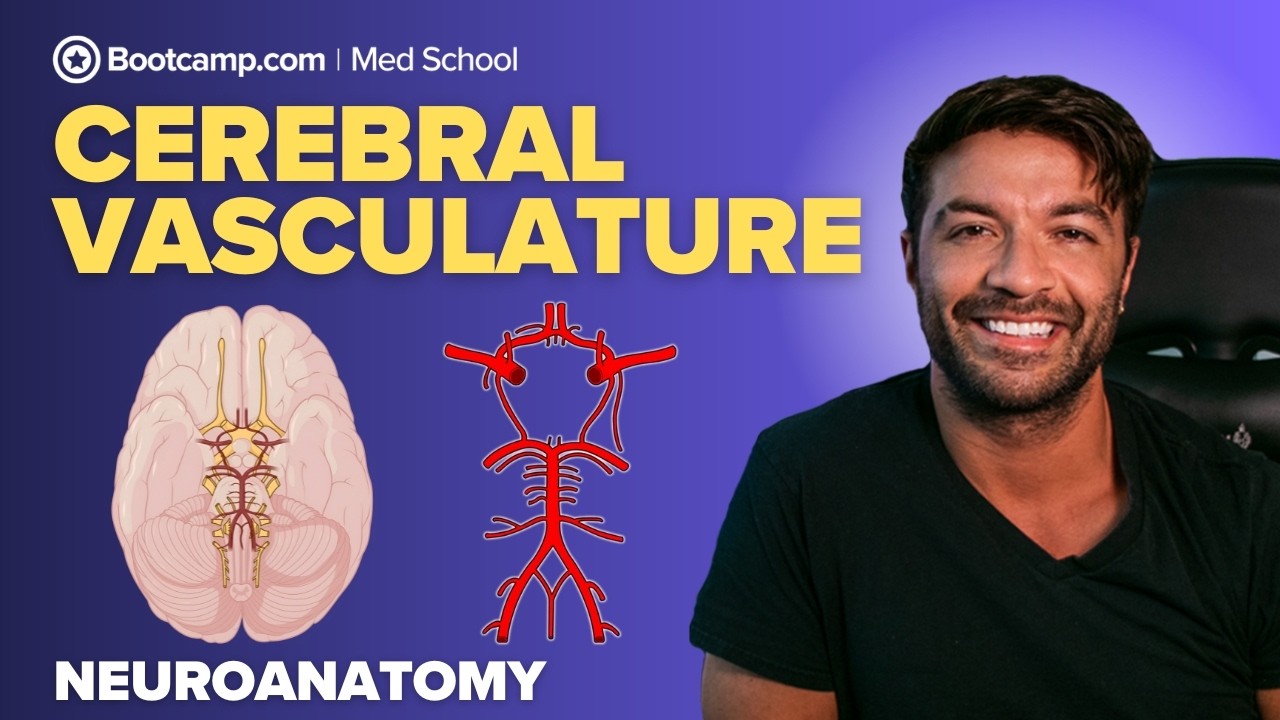
The cerebral vasculature is critical for understanding stroke syndromes. In this video, we explore the Circle of Willis, cortical and cerebellar territories, and angiogram anatomy. Learn how occlusions in the ACA, MCA, or PCA produce distinct motor, sensory, and language deficits, and how cerebellar arteries (SCA, AICA, PICA) contribute to balance and coordination. Clinical case studies illustrate how to localize vascular lesions from patient symptoms.
You’ll learn
1. Entry routes: internal carotid via carotid canal; vertebral → basilar via foramen magnum
2. Circle of Willis: ACA, MCA, PCA, ACom, PCom; key branches (ophthalmic, anterior choroidal, lenticulostriates)
3. Territories:
ACA → medial frontal/parietal (leg greater than arm)
MCA → lateral hemispheres (face/arm, language in dominant hemisphere)
PCA → occipital & inferior temporal (visual field cuts)
4. Cerebellar supply: SCA, AICA, PICA basics
5. Clinical integration: localize deficits (eg, left MCA → right face/arm weakness, aphasia); read the “stick-figure” on angiogram to spot occlusions
⏱️ Timestamps
0:00 – Intro & case study (stroke presentation)
1:02 – How blood enters the cranial cavity (internal carotid & vertebral arteries)
1:22 – Internal carotid artery pathway & contribution
1:45 – Vertebral artery pathway → basilar artery
2:08 – Vertebral artery branches: anterior & posterior spinal arteries
3:04 – Posterior inferior cerebellar artery (PICA)
3:23 – Anterior inferior cerebellar artery (AICA)
3:51 – Vertebral arteries join → basilar artery & pontine branches
4:41 – Superior cerebellar artery (SCA)
5:09 – Posterior cerebral artery (PCA) & posterior communicating artery (PCom)
5:37 – Internal carotid branches → middle cerebral artery (MCA) & anterior cerebral artery (ACA)
6:03 – Anterior choroidal & ophthalmic arteries
6:28 – Anterior communicating artery (ACom) & medial striate arteries
7:43 – Circle of Willis overview & collateral flow
8:08 – Angiogram: identifying arteries with “stick figure” method
9:23 – Middle cerebral artery branches on angiogram
10:11 – Posterior communicating & posterior cerebral arteries
10:34 – Identifying vertebral & basilar arteries on angiogram
11:21 – Cortical territories: ACA, MCA, PCA supply
12:49 – Midline view: ACA vs PCA distributions
13:34 – Homunculus blood supply mapping
14:28 – Stroke localization examples (ACA vs MCA occlusion)
14:52 – Cerebellar blood supply: SCA, AICA, PICA
16:05 – Revisiting case study: left MCA occlusion → symptoms explained
17:41 – Angiogram occlusion example: MCA stroke
18:58 – Practice question: cortical territories (ACA vs PCA)
19:48 – Practice question: angiogram vessel identification
21:00 – Summary: arteries, territories, lesion localization
This lesson is especially helpful for medical students, or anyone reviewing for anatomy exams.
If it helps you out, give it a like, leave your questions in the comments, and subscribe for more Bootcamp videos.
TikTok: / medschoolbootcamp
INSTAGRAM: / medschoolbootcamp
#medschoolbootcamp #medicine #Medical #MedStudent #MedicalStudent #MedSchool #MedicalSchool #Doctor #Resident #Hospital #MD #Med #Anatomy #Science #Whitecoat #WhiteCoatCeremony #MS1 #ms2
__________________________________________________________________
cerebral vasculature, circle of willis, internal carotid artery, vertebral basilar system, basilar artery, ACA MCA PCA territories, middle cerebral artery stroke, anterior cerebral artery stroke, posterior cerebral artery stroke, posterior communicating artery, superior cerebellar artery, AICA, PICA, pontine arteries, angiogram anatomy, cerebral blood supply, cortical homunculus blood supply, aphasia MCA, hemiplegia stroke, neuroanatomy made easy, med school neuro review

Информация по комментариям в разработке