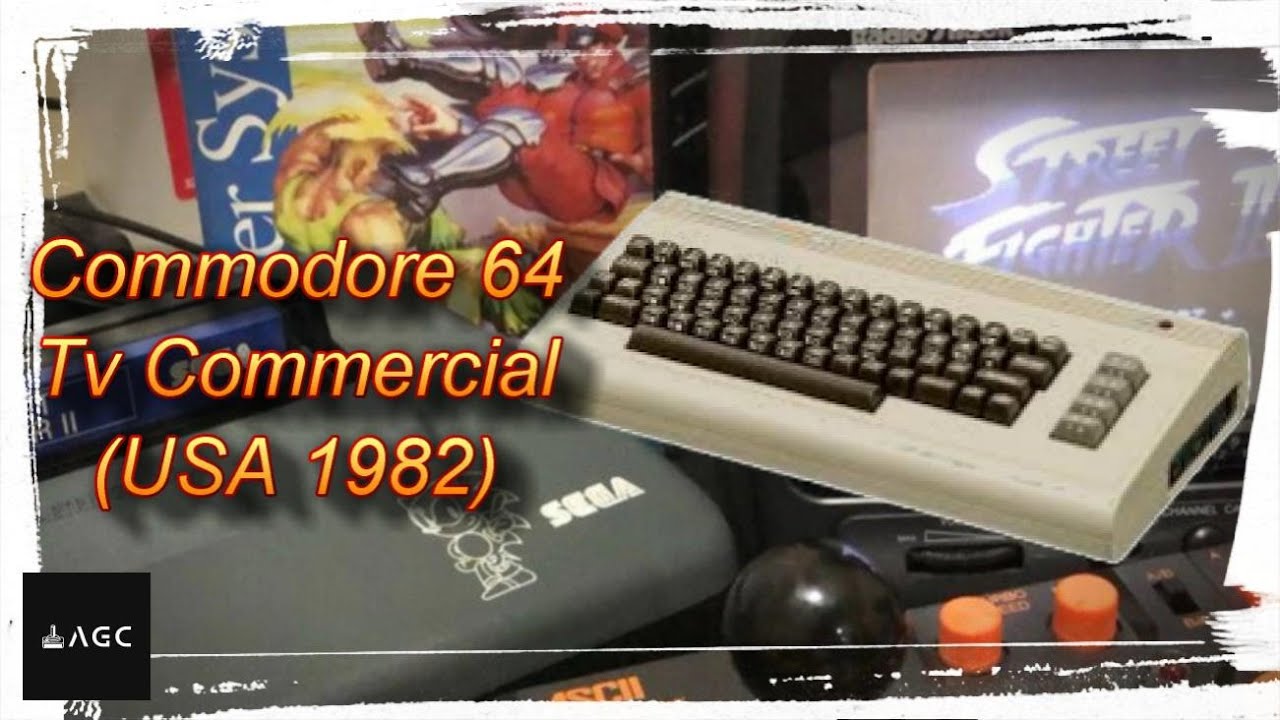
Game Archive - Commodore 64 by CBM - TV Commercial (USA 1982)
The Commodore 64, also known as the C64 or the CBM 64, is an 8-bit home computer introduced in January 1982 by Commodore International (first shown at the Consumer Electronics Show, in Las Vegas, January 7–10, 1982).
Specifications & Internal hardware:
Commodore 64 ports (from left: Joy1, Joy2, Power, ROM cartridge, RF-adj, RF modulator, A/V, Serial 488 bus, Tape, User)
Microprocessor CPU:
MOS Technology 6510/8500 (the 6510/8500 is a modified 6502 with an integrated 6-bit I/O port)
Clock speed: 0.985 MHz (PAL) or 1.023 MHz (NTSC)
Video: MOS Technology VIC-II 6567/8562 (NTSC), 6569/8565 (PAL) 16 colors
Text mode: 40×25 characters; 256 user-defined chars (8×8 pixels, or 4×8 in multicolor mode); or extended background color; 64 user-defined chars with 4 background colors, 4-bit color RAM defines foreground color
Bitmap modes: 320×200 (2 unique colors in each 8×8 pixel block),160×200 (3 unique colors + 1 common color in each 4×8 block)
8 hardware sprites of 24×21 pixels (12×21 in multicolor mode)
Smooth scrolling, raster interrupts
Sound: MOS Technology 6581/8580 SID
3-channel synthesizer with programmable ADSR envelope
8 octaves
4 waveforms per audio channel: triangle, sawtooth, variable pulse, noise
Oscillator synchronization, ring modulation
Programmable filter: high pass, low pass, band pass, notch filter
Input/Output: Two 6526 Complex Interface Adapters
16 bit parallel I/O
8 bit serial I/O
24-hours (AM/PM) Time of Day clock (TOD), with programmable alarm clock
16 bit interval timers
RAM:
64 KB, of which 38 KB were available for BASIC programs
1024 nybbles:262 color RAM (memory allocated for screen color data storage)
Expandable to 320 KB with Commodore 1764 256 KB RAM Expansion Unit (REU);
Expansions of up to 16 MB via the CMD SuperCPU.
ROM:
20 KB (9 KB Commodore BASIC 2.0; 7 KB KERNAL; 4 KB character generator, providing two 2 KB character sets)
Input/output (I/O) ports and power supply
I/O ports:
ROM cartridge expansion slot
Integrated RF modulator television antenna output via a RCA connector. The used channel could be adjusted from number 36 with the potentiometer to the left.
8-pin DIN connector containing composite video output, separate Y/C outputs and sound input/output.
Serial bus (proprietary serial version of IEEE-488, 6-pin DIN plug) for CBM printers and disk drives
PET-type Commodore Datassette 300 baud tape interface (edge connector with digital cassette motor/read/write/key-sense signals, Ground and +5V DC lines. The cassette motor is controlled by a +5V DC signal from the 6502 CPU.
User port (edge connector with TTL-level signals, for modems and so on.; byte-parallel signals which can be used to drive third-party parallel printers, among other things, 17 logic signals, 7 Ground and voltage pins, including 9V AC)
2 × screwless DE9M game controller ports (compatible with Atari 2600 controllers), each supporting five digital inputs and two analog inputs. Available peripherals included digital joysticks, analog paddles, a light pen, the Commodore 1351 mouse, and graphics tablets such as the KoalaPad.
Power supply:
5V DC and 9V AC from an external "power brick", attached to a 7-pin female DIN-connector on the computer.
Like this video and subscribes to the channel. others link down below:
https://linktr.ee/agcave

Информация по комментариям в разработке