In this new tale inspired by Ancient Egypt, we journey deep into the world of Egyptian mythology, desert legends, forgotten shrines, and the gods of the Nile. This story brings together the mysteries of Seth, the desert storms, and a sacred meteorite relic long hidden beneath the sands.
Follow Iset-Ren as a simple mission turns into a desperate struggle for survival, a confrontation with bandits, and an unexpected encounter with a god whose help comes with conditions no mortal should take lightly.
When you’re ready for more, discover the story of Sekhmet — who may or may not have made a cameo in the tale of Seth: • The Story of Sekhmet and the Desert | Anci...
---- ABOUT THE STORY -----
1) Seth — Lord of the Desert, Foreign Lands, and Necessary Chaos
Seth (Sutekh, Setesh, Set) is one of the most complex figures in Egyptian religion, shaped by more than two millennia of evolving myth. Far from being a simple “god of evil,” Seth represents force, disruption, foreignness, war, chaos, the desert, and the untamable parts of nature. His earliest appearances in the Pyramid Texts show him as a powerful protector of the sun god Re, standing at the prow of the solar barque and spearing the serpent Apophis each night. In this older cosmic role, Seth is essential: without him, the universe collapses into darkness.
Even his association with the desert reflects a nuanced worldview. For Egyptians, the desert was not merely “emptiness,” but a threshold between worlds, the place where storms, sand, danger, and gods overlapped. Seth’s storms were understood as expressions of raw divine force, not purely destructive but capable of revealing or uncovering hidden things—just as in this story.
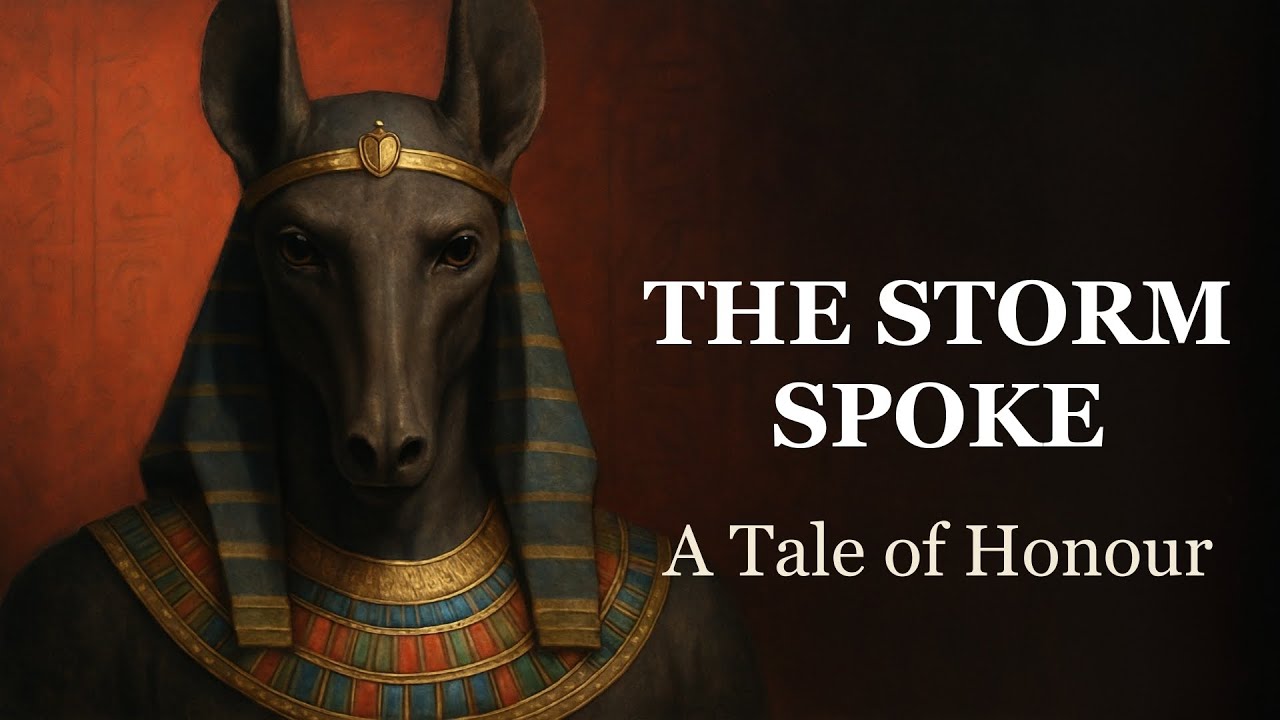
His animal form (with the distinctive rectangular ears and curved snout) has been debated for centuries. Some scholars interpret it as a stylized representation of an oryx, a donkey, an aardvark, or even a fennec fox, while others maintain it is an entirely mythic creature: the sha, a desert spirit unknown to zoology. Linguistic evidence suggests the sha-animal symbolizes the wild “otherness” that Seth embodies.
In short: Seth stands not for “evil,” but for the uncontrolled forces that shape the edge of the world. His storm in this story follows that tradition: destructive, revealing, and morally demanding.
2) Worship of Meteorites in Ancient Egypt — Stones from the Sky
Meteorites held a unique place in Egyptian religious imagination. Known as bjA-en-pet (“iron from the sky”), they were venerated as divine material long before Egypt entered its classical dynastic period. Egyptians understood perfectly that these stones were unlike anything they quarried. Their hardness, metallic sheen, magnetic properties, and fusion crust suggested a celestial origin—and thus a direct link to the gods.
Archaeological finds include meteoritic iron beads from Gerzeh (predynastic, c. 3200 BCE), hammered cold into jewelry centuries before Egypt developed smelting technology. Several ritual knives and ceremonial objects dating to the Middle and New Kingdom also contain meteoritic iron, identifiable through nickel content. These artifacts were not utilitarian; they were symbolic, used in royal or priestly contexts.
Cultic worship of meteorites is well attested across the Near East—Emesa, Emar, and Arabia foremost—and Egypt, being deeply connected to Levantine trade and ritual exchange, was familiar with these practices. The idea that a temple might guard a “heaven-stone” (ḥetep-pet or “peace of the sky”) is therefore plausible, even likely. A meteorite displaying turquoise veining and jasper-red streaks could easily be interpreted as a sacred object infused with celestial symbolism, combining the colors of Hathor, Nut, and the desert’s protective spirits.
A relic like the one in this story would not merely be a curiosity. It would be dangerous, powerful, and ritually charged—worthy of secrecy, theft, divine protection, and strict conditions on its handling. That a god like Seth would demand it be treated with honour rather than greed matches Egyptian religious logic: divine gifts are to be respected, not profited from.
---------------------------------------------------------------------------------------------------
Written and produced by Alex Wynn Ashwood.
Original score inspired by ancient Egyptian music and temple acoustics.
All images are painterly recreations evoking the landscape, architecture, and mythology of Ancient Egypt.
Every story is based on historical, cultural, and archaeological research, blended with narrative imagination.

Информация по комментариям в разработке