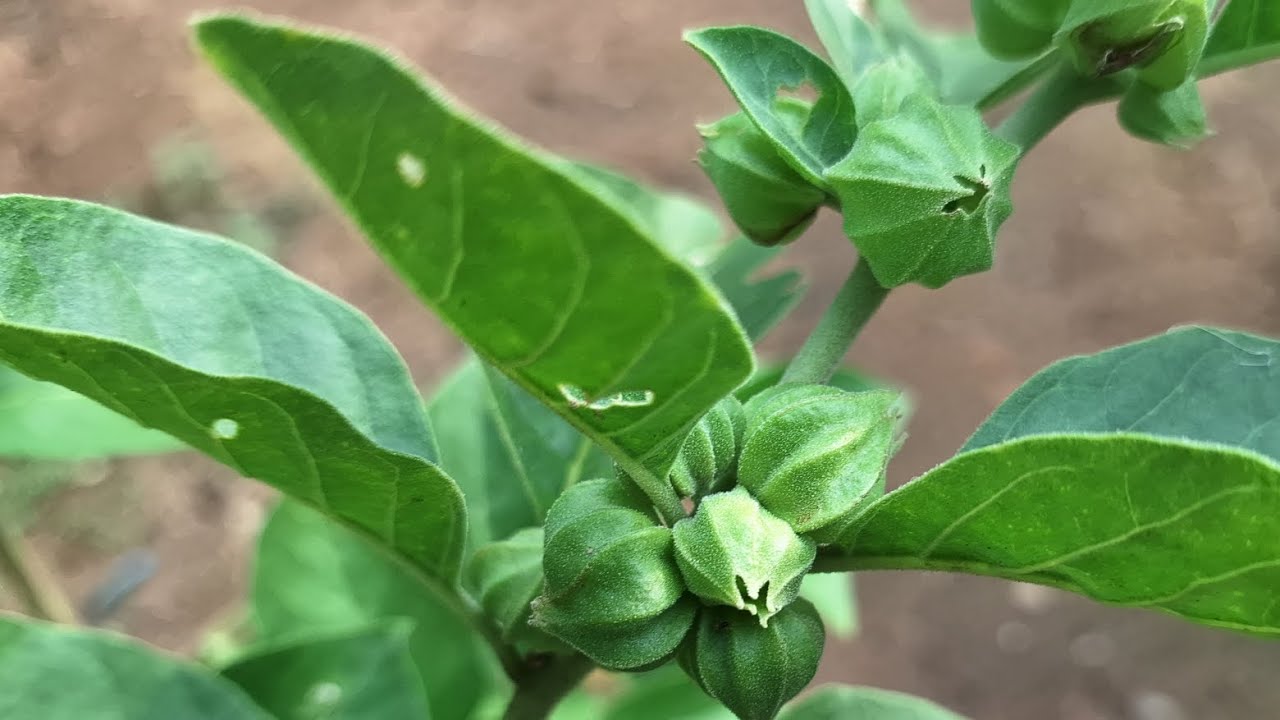
Withania somnifera, ashwagandha,Clustered Winter Cherry, Indian Ginseng, Strychnos, Winter cherry, Peyette, Asgandha, poison gooseberry
Local names
Assamese: অশ্বগন্ধা asbagandha • Bengali: অশ্বগন্ধা asbagandha • Gujarati: આકસંદ aksand, અશ્વગંધા asvagandha • Hindi: असगन्ध asgandh, अश्वगंधा ashwagandha • Kachchhi: આસુન aasun, આસુંઢ aasund • Kannada: ಅಂಗರ ಬೇರು/ಗಡ್ಡೆ Angara beru/gadde, ಅಶ್ವಗಂಧ Ashwagandha, ಹಿರೇಮದ್ದಿನ ಗಿಡ Hiremaddina gida, ಪೆನ್ನೇರು Penneru, ಸೊಗದೆ ಬೇರು Sogade beru • Malayalam: അമുക്കുരം amukkuram, പേവെട്ടി pevetti • Marathi: अश्वगंधा ashwagandha, आस्कंद askanda • Nepali: अश्वगन्धा ashwagandha • Oriya: ଅଶ୍ବଗନ୍ଧା ashwagandha • Punjabi: ਅਸਗੰਧ asgandh, ਅਸ਼ਵਗੰਧਾ ashwagandha • Sanskrit: अश्वगन्धा Ashwagandha • Tamil: அமுக்கிரா amukkira • Telugu: అశ్వగంధ ashwagandha • Tibetan: a swa ga ndhi, ba-dzi-ga-ndha • Tulu: ಅಶ್ವಗಂಧೊ ashwagandho • Urdu: اسگندهہ asgandh
Botanical name: Withania somnifera
Family: Solanaceae (Potato family)
ashwagandha is traditionally used as an adaptogen, it is used for many conditions related to stress. Adaptogens are believed to help the body resist physical and mental stress. Some of the conditions it is used for include insomnia, aging, anxiety and many others, but there is no good scientific evidence to support most of these uses. There is also no good evidence to support using ashwagandha for COVID-19.
AshwagandhaTrusted Source is an important herb in Ayurvedic medicine. This is one of the world’s oldest medical systems and one of India’s healthcare systems.
In Ayurvedic medicine, ashwagandha is considered a Rasayana. This means that it helps maintain youth, both mentally and physically.
There is some evidence to suggest that the herb can have neuroprotective and anti-inflammatory effects. Inflammation underpins many health conditions, and reducing inflammation can protect the body against a variety of conditions.
Effective for
Anxiety. Taking ashwagandha by mouth might reduce anxiety.
A type of persistent anxiety marked by exaggerated worry and tension (generalized anxiety disorder or GAD). Taking ashwagandha by mouth seems to improve anxiety in people with persistent anxiety.
Insomnia. Taking ashwagandha by mouth seems to improve overall sleep and sleep quality in some people.
Stress. Taking ashwagandha by mouth seems to help reduce stress in some people. It might also help reduce stress-related weight gain.
Heart health
Some people may use ashwagandha to boost their heart health, including:
lowering high blood pressure
lowering high cholesterol
easing chest pain
preventing heart disease
Effects on cancer
Several studies have shown ashwagandha has compounds that may help fight certain types of cancer. Researchers aren’t sure how, but extracts in the herb seem to limit the activity of cancer cells in breast, colon, prostate, ovarian, lung, and brain cancers in the lab. It does the same for thyroid, gastrointestinal, cervix, and skin (melanoma) cancers. Almost all of these studies have been done on cancer cells or animals with cancer, and they haven’t been proven in humans yet. Ashwagandha is considered safe to use with traditional cancer treatments like chemotherapy and radiation. Experts say it may ease some side effects, such as a weak immune system.
For neurodegenerative diseases
Studies show ashwagandha can slow, stop, and possibly reverse certain types of nerve cell damage. That’s what leads to diseases such as Alzheimer’s, Parkinson’s, and Huntington’s. Ashwagandha may also be neuroprotective, meaning it may help prevent the development of some neurodegenerative diseases. Still, almost all of the studies on ashwagandha and nerve cell damage in the brain have been done on animals or animal cells, and more research is needed to know if ashwagandha might have any effect on these diseases.
ashwagandha in several different forms, including powder, capsule, tablet, or gummy. What form you choose depends on what works best for your dosage and lifestyle.
Ashwagandha powder
Ashwagandha powder is a commonly available type of ashwagandha. The powder typically contains the herb’s dried root, leaf, or a combination of the two. The powder can be put into a capsule and swallowed as a pill, or it can be mixed into a drink with water, ghee (clarified butter), milk, or honey.
Ashwagandha tablets
Ashwagandha can also be taken in tablet form, though this is a less common form than capsules. Keep in mind that as with all herbal supplements, ashwagandha supplements are dietary supplements, and so they are regulated less strictly than medical drugs.
Ashwagandha gummies
Ashwagandha can also be taken as flavored gummies. This may be a good option for people who can’t swallow pills, and who find the taste of the powder to be unpleasant.

Информация по комментариям в разработке