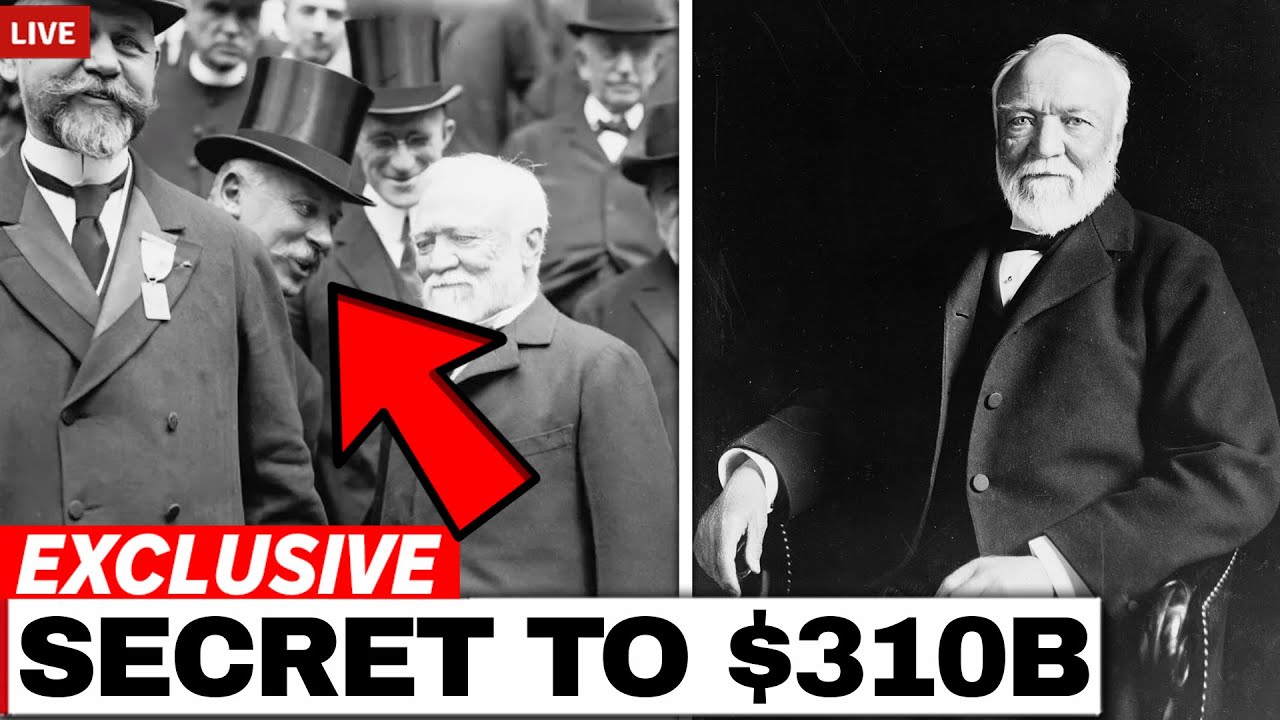
The DARK Truth Behind Andrew Carnegie's Success REVEALED...
Andrew Carnegie’s story doesn’t begin with golden libraries or massive steel empires. It begins with smoke-filled factories, poverty, and a boy who understood struggle long before he ever touched a dollar bill. History remembers him as both a ruthless industrialist and a great philanthropist, but the truth lies somewhere in between—hidden in the cracks of a life that changed the course of America. And to understand the power he built, we have to go back to where it all began.
He was born in 1835 in a small Scottish town, in a cottage that barely fit a single family. His father was a hand-loom weaver—an honest craft, but one that couldn’t survive the tidal wave of the Industrial Revolution. Steam-powered machines swept through towns like his, wiping out jobs overnight. Families who once relied on skilled labor suddenly found themselves fighting just to eat. In those early years, Andrew learned what it meant to have the world change around you without asking for your permission.
His father, once proud of his work, found himself marching in the streets. He became involved in a movement called Chartism, demanding better conditions and fair voting rights for working men. Ironically, this was a man who fought for workers’ rights—while his son, years later, would do everything in his power to crush unions. Life has a strange way of foreshadowing the future.
By the time Andrew was 13, the Carnegies had lost almost everything. There were no prospects left in Scotland. His mother heard whispers of a better life across the ocean—tales of opportunity, steady work, and hope. So the family sold what little they had and boarded a ship bound for America. The journey wasn’t glamorous. The passengers were crammed into the dark cargo hold, seasick, hungry, and exhausted. Many got sick. Some didn’t make it. But the Carnegies did. They arrived in New York and then traveled west, settling in a gritty, growing industrial town—Pittsburgh, Pennsylvania.
Andrew didn’t have time to be a child anymore. The day after arriving, he was already working at a cotton mill as a bobbin boy. Twelve hours a day. Six days a week. For a dollar and twenty cents. That’s what his first week of labor was worth. Years later, when he became one of the richest men alive, he would say no paycheck ever made him happier than that first one. It wasn’t the money. It was the feeling that he had some control over his destiny.
He moved fast. He wasn’t going to stay a bobbin boy forever. His neat handwriting landed him a slightly better job at a bobbins manufacturer. Then, with a little help from an uncle, he got a position as a messenger boy at the telegraph office. That job changed everything. It wasn’t just about delivering messages; it was about listening, observing, and meeting the men who controlled the city. In those days, the telegraph was power. And Andrew stood right in the middle of it.
He memorized routes, faces, and names. When messages came in, he didn’t even need to look at addresses anymore. He became the fastest messenger boy in Pittsburgh. The city’s most powerful businessmen began to notice him. Soon, he was promoted to telegraph operator. And it was here, in the humming pulse of the telegraph wires, that Andrew Carnegie first glimpsed the world of money—not the kind you earn by the hour, but the kind that multiplies quietly while you sleep.

Информация по комментариям в разработке