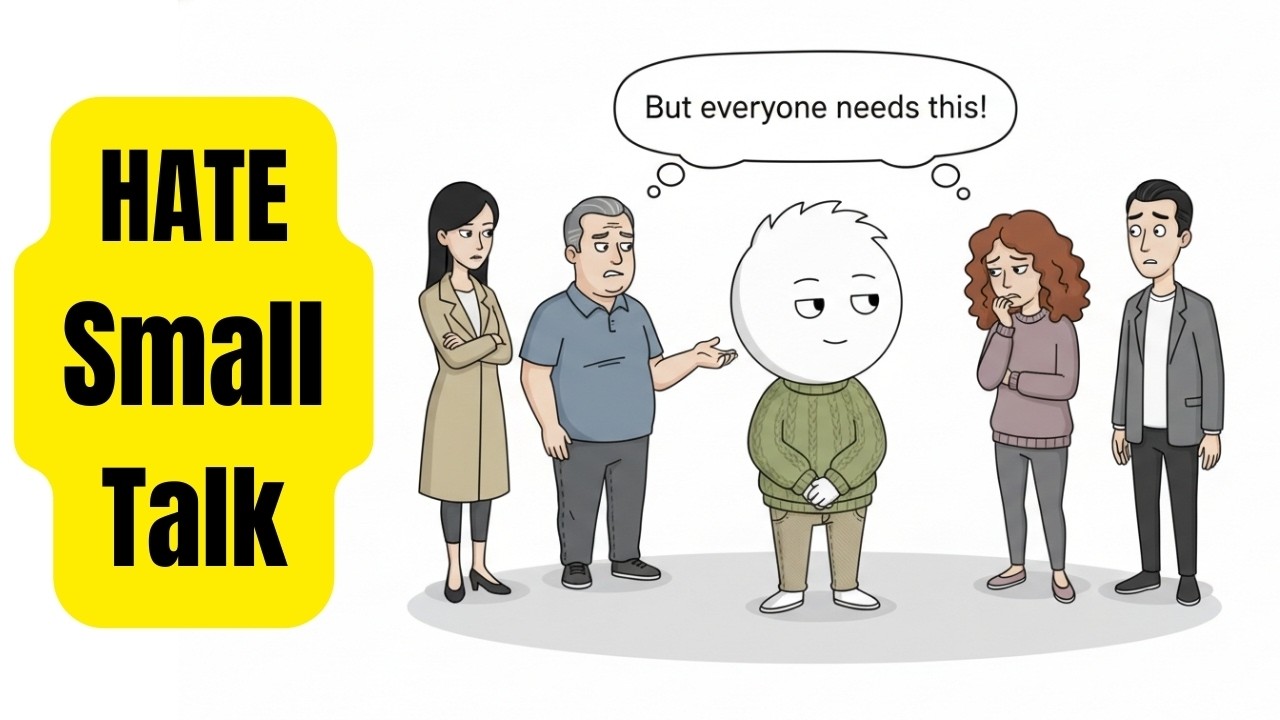
Psychology of people who hate small talk - 3 brain types science has identified, and one dark side nobody talks about.
Why do some people dread "So, what do you do?" while others breeze through it? If you're someone who hates small talk, you're not rude, antisocial, or socially broken. Research shows your brain is wired fundamentally differently.
In this video, we break down the 3 distinct psychological profiles behind people who hate small talk - backed by 8 named scientists and peer-reviewed research. You'll learn why introverts hate small talk (it's not just shyness), why smart people hate small talk (it's called Need for Cognition), and what philosopher Jean-Paul Sartre called the hidden cost of performing a version of yourself that isn't real.
We also cover the Dark Side - the uncomfortable difference between choosing depth and avoiding connection out of fear. Plus, Oxford professor Robin Dunbar's research on why fewer, deeper friendships actually lead to greater emotional well-being.
If you've ever felt drained by surface-level conversation, this video will finally explain what's happening inside your brain - and give you permission to trust it.
📚 Sources:
Cacioppo, J. T., & Petty, R. E. (1982). The need for cognition. Journal of Personality and Social Psychology, 42**(1), 116–131.
Holmes, A. J., et al. (2012). Individual differences in amygdala-medial prefrontal anatomy link negative affect, impaired social functioning, and polygenic depression risk. Journal of Neuroscience, 32(50), 18087–18100.
Mehl, M. R., et al. (2010). Eavesdropping on happiness: Well-being is related to having less small talk and more substantive conversations. Psychological Science, 21(4), 539–541.
Sweller, J. (1988). Cognitive load during problem solving: Effects on learning.Cognitive Science, 12(2), 257–285.
Kahneman, D. (2011). Thinking, Fast and Slow. New York: Farrar, Straus and Giroux.
Sartre, J.-P. (1943). Being and Nothingness. Paris: Gallimard.
Kardas, M., Kumar, A., & Epley, N. (2022). Overly shallow?: Miscalibrated expectations create a barrier to deeper conversation. Journal of Personality and Social Psychology, 122 (3), 367–398.
Dunbar, R. I. M. (2018). The anatomy of friendship. Trends in Cognitive Sciences, 22(1), 32–51.
Explore the full behavioral psychology playlist here: • Psychology of Introverts
Disclaimer: This channel is for educational purposes only and is not a substitute for professional mental health advice.
#psychologyofpeoplewhohatesmalltalk #whyintrovertshatepeopletalk #introvertpsychology #quietstrength #smalltalkpsychology






Информация по комментариям в разработке