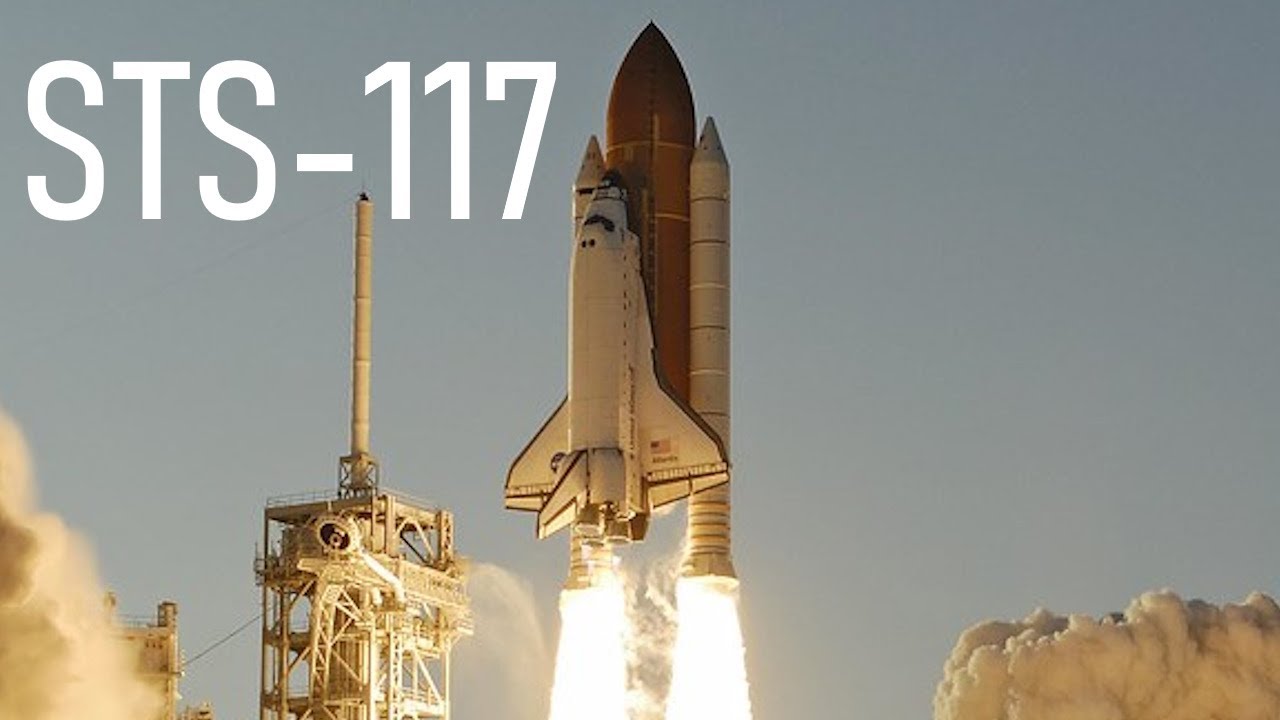
STS-117 (ISS assembly flight 13A) was a Space Shuttle mission flown by Space Shuttle Atlantis, launched from pad 39A of the Kennedy Space Centre on June 8, 2007. Atlantis lifted off from the launch pad at 19:38 EDT. Damage from a hail storm on February 26, 2007, had previously caused the launch to be postponed from an originally-planned launch date of March 15, 2007. The launch of STS-117 marked the 250th orbital human spaceflight. Atlantis delivered to the International Space Station (ISS) the second starboard truss segment (the S3/S4 Truss) and its associated energy systems, including a set of solar arrays. During the course of the mission the crew installed the new truss segment, retracted one set of solar arrays, and unfolded the new set on the starboard side of the station. STS-117 also brought Expedition 15 crewmember Clayton Anderson to the station, and returned with ISS crewmember Sunita Williams. On June 11, 2007, NASA mission managers announced a two-day extension of the mission, adding a fourth extra-vehicular activity (EVA). These two days were inserted into the mission timeline after flight day 8. This possibility had been discussed prior to launch. Because of launch day and thus rendezvous day uncertainty the decision to extend was deferred until after launch. The repair of the gap in the Orbital Manoeuvring System (OMS) thermal blanket (heat shielding) was conducted during EVA 3. STS-117 remains the longest mission for Atlantis because of the cancellation of landing opportunities on June 21, 2007, due to bad weather. Atlantis landed at Edwards Air Force Base on June 22, 2007. Atlantis was launched on schedule at 23:38:04 UTC from launch pad 39A at the KSC with NASA launch commentator George Diller's words upon launch being "and Lift-off of Space Shuttle Atlantis, to assemble the framework for the science laboratories of tomorrow!". STS-117 was the first launch from launch pad 39A since the fateful STS-107 launch of Space Shuttle Columbia in 2003. All pre-launch processing proceeded normally, and the crew started to board Atlantis at 16:17 EDT (20:17 UTC). Crew boarding was completed at 20:58 UTC, and the hatch was closed at around 21:40 UTC. Weather was 80% go to support the launch. There were concerns about the weather at TAL abort landing sites, but Istres in France changed to go in time for the launch. The conditions at the other available site, Zaragoza, were observed to be improving. The third TAL site, Morón AFB, was closed for runway maintenance until June 15, 2007. Powered flight confirmed to the standard timeline (see Space Shuttle – Mission Profile – Launch).
Atlantis' eight-and-a-half-minute ride to orbit was mostly uneventful with only one small piece of debris spotted just after solid rocket booster separation two minutes and five seconds after the launch. Shuttle Program Manager, Wayne Hale said a preliminary analysis of launch video "indicates the debris didn't strike the orbiter". As Atlantis launched, the space station flew 220 miles (350 km) above the southern Indian Ocean, southwest of Australia.[26] Aboard the ISS, cosmonauts Fyodor Yurchikhin, Oleg Kotov and NASA astronaut Sunita Williams watched the launch of Atlantis on a video feed provided by flight controllers in Houston. After reaching orbit, Atlantis' crew began procedures to open the shuttle's payload bay doors and set up computers and other equipment. They also powered up the shuttle's robotic arm to check its operation. Photos taken during the robotic arm checkout showed a 4-inch by 6-inch corner area of insulation blanket on the shuttle's port orbital manoeuvring system (OMS) pod pulled away from an adjacent row of heat-shield tiles. Atlantis' crew was awakened at 13:08 UTC.[31] Guided by the Terminal Insertion burn to refine the shuttle's trajectory—Atlantis closed in on the ISS. Before the shuttle docked, at a distance of 600 feet (180 m) below the station, STS-117 Commander Rick Sturckow performed what is known as the Rendezvous Pitch Manoeuvre (RPM). The back flip RPM allowed station crewmembers Fyodor Yurchikhin and Oleg Kotov to photograph heat shield tiles on the shuttle's underside using long-range, high resolution cameras. Atlantis docked to Destiny/Pressurized Mating Adapter-2 on the ISS at 19:36 UTC while the two spacecraft were traveling 220 miles (350 km) above the northeast coast of Australia.
Credit: @NASA

Информация по комментариям в разработке