www.23homes.com
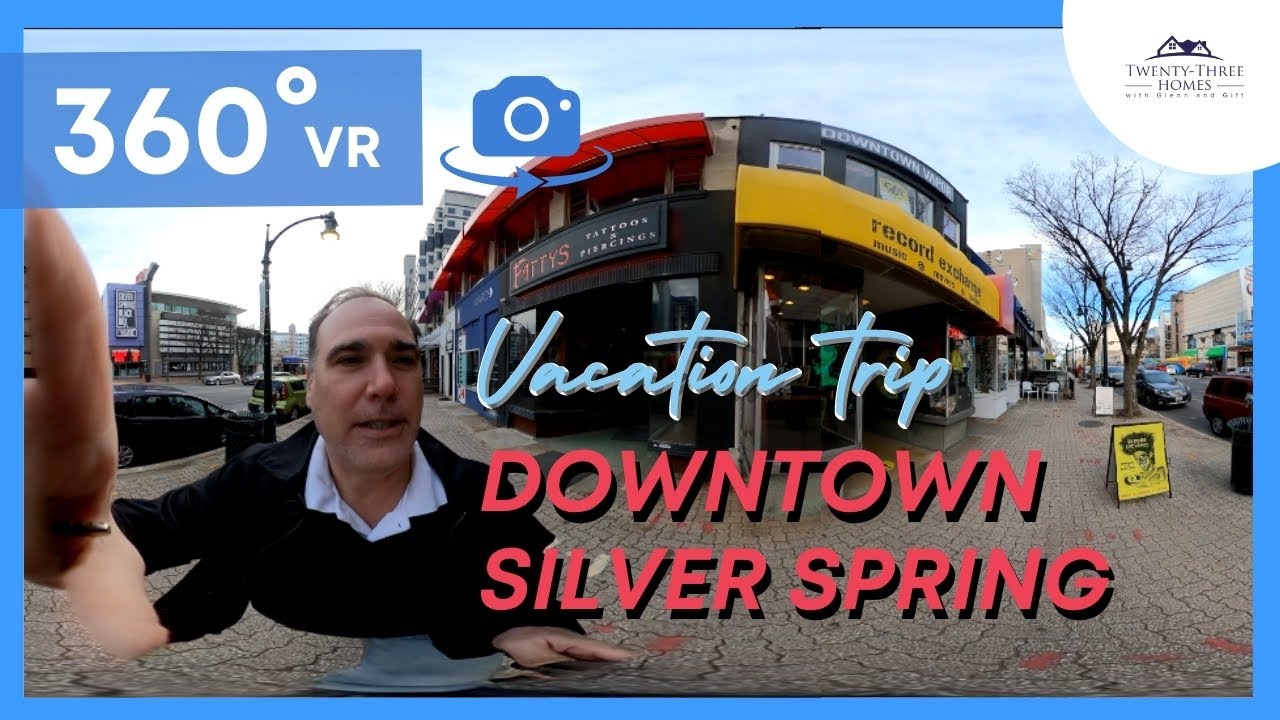
Downtown Silver Spring Maryland | 360° Virtual Reality
A busy commercial zone, Downtown is packed with shops and mid-rise apartment buildings. A two-level pedestrian plaza offers chain fashion stores and fast-food options. In winter, kids skate on an outdoor ice rink. The AFI Silver Theatre screens indie films and hosts festivals, and touring bands play the Fillmore. A diverse dining scene includes Thai, Ethiopian, and Burmese fare, plus shops selling Salvadoran pupusas
By 1854, Blair's son, Montgomery Blair, who became Postmaster General under Abraham Lincoln and represented Dred Scott before the United States Supreme Court, built the Falkland house in the area.
By the end of the decade, Elizabeth Blair married Samuel Phillips Lee, third cousin of future Confederate leader Robert E. Lee, and gave birth to a boy, Francis Preston Blair Lee. The child would eventually become the first popularly elected Senator in United States history.
During the American Civil War, Abraham Lincoln visited the Silver Spring mansion multiple times. During some of the visits he relaxed by playing town ball with Francis P. Blair's grandchildren.
In 1864, Confederate Army General Jubal Early occupied Silver Spring prior to the Battle of Fort Stevens. After the engagement, fleeing Confederate soldiers razed Montgomery Blair's Falkland residence.
At the time, there was a community called Sligo located at the intersection of the Washington-Brookeville Turnpike and the Washington-Colesville-Ashton Turnpike (now named Georgia Avenue and Colesville Road). Sligo included a tollhouse, a store, a post office, and a few homes. The communities of Woodside, Forest Glen, and Linden were founded after the Civil War. These small towns largely lost their separate identities when a post office was established in Silver Spring in 1899.
By the end of the 19th century, the region began to develop into a town of size and importance. The Baltimore & Ohio Railroad's Metropolitan Branch opened on April 30, 1873, and ran from Washington, D.C. to Point of Rocks, Maryland, through Silver Spring.
Washington Metro rail service into Washington, D.C. helped breathe life into the region starting in 1978 with the opening of the Silver Spring station. The Metro Red Line was built following the alignment of the B&O Metropolitan Branch, with the Metro tracks centered between the B&O's eastbound and westbound mains. The Red Line heads south to downtown DC from Silver Spring, running at grade before descending into Union Station. By the mid-1990s, the Red Line continued north from the downtown Silver Spring core, entering a tunnel just past the Silver Spring station and running underground to three more stations, Forest Glen, Wheaton and Glenmont.
Nevertheless, the downtown decline continued in the 1980s, as the Hecht Company closed in 1987 and opened a new store at Wheaton Plaza; furthermore, Hecht's added a covenant forbidding another department store from renting its old spot. City Place, a multi-level mall, was established in the old Hecht Company building in 1992, but it had trouble attracting quality anchor stores and gained a reputation as a budget mall, anchored by Burlington Coat Factory and Marshalls, as well as now-closed anchors AMC Theatres, Gold's Gym, Steve and Barry's, and Nordstrom Rack. JC Penney closed its downtown store—downtown's last remaining department store—in 1989, opening several years later at Wheaton Plaza. In the late 1980s and early 1990s, developers considered a shopping mall and office project called Silver Triangle, with possible anchor stores Nordstrom, Macy's, and JC Penney, but no final agreement was reached. Shortly thereafter, in the mid-1990s, developers considered building a mega-mall and entertainment complex called the American Dream (similar to the Mall of America) in downtown Silver Spring, but the revitalization plan fell through before any construction began because the developers were unable to secure funding. However, one bright spot for downtown was that the National Oceanographic and Atmospheric Administration (NOAA) consolidated its headquarters in a series of 4 new high-rise office buildings near the Silver Spring Metro station in the late 1980s and early 1990s.
The first suburban development appeared in 1887 when Selina Wilson divided part of her farm on current-day Colesville Road (U.S. Route 29) and Brookeville Road into five- and ten-acre (20,000- and 40,000 m2) plots.
The downtown, located next to the northern tip of Washington, D.C., is the oldest and most urbanized part of the community. Since beginning a significant renaissance in 2004, many new mixed-use developments combining retail, residential, and office space have been built. Downtown is in turn surrounded by several inner suburban residential neighborhoods located inside the Capital Beltway.


![[4K] Asheville City Sounds: Strolling in Asheville | No Music](https://i.ytimg.com/vi/AbWPpkSg-nU/maxresdefault.jpg)










Информация по комментариям в разработке