American robin
Audio https://commons.wikimedia.org/w/index...
is licensed under https://creativecommons.org/licenses/...
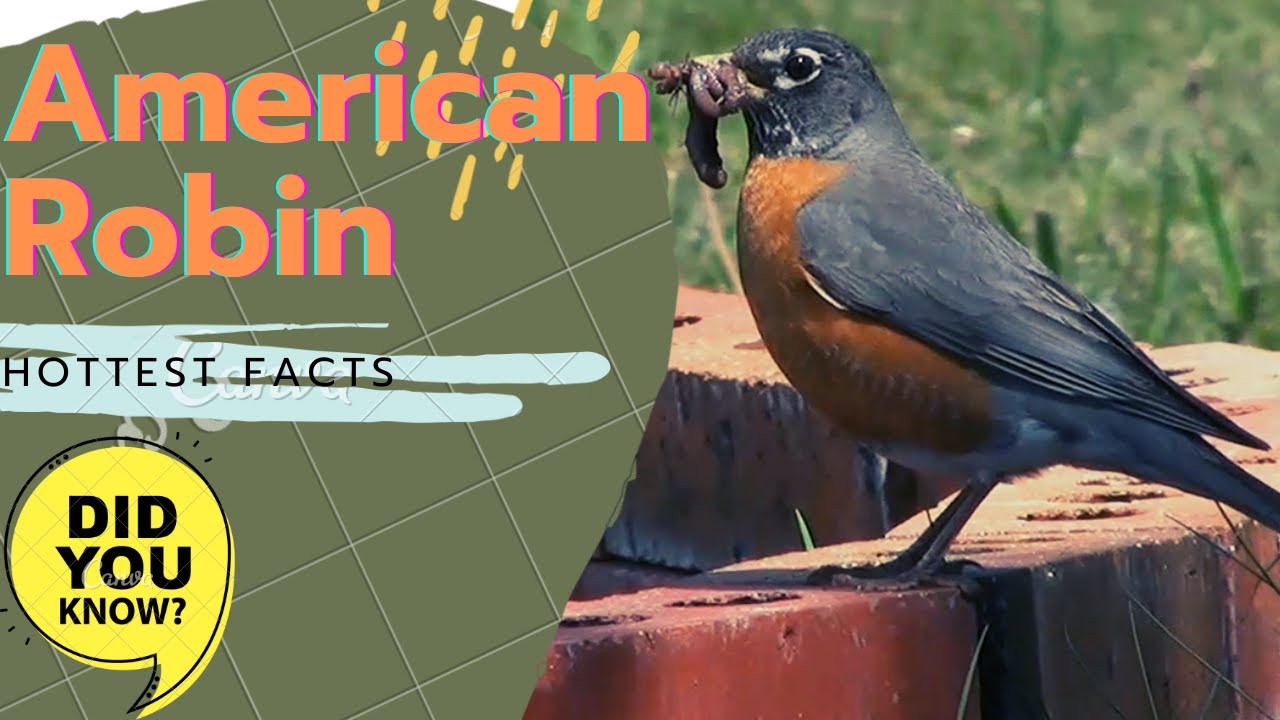
The American robin is a migratory songbird of the true thrush genus and Turdidae, the wider thrush family. It is named after the European robin because of its reddish-orange breast, though the two species are not closely related, with the European robin belonging to the Old World flycatcher family. The American robin is widely distributed throughout North America, wintering from southern Canada to central Mexico and along the Pacific Coast. It is the state bird of Connecticut, Michigan, and Wisconsin. According to the Partners in Flight database, the American robin is the most abundant bird in North America, ahead of red-winged blackbirds, introduced European starlings, mourning doves and house finches. It has seven subspecies, but only one of them, the San Lucas robin of Baja California Sur, is particularly distinctive, with pale gray-brown underparts.
It is active mostly during the day and assembles in large flocks at night. Its diet consists of invertebrates, fruits, and berries. It is one of the earliest bird species to lay its eggs, beginning to breed shortly after returning to its summer range from its winter range. The robin's nest consists of long coarse grass, twigs, paper, and feathers, and is smeared with mud and often cushioned with grass or other soft materials. It is among the earliest birds to sing at dawn, and its song consists of several discrete units that are repeated.
The adult robin's main predators are hawks, domestic cats, and snakes. When feeding in flocks, it can be vigilant, watching other birds for reactions to predators. Brown-headed cowbirds lay their eggs in robin nests, but the robins usually reject the egg. On its winter grounds it assembles in large flocks at night to roost in trees in secluded swamps or dense vegetation. The flocks break up during the day when the birds feed on fruits and berries in smaller groups. During the summer, it defends a breeding territory and is less social.
It's diet generally consists of around 40 percent small invertebrates, such as earthworms, beetle grubs, caterpillars and grasshoppers, and 60 percent wild and cultivated fruits and berries. Their ability to switch to berries allows them to winter much farther north than most other North American thrushes. They will flock to fermented Pyracantha berries, and after eating sufficient quantities will exhibit intoxicated behavior, such as falling over while walking. Robins forage primarily on the ground for soft-bodied invertebrates, and find worms by sight, pouncing on them and then pulling them up. Nestlings are fed mainly on earthworms and other soft-bodied animal prey. In some areas, robins, particularly of the northwestern subspecies, will feed on beaches, taking insects and small mollusks. The male American robin, as with many thrushes, has a complex and almost continuous song. It is commonly described as a cheery carol, made up of discrete units, often repeated, and spliced together into a string with brief pauses in between.

Информация по комментариям в разработке