Everything you think you know about vitamin C comes from one of history's most successful marketing campaigns—not science.
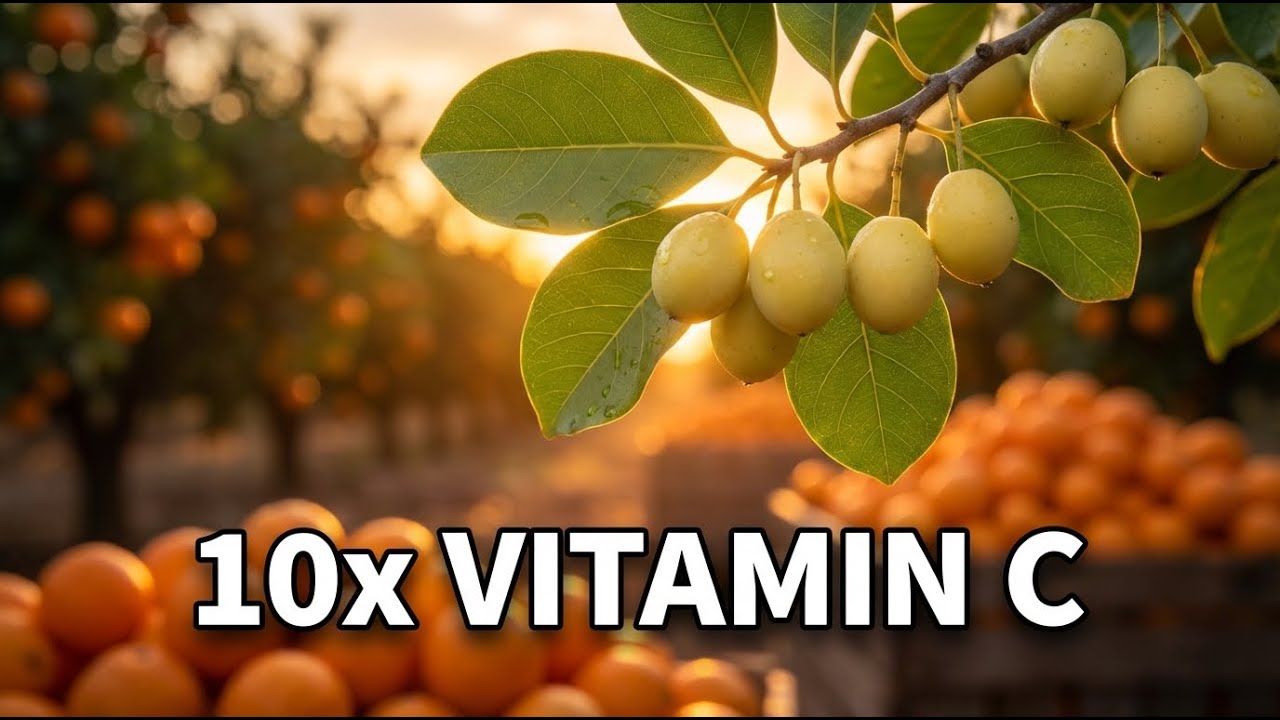
When you feel a cold coming on, you probably reach for orange juice. It's practically instinct. But here's what nobody told you: sitting in the tropical woodlands of northern Australia is a small green fruit called the Kakadu plum that contains up to 100 times more vitamin C than an orange. A single fruit, no bigger than a cherry, packs 350-480mg of vitamin C. A medium orange? Just 70mg.
Aboriginal Australians have used this fruit as medicine for over 40,000 years—treating illnesses, healing wounds, and maintaining health. So how did oranges become the global symbol of vitamin C while this nutritional powerhouse remained virtually unknown?
The answer starts in early 1900s California. The Southern California Fruit Growers Association (later Sunkist) faced a crisis: they were growing more oranges than Americans would eat. Their solution? Convince people to drink oranges instead. The "Drink an Orange" campaign launched, and sales increased by 400%.
Then came 1918 and the deadly influenza pandemic. Sunkist's marketing claimed orange juice could prevent or cure colds and flu. For a terrified population, these claims gave orange juice almost mystical appeal. The connection between oranges and health wasn't established through science—it was established through advertising that exploited fear.
Meanwhile, Western scientists didn't bother analyzing the Kakadu plum until the 1980s. Humans walked on the moon before anyone thought to study what Aboriginal Australians had been using as medicine for millennia. The knowledge was always there. Scientists just weren't listening.
The Kakadu plum isn't alone. Acerola cherries contain 50-100 times more vitamin C than oranges. Camu camu berries have 40 times more. Even red bell peppers have triple the vitamin C of oranges. The orange sits somewhere in the middle of the rankings—elevated not by nutritional superiority, but by its marketing budget.
There's also a troubling pattern: as the world recognizes the Kakadu plum's value, Indigenous communities who protected this knowledge for 40,000 years have been largely excluded from commercial benefits. Companies have patented extracts without any benefit-sharing arrangements.
The real lesson? Marketing has shaped our nutritional beliefs far more than science. Indigenous knowledge holds treasures we're only beginning to discover. And if we want access to that wisdom, we need to ensure the benefits return to the communities who carried it forward through time.
Forty thousand years of knowledge is waiting. We just have to listen.
📚 SOURCES:
Bobasa, E.M., Phan, A.D.T., Netzel, M.E., Cozzolino, D., & Sultanbawa, Y. (2024). "Nutritional and Functional Properties of Terminalia ferdinandiana Fruits Wild Harvested from Western Australia." Foods, 13(18), 2888.
Tan, J., et al. (2023). "Bioactive Properties of Kakadu Plum-Blended Products." Foods, 12(7), 1388.
Li, J., et al. (2023). "Terminalia ferdinandiana Exell (Kakadu plum): Nutritional value, phenolic compounds, health benefits and potential industrial applications." Food Bioscience, 56, 103434.
Cock, I.E. (2012). "The chemotherapeutic potential of Terminalia ferdinandiana: Phytochemistry and bioactivity." Pharmacognosy Reviews, 6(11), 29-36.
Cock, I.E. & Mohanty, S. (2011). "Evaluation of the antibacterial activity and toxicity of Terminalia ferdinandiana fruit extracts." Pharmacognosy Journal, 3(20), 72-79.
Garcia, V.A.S., Borges, J.G., Vanin, F.M., & Carvalho, R.A. (2020). "Vitamin C stability in acerola and camu-camu powder obtained by spray drying." Brazilian Journal of Food Technology, 23, e2019237.
Delva, L. & Schneider, R.G. (2013). "Acerola (Malpighia emarginata DC): Production, Postharvest Handling, Nutrition, and Biological Activity." Food Reviews International, 29(2), 107-126.
Moreira, G.E.A., et al. (2009). "Ascorbic acid and total phenolic content of acerola fruit." Journal of Food Science and Technology, 53(6), 501-507.
Hemilä, H. (2017). "Vitamin C and Infections." Nutrients, 9(4), 339.
Laszlo, P. (2007). Citrus: A History. University of Chicago Press.

Информация по комментариям в разработке