While much of the medieval world remained localized and economically constrained, one city was engineered to operate on a global scale.
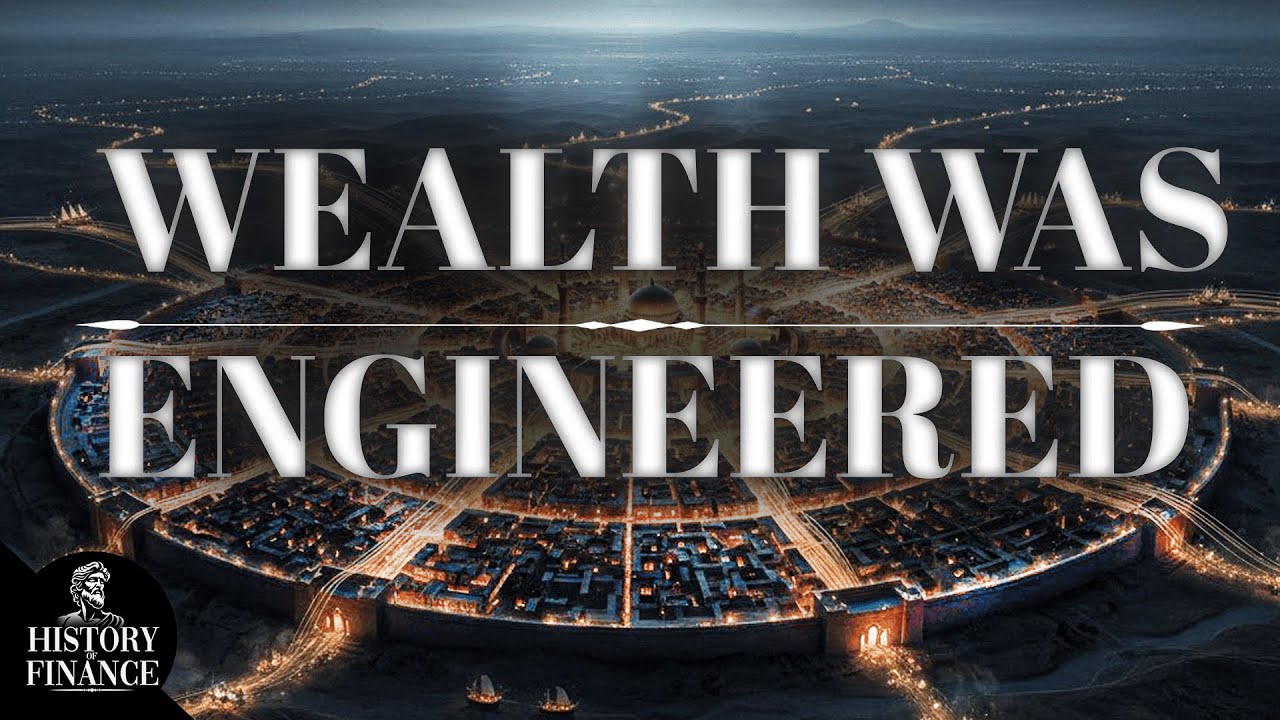
In this episode of History of Finance, we examine how Abbasid Baghdad became the most sophisticated economic system of its era — not through conquest or mythology, but through design. Purpose-built infrastructure, long-distance trade coordination, legal clarity, and early financial instruments transformed Baghdad into a hub where capital, knowledge, and power continuously reinforced one another.
This is not a romanticized “golden age” narrative. It is a case study in how prosperity is created when systems reduce friction, reward specialization, and treat information as an economic resource. By tracing how Baghdad rose — and why it eventually fragmented — we uncover principles that remain relevant to modern economies today.
——————————————————
Key Facts & Insights
• Founded in 762 CE, Baghdad was designed as a centralized capital to manage trade, taxation, and administration efficiently.
• The Abbasid economy linked Europe, Africa, Central Asia, India, and the Indian Ocean into a single commercial network.
• Financial mechanisms such as credit instruments and transferable deposits enabled capital movement without physical gold.
• Economic strength came from circulation and coordination, not territorial expansion alone.
• State investment in knowledge — mathematics, astronomy, medicine, and engineering — directly improved economic productivity.
• Baghdad’s urban scale, specialization, and market integration surpassed any contemporary European city.
• Decline began internally, as governance fragmentation and rising extraction eroded trust and coordination before external shocks.
———————————————
#EconomicHistory #AbbasidCaliphate #Baghdad #AncientEconomies #EconomicSystems #RealWealth #FinancialHistorian #financialhistory
———————————————
Further Reading & Sources
• When Baghdad Ruled the Muslim World — Hugh Kennedy
A detailed examination of how the Abbasid state managed power, taxation, administration, and long-distance trade at scale.
• The House of Wisdom — Jim Al-Khalili
Explores how translation, science, and institutionalized knowledge became economic multipliers rather than cultural luxuries.
• Islamic Science and the Making of the European Renaissance — George Saliba
Analyzes how Abbasid knowledge systems influenced later European economic and intellectual development.
———————————————
If this changed how you see wealth and power, subscribe.
History of Finance uncovers the systems behind the world.

Информация по комментариям в разработке