This is the 1500th video published on this channel (not counting a few videos I uploaded multiple times owing to compression issues). So thanks again all for watching, commenting, and providing new idea.
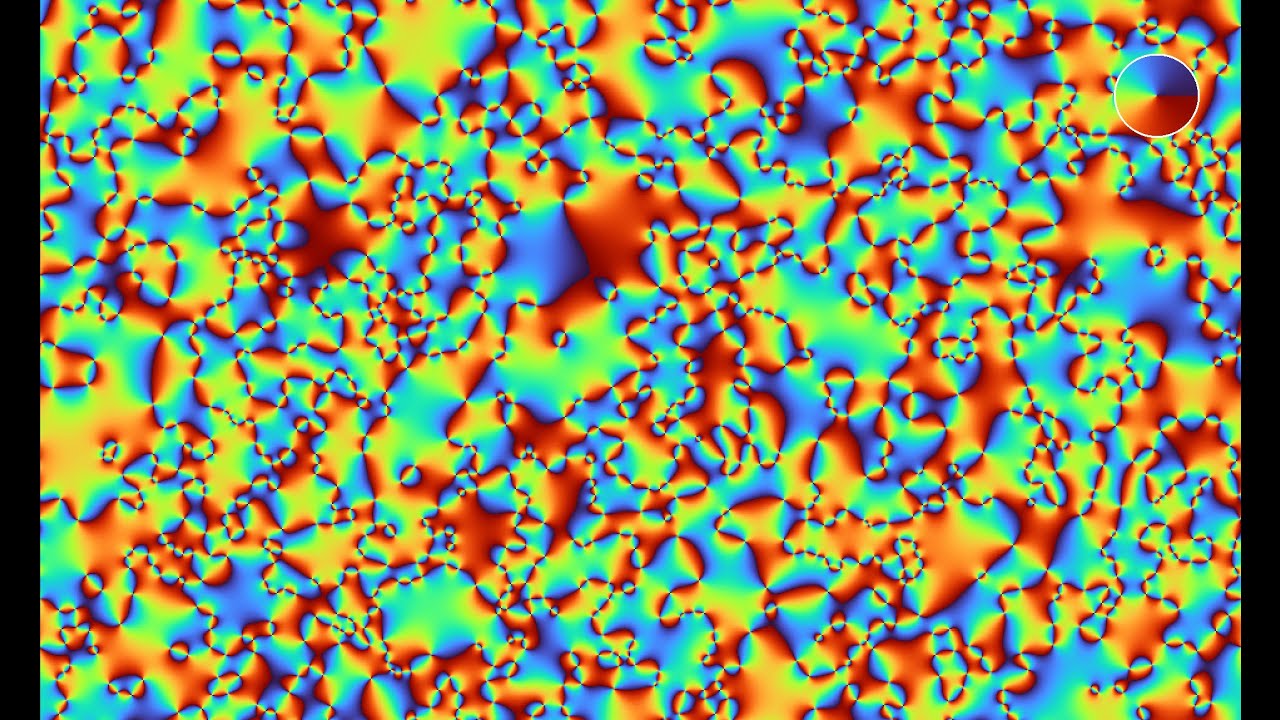
As usual for a milestone, I try to make a video that is somewhat special. In this case, it is the first simulation of a new type of equation, which is a particular case of Kuramoto model. The variables in this equation are angles, or phases, describing the state of a so-called phase oscillator. This oscillator could be a pendulum, a firefly, or any other system with a periodic motion. The dynamics of each oscillator is driven by two terms: a local term, which is just a rotation at constant angular speed, and a coupling to the four nearest neighbors. The coupling is proportional to the negative of the sine of the phase difference, which tends to align the phases, a phenomenon called synchronization.
The initial phases of the oscillators are random. The coupling soon leads neighboring oscillators to have similar phases. However, there is a topological feature, which is that the system develops singularities, which are points around which the phase makes a full turn. This singularities can move over time, and in some cases annihilate each other.
This video has four parts, using two different coupling intensities, and with and without an additional noise term:
Weak coupling, no noise: 0:00
Strong coupling, no noise: 1:10
Weak coupling, with noise: 2:20
Strong coupling, with noise: 3:30
In parts 2 and 4, the coupling between phases is 100 times larger than in parts 1 and 3. Parts 3 and 4 use an additional random forcing, which makes it easier for singularities to disappear. The color indicates the phase of the oscillator, taken modulo pi (instead of 2*pi), because this leads to nicer visuals.
The idea for this simulation comes from a recent research work of mine with two colleagues, looking at a one-dimensional version of this model:
https://www.researchgate.net/publicat...
Render time: 1 hour 20 minutes
Color scheme: Turbo, by Anton Mikhailov
https://gist.github.com/mikhailov-wor...
Music: "Future Freeway" by Adam MacDougall@AdamMacDougall-q2d
See also https://images.math.cnrs.fr/Des-ondes... for more explanations (in French) on a few previous simulations of wave equations.
#Kuramoto #synchronisation #synchronization
The simulation solves a partial differential equation by discretization.
C code: https://github.com/nilsberglund-orlea...
https://www.idpoisson.fr/berglund/sof...

Информация по комментариям в разработке