★ Follow music ► / reciclassicat
Composer: Gervais-François Couperin (1759-1826)
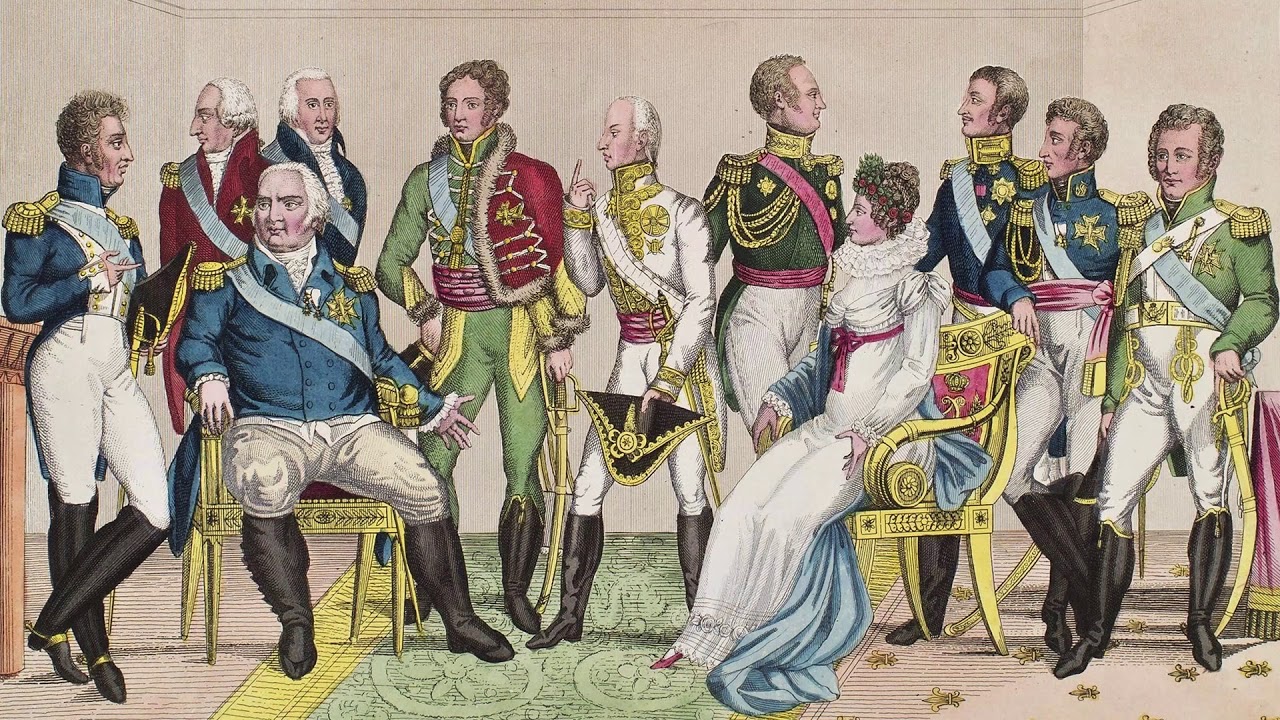
Work: Louis XVIII, ou le retour du bonheur en France, Op.14 (1814)
Performers: André lsoir (orgue)
Engraving: Décrouant (early 19th Century) - La famille royale et les alliées s'occupant du bonheur de l'Europe
Image in high resolution: https://flic.kr/p/2j4s7a3
Further info: https://www.amazon.es/dp/B00F2N3M5K
Listen free: https://open.spotify.com/album/4bWQt9...
---
Gervais-François (François-Gervais) Couperin
(Paris, 22 May 1759 - Paris, 11 March 1826)
Composer and organist, son of Armand-Louis Couperin (1727-1789). Of his life before the deaths of his father and brother, Taskin said only that he was instructed by his parents and that at the age of 18 he had a ‘symphonie à grand orchestre’ performed (possibly the Première simphonie). He must have taken over the posts left vacant on his brother’s death; already on 15 November 1789, he played ‘tout l’office’ for the Fête de la Providence at St Gervais, and in 1790 the title-page of his Complainte béarnoise called him ‘organiste du Roi en sa Ste Chapelle de Paris, de St Gervais, de St Jean, de Ste Marguerite, et des Carmes Billettes’. He also took over his father’s trimester at Notre Dame. Perhaps in anticipation of disaster, or because St Gervais was under pressure to divest itself of its dependencies, Couperin and his mother moved into a tiny entresol in the Palais de Justice, to which his position at the Ste Chapelle gave him the right, about 1791. On the first day of the Republic, 22 September 1792, Couperin married his pupil, Hélène-Narcisse Frey, a fine singer, and that year his mother moved to Versailles, where she became organist of the church of St Louis and lived to her 87th year in full possession of her brilliant musical talent. Couperin himself moved again, to the Marais. In 1793, for the reopening of the opera, he and Séjan played patriotic airs on two small organs in boxes on either side of the stage. This continued for four months, after which the instruments were removed, ostensibly to provide more revenue space (Séjan said the administration was jealous of the ‘accueil distingué’ that the organists received; see Bouvet, 1932). In one of the most bizarre scenes of the Republican aberration (6 November 1799), Couperin found himself playing dinner music on the greatest organ in Paris, at St Sulpice, while Napoleon and a nervous Directory, which was to be overthrown three days later by its guest of honour, consumed an immense banquet in the nave below, watched over by a statue of Victory (herself about to be overthrown), whose temple the church had become. When the churches reopened, Couperin took up his duties in those that had not been destroyed. St Jean-en-Grève, demolished in 1800, was joined administratively to St François, and Couperin followed. From about 1810 he may have shared the functions at St Merri with the ancient titulaire, Joseph Pouteau (1739-1823). Couperin greeted the Restoration with the same impartial loyalty that he had shown towards the various powers during the interregnum; his 14th opus was Louis XVIII, ou Le retour du bonheur en France, and an autograph letter survives in which he begged the wardens of St François (not St Louis) to accept a funeral wreath he had made himself, to be used at the commemoration of the deaths of Louis XVI and Marie Antoinette. He had managed to survive, but the inventory taken on his death suggests that his circumstances were by then modest (the only instruments were two pianos).
Opinion was divided as to his stature. The public flocked to hear the thunder in his Te Deum performances, but J.F. Reichardt (cited by Bouvet, 1932, pp.133–4), who heard a mass on St Cecilia’s Day 1802, called him ‘miserable … An organist of that ilk has no business calling himself a Couperin … During the benediction and the distribution of the Host – six immense brioches – Couperin played motifs chosen in defiance of common sense’. Fétis called him ‘médiocre’, while A.-P.-F. Boëly, by far the best organ composer of the time and a friend of Couperin’s, poked fun at ‘ce petit coquin de Couperin qui passe de C sol ut en G ré sol sans préparation’ (Bouvet, 1919). In fact, Gervais-François may well be the most interesting composer of the family after Louis and François Couperin (II). Certainly his range was broader than his father’s, and at least two writers, Bouvet (1919) and Favre (La musique française de piano avant 1830, Paris, 1953/R), found something to admire in his romances and piano pieces, some of which exist in varying versions and sketches. His daughter Céleste-Thérèse (Paris, 1792/3 - Belleville, 14 Feb 1860) was the family’s last musician.

Информация по комментариям в разработке