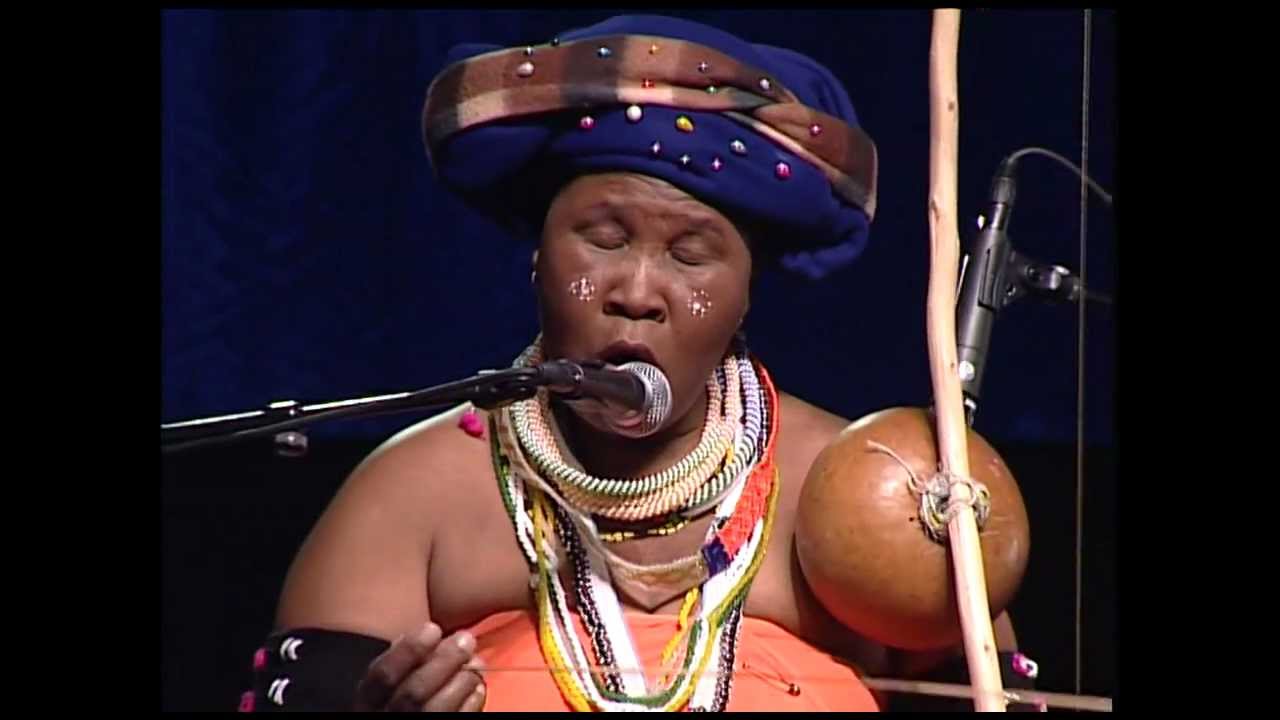
Madosini, South African octogenarian singer Madosini perform at the 2003 WOMAD Festival.
Madosini is the Queen and muse of Mpondoland. Her time-enriched skills as a composer, musician, storyteller and dancer have made her an icon among the Bundu people of the eastern Cape.
Madosini plays songs of ancient village life on the umrhubhe (mouthbow), uhadi (mouth harp) and isitolotolo (Jew s harp).
Dancer Vuyo on marimba an talking drums. A member of veteran South African group Amampondo, Vuyo is a charismatic and engaging performer who will add yet another magical dimension to this collaboration.
-
The Uhadi, a musical bow, is a traditional Southern African Xhosa musical instrument. It is a large unembraced musical bow which is attached to a resonator and played by percussion. The length of the string bow ranges from 115 to 130 centimeters.
-
uHadi is a traditional Xhosa unbraced musical bow instrument. The wooden bow is strung with gut or wire and attached to iSelwa (calabash) which resonates and amplifies the sound. The bow is played with uMqungu (a beater) made from a “thin stalk of grass often plucked from the roof-thatch which is beaten against the string” (Dargie, 1986).
-
Uhadi playing position is like that of the Zulu Ugubhu, the bow stave is held in the right hand (or left if the player is left-handed), near the lower end of the stave, so that the opening in the gourd resonator faces the player’s breast” (Mandela, 2005).
-
In traditional Xhosa and Mpondo life, these instruments were played by women for songs of place names, journeys and events, and topical songs about everyday life. Today, alongside famed women elders such as Matombi Matotiyana and Madosini Manquina, young women such as Thankdeka Mfinyongo and Nomapostile Nyiki and men such as Luyolo Lenga and Dizu Plaatjies make, play and promote the intrinsic cultural values and unique sonic and poetic appeal of these instruments.
---
Traditional Xhosa music resonates as something special for South Africans. It is part of the Xhosa people’s culture, the individuals who formed such a vital part of our country’s history, and it depicts a clear picture of what makes Xhosa people admirable. The Uhadi Calabash is not just a simple instrument, it is a symbol of Xhosa ingenuity and creativity
The exact origins of the Uhadi Calabash are unknown, as there is little documentation of the instrument. The earliest discovery was documented in 1815 by James Campbell, a British historian who had a fascination with Anglo-Saxon studies.
Campbell described the instrument in detail, telling of how Xhosa people played it in harmony while recollecting the names of friends, rivers, and places. It is known that the Uhadi Calabash was mostly played by married women, and individuals learned to play the instrument by observing others.
What is the Uhadi Calabash made of?
The original material used to make the stave of the Uhadi Calabash was wood from a tree called ‘umbangandlela’ which can be found in the Eastern Cape. There are, however, versions of another wood used around the same time which was made from a bush called ‘uliza’.
The string was originally made from animal hair or gut. Some used the strings afterward as ankle bracelets after twisting the string into shape.
Completing the instrument is a harvested calabash that is hollowed out and left to dry until it is hardened. The calabash is then prepared by cutting a hole (roughly 9mm in diameter) where the stalk of the calabash was, then is scraped on the inside until completely clean. Two holes are then cut into the top, while a small piece of cloth is twisted into a string and placed on the inside to insulate it.
This creative attachment showcases the Xhosa people’s early understanding of how to manipulate sound.
How do you play the Uhadi Calabash?
The technique required to play the Uhadi Calabash is a simple one once mastered. The instrument is placed on the person’s lap or pressed against the chest, with the resonator used as the main gripping object.
By pinching or beating the string using your hand, a stick, or some tambookie grass, you can play the instrument to your heart’s content.
When is the Uhadi Calabash used?
The Uhadi Calabash is most commonly used at traditional Xhosa ceremonies, weddings, and ritual rites of passage. Although the instrument is not commonly played, there are some African musicians who still practice playing the Uhadi Calabash, most notably Dizu Plaatjies and Madosini Manqineni.
Like many other instruments, the Uhadi Calabash is more than an object that is used to make music. It embodies the heritage of Xhosa people, showcases their creativity throughout history, and teaches the world a bit more about South Africa.
Variations in pitch are produced by pinching the string, and variations in tone are made by shifting the gourd’s position on the chest.
-

Информация по комментариям в разработке