Chemistry Bsc 3rd Semester Notes | Chemistry-iii Notes Sem 3 | Bsc 2nd Year Chemistry/ GU FYUGP-NEP
For PDF 👇
Please WhatsApp 9401466545 @79 only
RT knowledge icon
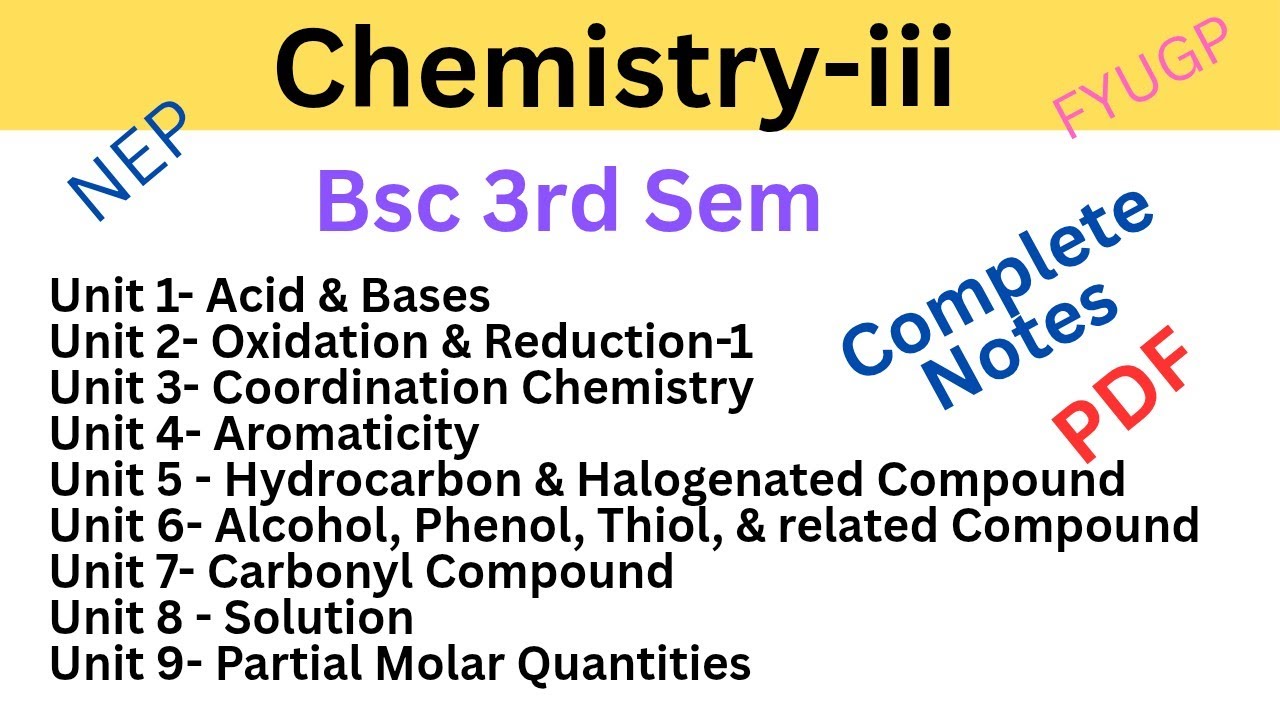
Contents
Unit I: Acid and Bases
Acid-base concepts, measure of acid and base strength, proton affinity, acidity and basicity of binary hydrogen compounds, inductive effect and strength of oxyacids, acidity of aqua ions, steric effect, proton sponge, solvation and acid base strength, non-aqueous solvents and acid base strength, levelling effect, superacids and superbases. Hard and soft acids and bases (HSAB), application of HSAB principle and symbiosis.
Unit II: Oxidation and reduction -I
Reduction potentials: Redox half-reactions, standard potentials and spontaneity, trends in standard potentials, the electrochemical series, Nernst equation (Influence of pH and concentration on electrode potential). Principles of redox titration and choice of redox indicators.
Unit III: Coordination chemistry-II
Valence bond theory (VBT), inner and outer orbital complexes, electroneutrality principle and back bonding, effects of hybridization in metal ligand bond strength and stability of complexes, choice of metal d-orbital(s) in hybridization in different coordination geometries, magnetic properties of complexes, drawback of VBT.
Unit IV: Aromaticity
Concepts of aromatic, anti-aromatic and non-aromatic compounds (including examples of cyclic carbocations, carbanions and heterocyclic compounds); Hückel’s rule.
Unit V: Hydrocarbons and halogenated compounds
Methods of preparation, properties and relative reactivity of alkyl and aryl halides; Selectivity in electrophilic and nucleophilic substitution reactions (SNAr), Preparation and reactions of diazonium salts; Benzyne mechanism.
Unit VI: Alcohols, phenols, thiols and related compounds
Preparation, properties and relative reactivity of 1°, 2°, and 3°-alcohols, ethers, epoxides (preparation and reactions with alcohols, ammonia derivatives and LiAlH4). Thiols and sulfides; phenols (preparation, properties and reactivity; Reimer-Tiemann and Kolbe’s-Schmidt Reactions)
Unit VII: Carbonyl compounds
Structure, reactivity and preparation; oxidations and reductions (Jones reagent, PCC and PDC, Oppenauer, Clemmensen, Wolff-Kishner, NaBH4, LiAlH4, MPV), Baeyer Villiger oxidation.
Unit VIII: Solution
Vapour pressure of solution. Ideal solutions, ideally diluted solutions and colligative properties. Raoult's law & Henry’s Law. Thermodynamic derivation of colligative properties of solution (using chemical potentials) and their inter relationships. Abnormal colligative properties.
Unit IX: Partial molar quantities
Fugacity, activity coefficients and concept of chemical potential: Gibbs Duhem equation and Duhem-Margules equation: their use and application, Enthalpy, free energy and entropy of mixing, excess thermodynamic functions
#book #nep #book #new #nep #assam #syllabus #2025 #2026 #bsc #sem3 #semester3 #3rdsem #3rdsemester #pdf #notes #answer #rtknowledgeicon #rtki #sessional #finalexam #chemistry #chemistrynotes #bscchemistry #bscchemistrynotes #gu #du #bu #guwahati_university #gauhati_university #fyugp #bscsem3 #exam #honours #rt_knowledge_icon #chemistrybook #chemistryiii #handwrittennotes #importantquestion #answer #previousyearquestions #core #dibrugarhuniversity #dibrugarh_university #Assam #assamuniversity #bodoland_university #bodolanduniversity #bu #Alcohols,phenols,thiolsandrelatedcompounds #carbonylcompounds #solution #Partialmolarquantities #Hydrocarbonsandhalogenatedcompounds #aromaticity #Coordinationchemistry-II #Oxidationandreduction-I #AcidandBases

Информация по комментариям в разработке