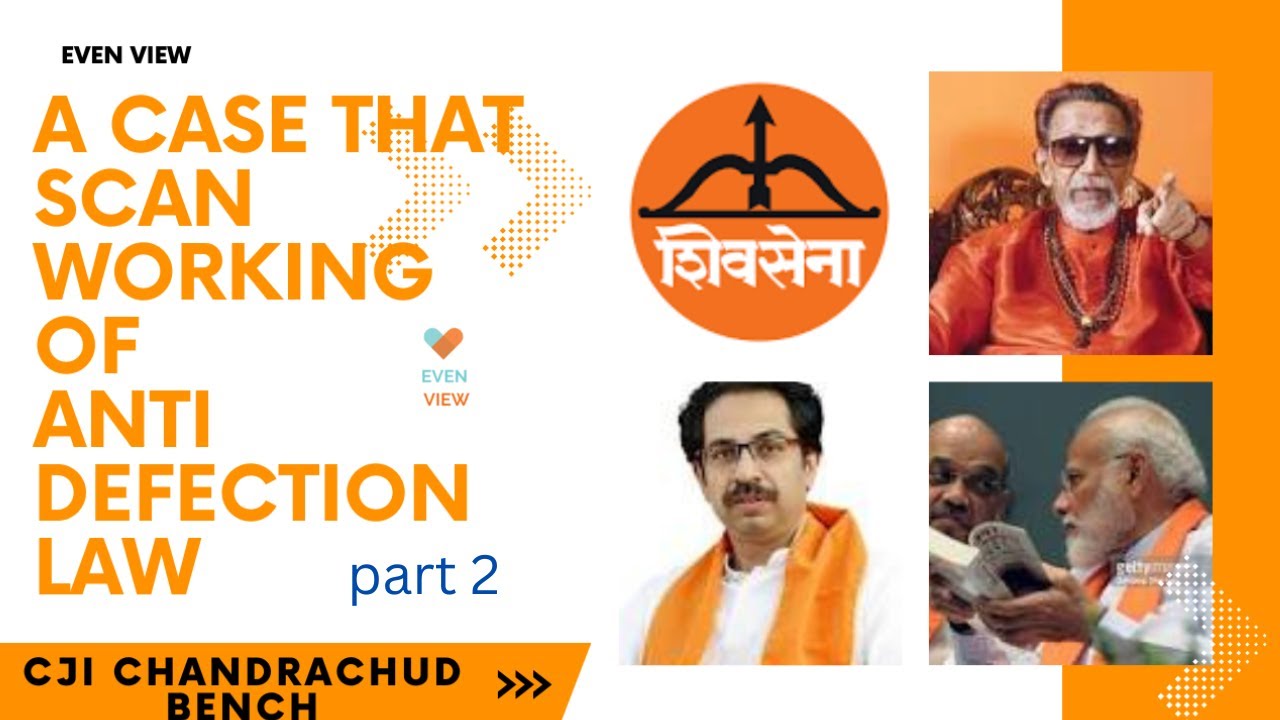
A five-judge Bench of the Supreme Court of India is presently hearing a set of cases popularly known as the “Maharashtra political controversy cases”. Recently Election Commission of India (ECI) ordered that Eknath Shinde’s faction is entitled to the Shiv Sena party name and symbol. The anti-defection law (ADL) was introduced into the Constitution via the Tenth Schedule, in 1985. Its purpose was to check increasingly frequent floor-crossing; lured by money, ministerial berths, threats, or a combination of the three, legislators were regularly switching party affiliations in the house (and bringing down governments with them). The Tenth Schedule sought to put a stop to this by stipulating that if any legislator voted against the party whip, he or she would be disqualified from the house. While on the one hand this empowered party leadership against the legislative backbench, and weakened the prospect of intra-party dissent, the Tenth Schedule viewed this as an acceptable compromise in the interests of checking unprincipled floor-crossing. 40 years later, we find that the working of the Tenth Schedule has been patchy, at best. In the last few years, there have been innumerable instances of governments being “toppled” mid-term after a set of the ruling party or coalition’s own members turn against it. That this is power-politics and no high-minded expression of intra-party dissent is evident from the well-documented rise of “resort-politics”, where party leaders hold their “flock” more or less captive within expensive holiday resorts, so as to prevent the other side from getting at them. Indeed, politicians have adopted various stratagems to go around the anti-defection law: Mass resignations (instead of defections) to force a fresh election Partisan actions by State Governors (who are nominees of the central government) with respect to swearing-in ceremonies and the timing of floor tests Partisan actions by Speakers (in refusing to decide disqualification petitions, or acting in undue haste to do so). This is where the role of the Supreme Court becomes crucial. Disputes over government formation and government toppling invariably end up before the highest court. It must immediately be acknowledged that such cases place the Court in an unenviable position: the Court has to adjudicate the actions of a number of constitutional functionaries: Governors, Speakers, legislative party leaders, elected representatives, many (if not all) of whom, to put it charitably, have acted dubiously. But the Court does not have the liberty of presuming dishonesty: it must maintain an institutional arm’s-length from the political actors, and adjudicate according to legalities, even as political actors in anti-defection cases do their best to undermine legality. This is a challenging task. The present case (the Maharashtra political controversy) that presents an interesting case study. It began when a set of legislators from the Shiv Sena rebelled against then CM Uddhav Thackeray. The Deputy Speaker (there was no Speaker at the time) moved to disqualify the “rebels” who in turn moved the Court, arguing that there was a pending no-confidence motion against the Deputy Speaker, and therefore, as per the Supreme Court’s judgement in Nabam Rebia case, he was disqualified from deciding on the disqualifications while it was pending. The Supreme Court’s vacation Bench stayed the Deputy Speaker’s hand, but also directed a floor test. The upshot of this was that the “rebel MLAs” (who may or may not have subjected themselves to disqualification) were able to vote in this floor test, and voted to bring the government down. The new government was swiftly sworn in (by the Governor), and appointed its own Speaker, thus effectively creating a fait accompli with respect to the pending disqualification petitions. To top it all, the Supreme Court’s orders were “interim” in nature, and therefore, no reasons were provided

Информация по комментариям в разработке