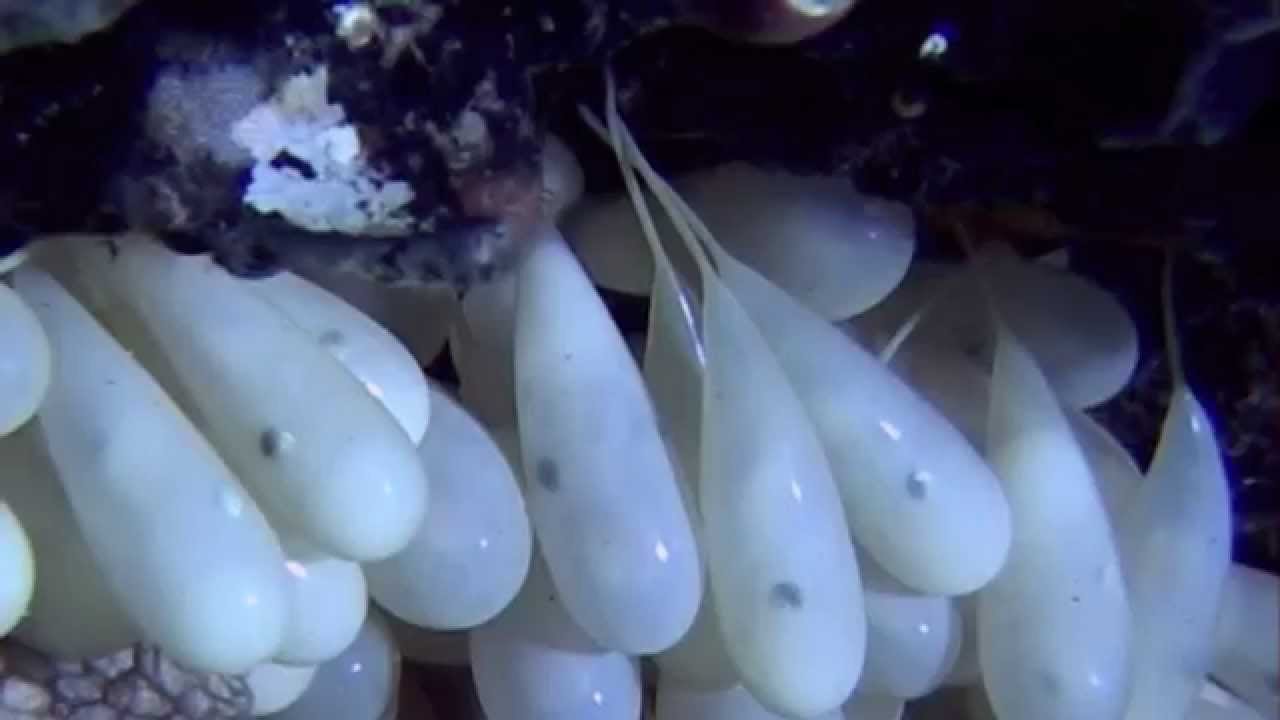
I filmed this baby octopus while night diving in the La Jolla Cove on Jan. 13 2008. The water temp. was a brisk 52 digrees.
Octopuses are characterized by their eight arms (not tentacles), usually bearing suction cups. These arms are a type of muscular hydrostat. Unlike most other cephalopods, the majority of octopuses — those in the suborder most commonly known, Incirrina — have almost entirely soft bodies with no internal skeleton. They have neither a protective outer shell like the nautilus, nor any vestige of an internal shell or bones, like cuttlefish or squids. A beak, similar in shape to a parrot's beak, is the only hard part of their body. This enables them to squeeze through very narrow slits between underwater rocks, which is very helpful when they are fleeing from morays or other predatory fish. The octopuses in the less familiar Cirrina suborder have two fins and an internal shell, generally lessening their ability to squeeze into small spaces.
Octopuses have a relatively short life span, and some species live for as little as six months. Larger species, such as the North Pacific Giant Octopus, may live for up to five years under suitable circumstances. However, reproduction is a cause of death: males can only live for a few months after mating, and females die shortly after their eggs hatch. They neglect to eat during the (roughly) one month period spent taking care of their unhatched eggs, but they don't die of starvation. Endocrine secretions from the two optic glands are the cause of genetically-programmed death (and if these glands are surgically removed, the octopus may live many months beyond reproduction, until she finally starves).
Octopuses have three hearts. Two pump blood through each of the two gills, while the third pumps blood through the body. Octopus blood contains the copper-rich protein hemocyanin for transporting oxygen. Although less efficient under normal conditions than the iron-rich hemoglobin of vertebrates, in cold conditions with low oxygen pressure, hemoglobin oxygen transportation is less efficient than hemocyanin oxygen transportation. The hemocyanin is dissolved in the plasma instead of being bound in red blood cells and gives the blood a blue color. Octopuses draw water into their mantle cavity where it passes through its gills. As mollusks, octopuses have gills that are finely divided and vascularized outgrowths of either the outer or the inner body surface.
Octopuses are highly intelligent, probably more intelligent than any other order of invertebrates. The exact extent of their intelligence and learning capability is much debated among biologists, but maze and problem-solving experiments have shown that they do have both short- and long-term memory. Their short lifespans limit the amount they can ultimately learn. There has been much speculation to the effect that almost all octopus behaviors are independently learned rather than instinct-based, although this remains largely unproven. They learn almost no behaviors from their parents, with whom young octopuses have very little contact.
An octopus has a highly complex nervous system, only part of which is localized in its brain. Two-thirds of an octopus's neurons are found in the nerve cords of its arms, which have a remarkable amount of autonomy. Octopus arms show a wide variety of complex reflex actions arising on at least three different levels of the nervous system. Some octopuses, such as the Mimic Octopus, will move their arms in ways that emulate the movements of other sea creatures.
In laboratory experiments, octopuses can be readily trained to distinguish between different shapes and patterns. They have been reported to practice observational learning, although the validity of these findings is widely contested on a number of grounds. Octopuses have also been observed in what some have described as play: repeatedly releasing bottles or toys into a circular current in their aquariums and then catching them. Octopuses often break out of their aquariums and sometimes into others in search of food. They have even boarded fishing boats and opened holds to eat crabs.
In some countries, octopuses are on the list of experimental animals on which surgery may not be performed without anesthesia. In the UK, cephalopods such as octopuses are regarded as honorary vertebrates under the Animals (Scientific Procedures) Act 1986 and other cruelty to animals legislation, extending to them protections not normally afforded to invertebrates.
A common belief is that when stressed, an octopus may begin to eat its own arms. However, limited research conducted in this area has revealed that the cause of this abnormal behavior, called autophagy, may be a virus that attacks the octopus's nervous system. Thus this behavior may be more correctly labeled as a neurological disorder.














Информация по комментариям в разработке