Logo video2dn
  • Сохранить видео с ютуба
  • Категории
    • Музыка
    • Кино и Анимация
    • Автомобили
    • Животные
    • Спорт
    • Путешествия
    • Игры
    • Люди и Блоги
    • Юмор
    • Развлечения
    • Новости и Политика
    • Howto и Стиль
    • Diy своими руками
    • Образование
    • Наука и Технологии
    • Некоммерческие Организации
  • О сайте

Скачать или смотреть Resolving the Loop Current Complex: Implications on Hurricane Intensity Forecasting edited

  • SECOORA
  • 2018-09-19
  • 60
Resolving the Loop Current Complex: Implications on Hurricane Intensity Forecasting   edited
hurricaneoceanobservingupwellingdownwellingocean observationsioosnoaanoaa hurricane
  • ok logo

Скачать Resolving the Loop Current Complex: Implications on Hurricane Intensity Forecasting edited бесплатно в качестве 4к (2к / 1080p)

У нас вы можете скачать бесплатно Resolving the Loop Current Complex: Implications on Hurricane Intensity Forecasting edited или посмотреть видео с ютуба в максимальном доступном качестве.

Для скачивания выберите вариант из формы ниже:

  • Информация по загрузке:

Cкачать музыку Resolving the Loop Current Complex: Implications on Hurricane Intensity Forecasting edited бесплатно в формате MP3:

Если иконки загрузки не отобразились, ПОЖАЛУЙСТА, НАЖМИТЕ ЗДЕСЬ или обновите страницу
Если у вас возникли трудности с загрузкой, пожалуйста, свяжитесь с нами по контактам, указанным в нижней части страницы.
Спасибо за использование сервиса video2dn.com

Описание к видео Resolving the Loop Current Complex: Implications on Hurricane Intensity Forecasting edited

Recorded August 28, 2018

Presenter: Lynn Keith (Nick) Shay, PhD – University of Miami’s Rosenstiel School of Marine and Atmospheric Science

More info: https://secoora.org/webinar-series/

Abstract
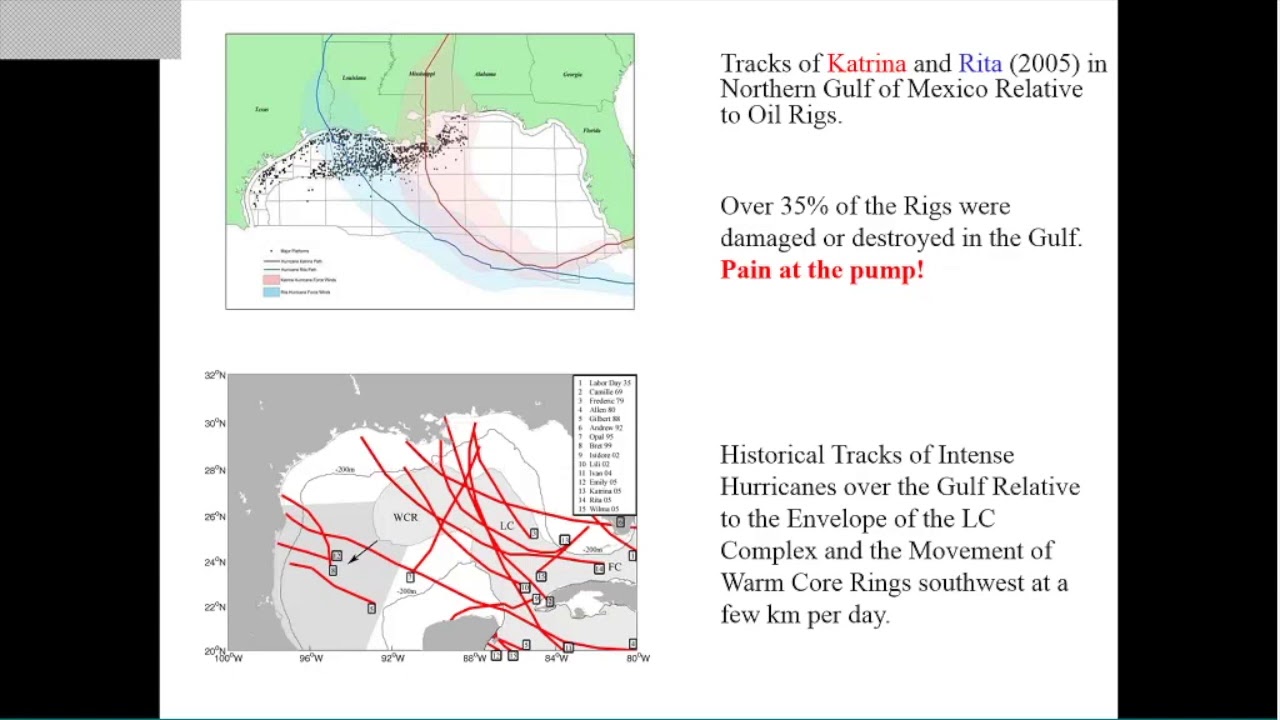
As a hurricane moves over the Gulf of Mexico’s Loop Current, hurricanes often intensify to severe (Category 3) status due to the deep warm water and the sustained air-sea fluxes feeding the storm. Given that the Gulf is a semi-enclosed basin, these intensifying hurricanes will make landfall around the Gulf and significantly impact coastal ocean processes.

In this context, it is critical to understand the 3-dimensional oceanic velocity response of the Loop Current and its complex warm and cold eddy field to hurricane forcing. This allows scientists to accurately evaluate dynamical loading on marine oil facilities and to assess mixing and dispersion of oil products through the water column. In addition, it is critical to understand the vertical extent of wind-forced ocean processes such as upwelling and downwelling of isotherms. In this context, measurements of ocean current, temperature and salinity fields prior, during, and subsequent to hurricane passage are critical to resolve these upwelling and mixing processes. Measurements also provide reference data sets to initialize, evaluate, and validate coupled forecast models.

As part of NOAA’s Hurricane Field Program over the past two decades, profilers have been deployed in the LC from NOAA research aircraft during hurricanes Isidore and Lili, Katrina and Rita, Gustav and Ike, Isaac and Nate. During Nate, the Gulf of Mexico Research Institute sponsored EM-APEX floats measured the hurricane-induced ocean response to the strong winds. These profiler measurements are cast into 2-dimensional satellite fields derived from multiple missions to estimate oceanic heat content, mixed layer and isotherm depths, and sea surface temperatures as part of ongoing research with scientists from NOAA-NESDIS. The oceanic response affects physical processes as well as biochemical processes and the ecosystem through upwelling, mixing and transport throughout the water column.

Комментарии

Информация по комментариям в разработке

Похожие видео

  • О нас
  • Контакты
  • Отказ от ответственности - Disclaimer
  • Условия использования сайта - TOS
  • Политика конфиденциальности

video2dn Copyright © 2023 - 2025

Контакты для правообладателей [email protected]