On the panel:
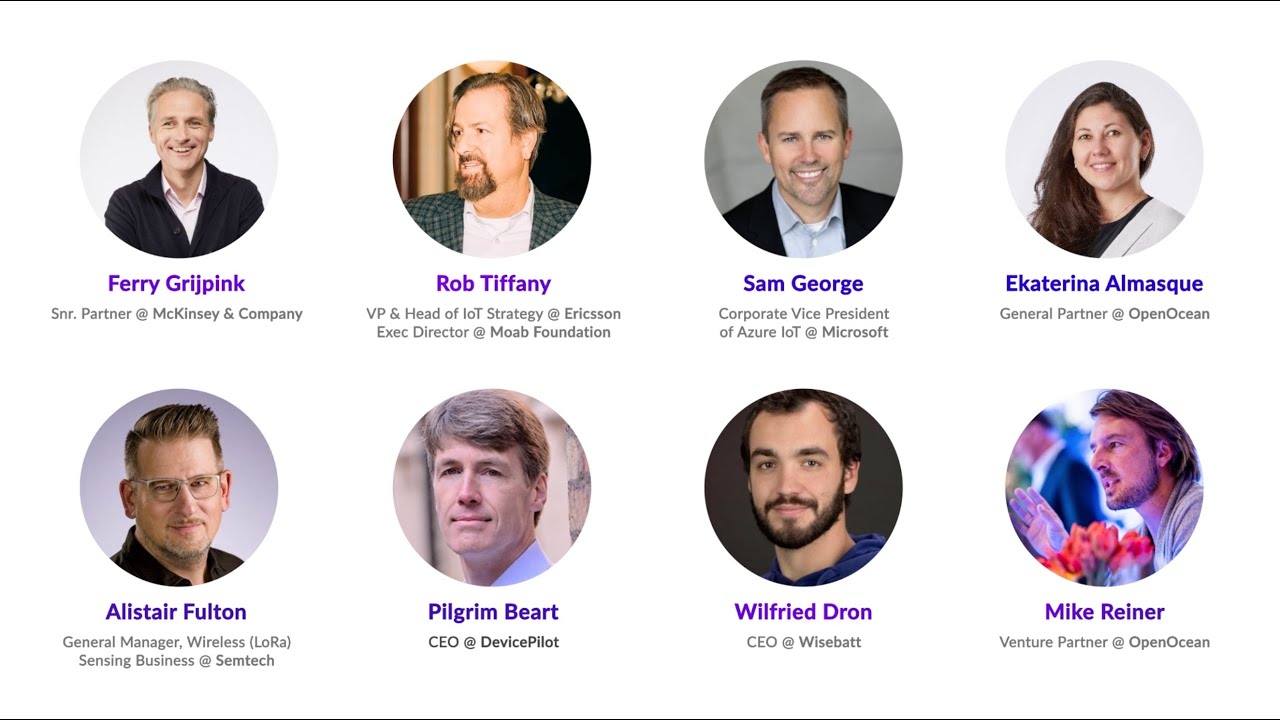
Ferry Grijpink, Snr. Partner @ McKinsey & Company
Rob Tiffany, VP & Head of IoT Strategy @ Ericsson | Exec Director @ Moab Foundation
Sam George, Corporate Vice President of Azure IoT @ Microsoft
Alistair Fulton, General Manager, Wireless (LoRa) & Sensing Business @ Semtech
Pilgrim Beart, CEO @ DevicePilot
Wilfried Dron, CEO @ Wisebatt
Moderated by:
Wienke Giezeman - CEO - Co-Founder @ The Things Industries
Back in 2015, McKinsey estimated that the IoT market has the potential to create value between $4 - $11 trillion. Today’s perspective shows us that we are ~ 20% short of our predictions.
This is mainly driven by the slow speed in adoption. Organizations are currently seeing a lot of inertia (stuck in PoCs hell) and moving from this stage to a large scale transformation is proving to be complex. Two key drivers suppressing this development are:
Handling the supply chain management and working together with scattered parties
Also, Change Management seems to be a hurdle in the space (e.g. getting new technologies implemented in large complex organizations. There is an overflow of new tech, which makes it difficult for organizations to choose and architecturally combine all the tools).
Another blocker to adoption is economics at scale. Clients see the value being created in their PoCs, however, including the hardware perspective, you start deploying the tools at scale and the costs add up quickly (e.g. microcontrollers, sensors, server to cloud connections, etc). Clients freeze simply due to a higher bill than the potential value being derived from the solution. “There is a lot of desire for the value created by IoT, but economics keeps slapping folks in the face, depending on the kind of industry they happen to be in”.
Another great challenge is the encapsulation of all the solutions. The promise of IoT has always been contingent on it being an extension of an existing system, not an isolated island. The whole purpose of IoT solutions is to do things more effectively for less. If, as an IoT company, you don’t manage to integrate your solution into an organization, then your solution has failed. The reason why we haven’t seen the hockey stick curve yet is that we haven’t made the technology accessible to the average individual. The core pieces are still quite difficult to integrate and to create a collaborative network.
Positive signs for the road ahead
We are seeing more and more customers and partners approaching IoT companies with a clearer business discipline: calculating the return on investment ahead of time, figuring out the total cost of an IoT solution, implementing a stage-gate process, etc. This is a positive mark in the IoT world that shows us that as an industry, we are getting close to solving major challenges. Simply and easy-to-use solutions coupled with a higher business maturity is going to be the driving force in unlocking further potential.
The impact of PoCs is higher than expected driving a larger number of the new implementations
The current technological level is also better than expected, allowing us to advance quicker
IoT platforms have helped in breaking down certain barricades. There are currently about 500 IoT platforms in the market, of which 10-15 will emerge as a winner.
IoT plug and play solutions are making everyone's life easier
Interesting to see how legacy companies are integrating IoT solutions and thereby adopting new business models.
IoT Edge computing will overcome the limited data processing and storage capacities, so substantial data processing needs to occur off the device, with the edge offering an environment to undertake this processing and manage large volumes of IoT devices and data (IoT will be an ecosystem that we haven’t seen before).
Enablement platforms and cloud computing (data processing, usually in real-time, within a central cloud server farm or with edge computing | data storage and integration using standard protocols)
The emergence of an orchestration company (branded) that will synchronize all the isolated solutions and make it as easy as an iPhone.
The IoT industry needs a de facto standard which can fuel the interconnectivity of devices
In the coming years, IoT will evolve from an aftermarket technology to an embedded technology.











Информация по комментариям в разработке