Logo video2dn
  • Сохранить видео с ютуба
  • Категории
    • Музыка
    • Кино и Анимация
    • Автомобили
    • Животные
    • Спорт
    • Путешествия
    • Игры
    • Люди и Блоги
    • Юмор
    • Развлечения
    • Новости и Политика
    • Howto и Стиль
    • Diy своими руками
    • Образование
    • Наука и Технологии
    • Некоммерческие Организации
  • О сайте

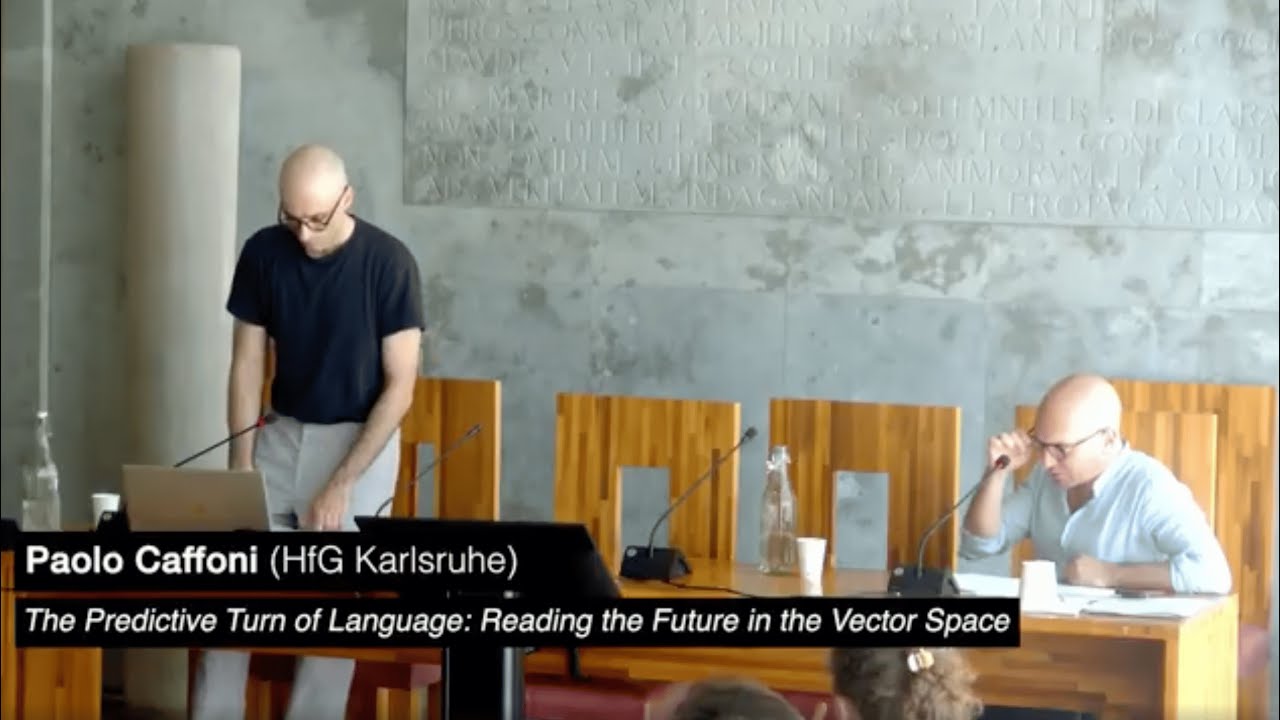
Скачать или смотреть Paolo Caffoni - The Predictive Turn of Language: Reading the Future in the Vector Space

  • ERC project AIMODELS
  • 2025-07-09
  • 66
Paolo Caffoni - The Predictive Turn of Language: Reading the Future in the Vector Space
  • ok logo

Скачать Paolo Caffoni - The Predictive Turn of Language: Reading the Future in the Vector Space бесплатно в качестве 4к (2к / 1080p)

У нас вы можете скачать бесплатно Paolo Caffoni - The Predictive Turn of Language: Reading the Future in the Vector Space или посмотреть видео с ютуба в максимальном доступном качестве.

Для скачивания выберите вариант из формы ниже:

  • Информация по загрузке:

Cкачать музыку Paolo Caffoni - The Predictive Turn of Language: Reading the Future in the Vector Space бесплатно в формате MP3:

Если иконки загрузки не отобразились, ПОЖАЛУЙСТА, НАЖМИТЕ ЗДЕСЬ или обновите страницу
Если у вас возникли трудности с загрузкой, пожалуйста, свяжитесь с нами по контактам, указанным в нижней части страницы.
Спасибо за использование сервиса video2dn.com

Описание к видео Paolo Caffoni - The Predictive Turn of Language: Reading the Future in the Vector Space

From the symposium "Chat Token Vector: Questioning Models of Language and Neo-Structuralism in AI", 11-13 June 2025, Venice, Aula Baratto.

Organized by ERC project AIMODELS (unive.it/aimodels)
Department of Philosophy and Cultural Heritage, Ca’ Foscari University Venice
_____________________________________________

The Predictive Turn of Language. Reading the Future in the Vector Space
Paolo Caffoni (Staatliche Hochschule für Gestaltung Karlsruhe)

In 2016, Google Translate implemented a single encoder-decoder architecture capable of supporting over 100 languages through shared parameters (Johnson et al. 2017). This shift enabled what is now known as “zero-shot translation” – the model’s ability to translate between previously unseen language pairs without using pivot languages or fine-tuning. Researchers at Google observed that semantically similar sentences across different languages tended to cluster within the same region of vector space, suggesting the emergence of a shared semantic representation – an “interlingua.” What is the value of prediction in language? While Foucauldian frameworks have attempted to conceptualize prediction within the rationalities of governance – e.g., “zero- shot politics” (Amoore, 2024) – such interpretations often foreground institutional control while sidelining the underlying infrastructural and material transformations. Reviewing the linguistic and philosophical work of the Cambridge Language Research Unit (1955–1970), Lydia H. Liu notes that the theoretical innovation introduced by the “machine interlingua” (Richens, 1956) lay precisely in its rejection of isolated, monolingual mental spaces that had dominated AI discourse (Liu, 2023). Although it may seem anachronistic to compare the social, economic, and intellectual contexts of 17th-century universal language projects (from Descartes to Wilkins) with mid-20th-century machine translation experiments, both eras – as Jacqueline Léon (2002) observes – placed intermediary and universal languages at the forefront of scientific agendas. Leibniz approached the task of inferring the unknown not as a problem of machine ontology – what we might today call computation, neural networks, or AI – but as a question of language epistemology. He coined the term cogitatio caeca (“blind thought”) to describe the capacity to perform calculations using words or symbols whose meanings might not be fully grasped (Leibniz, 1685). Today, Bender and Gebru might dismiss cogitatio caeca as yet another “stochastic parrot” (Bender et al., 2021). Yet it was precisely this symbolic manipulation of signs to infer the unknown that interested Leibniz. In Shannon’s information theory – an epistemic and political counterpoint to the literary theorizations of Russian Formalism – prediction is linked to uncertainty: the more predictable a message, the less information it conveys (Shannon, 1951). His measures of entropy and redundancy sought to quantify uncertainty, estimating how much could be anticipated within a communication system. Numerous examples suggest that the “predictive turn” in language cannot be attributed to a single historical moment or technological rupture. Rather than viewing prediction as a byproduct of epistemic truth-seeking, as in Leibniz’s philosophical language, we might understand it as the result of countless micro-abstractions enacted within everyday linguistic practices. This reconceptualization invites a critical inquiry into prediction’s relationship with labor: How does linguistic production in vector space connect with broader socio-economic structures of work? In this light, prediction becomes a mode of command over the future, operationalized through the accumulation of abstracted linguistic traces across digital platforms.

Paolo Caffoni is a PhD candidate at Karlsruhe University of Arts and Design and a research associate at the KIM and AI Forensics research groups. He is an external expert for the ERC project AI Models at Ca’ Foscari University in Venice. He is part of the editorial team of Umbau journal and curates the series Literatursalon in collaboration with HfG and ZKM Karlsruhe. Caffoni studied Literature, Semiotics and Curatorial Studies in Milan. He is faculty member of the New Academy of Fine Arts Milan and was part of the curatorial team of the 2018 Yinchuan Biennale. From 2009 to 2021, he held the position of Publishing editor at the Berlin based publishing house Archive Books and he co-directed the exhibition and public program at Archive Kabinett.

Комментарии

Информация по комментариям в разработке

Похожие видео

  • О нас
  • Контакты
  • Отказ от ответственности - Disclaimer
  • Условия использования сайта - TOS
  • Политика конфиденциальности

video2dn Copyright © 2023 - 2025

Контакты для правообладателей [email protected]