Construction is not a static workplace — it is a constantly changing risk system.
In this episode of QHSE Talks, we break down CSP Chapter 25: Construction Safety not as a list of OSHA rules, but as a professional risk framework that explains how danger is created, transferred, amplified, and concentrated on construction sites.
This chapter addresses one core reality:
construction hazards are not fixed — they are produced by the work itself.
As structures rise, ground conditions shift, loads move, systems change, and environments evolve, the risk profile of the jobsite continuously transforms. Safety in construction is not about memorizing regulations — it is about understanding risk mechanics.
This episode is intentionally structured to align with the CSP-11 Blueprint at the level of applied professional competence, not academic theory.
CSP-11 Blueprint Alignment
Domain 1 – Advanced Application of Safety Principles
This chapter directly supports the evaluation of real-world hazard systems, including:
Excavation and trenching as ground failure and load mechanics
Electrical hazards as energy transfer and exposure systems
Fall prevention and protection as force dynamics and control systems
Cranes and derricks as moving load and mechanical risk systems
Welding and hot work as thermal, ignition, and atmospheric hazards
Tools and equipment as kinetic and mechanical energy sources
The focus is not hazard recognition — it is hazard behavior.
Domain 6 – Occupational Health and Applied Science
The chapter also integrates occupational health risk through:
Welding fumes and toxic metal exposure
Ventilation failures and atmospheric contamination
Hot-work environments and oxygen displacement
Long-term physiological exposure pathways
Health impacts beyond immediate injury events
This episode treats safety and health as a single integrated risk system, not separate disciplines.
Episode Focus Areas
This episode explores how construction hazards function as interacting systems, including:
Excavation and Trenching
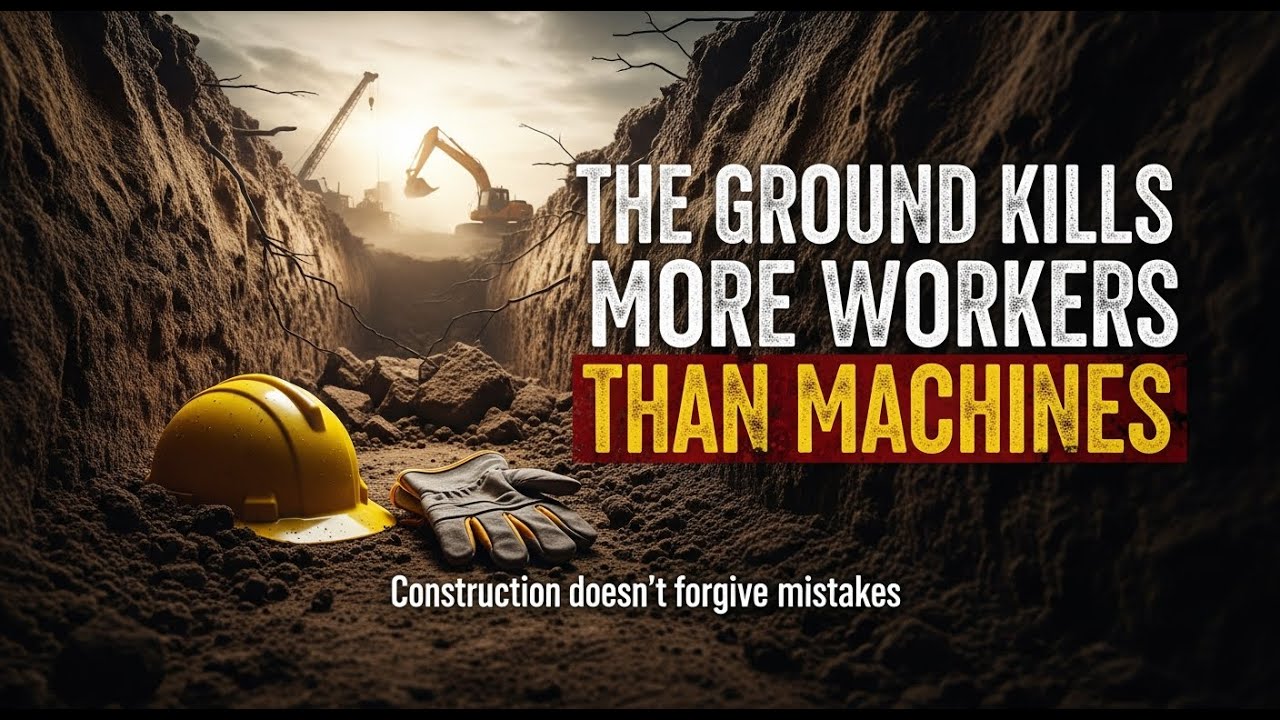
Ground stability, soil behavior, cave-in mechanics, load transfer, and collapse dynamics — examining why excavation is often described as the “silent killer” of construction.
Electrical Safety
Energy transfer, grounding systems, GFCIs, equipment bonding, overhead line exposure, and the relationship between electricity, moisture, and human contact.
Fall Prevention and Protection
Guardrails, safety nets, PFAS systems, fall dynamics, arrest forces, and suspension trauma as a physiological hazard — not just a rescue problem.
Cranes and Derricks
Mechanical systems, moving loads, inspection integrity, clearance zones, and power-line interaction as systemic risk factors.
Welding and Hot Work
Thermal energy, ignition sources, compressed gas storage, atmospheric hazards, toxic fumes, and ventilation failures.
Tools, Equipment, and Housekeeping
Kinetic energy, pressure systems, abrasive machinery, compressed air hazards, and how poor housekeeping amplifies systemic risk.
Professional Safety Perspective
This episode reframes construction safety as risk architecture:
Not compliance management —
but force management.
Not checklist enforcement —
but system stability.
Not rule memorization —
but interaction awareness.
Construction safety fails not because rules are missing,
but because forces are misunderstood and systems change faster than controls.
This episode is designed for:
CSP candidates
Safety engineers
HSE professionals
Construction safety managers
Site supervisors
Risk managers
Safety trainers
Occupational health practitioners
Exam-focused learners
Professional development listeners
If you are preparing for the CSP exam, this episode supports:
Blueprint-level thinking
Applied risk analysis
Systems-based hazard evaluation
Professional safety reasoning
Real-world risk interpretation
Dynamic hazard modeling
QHSE Talks is built for professionals who want more than definitions —
who want to understand how safety systems actually function in real environments.
Because safety is not static.
Risk is not fixed.
And construction is not predictable.
#ConstructionSafety
#CSPExam
#SafetyEngineering
#HSEProfessionals
#QHSETalks

Информация по комментариям в разработке