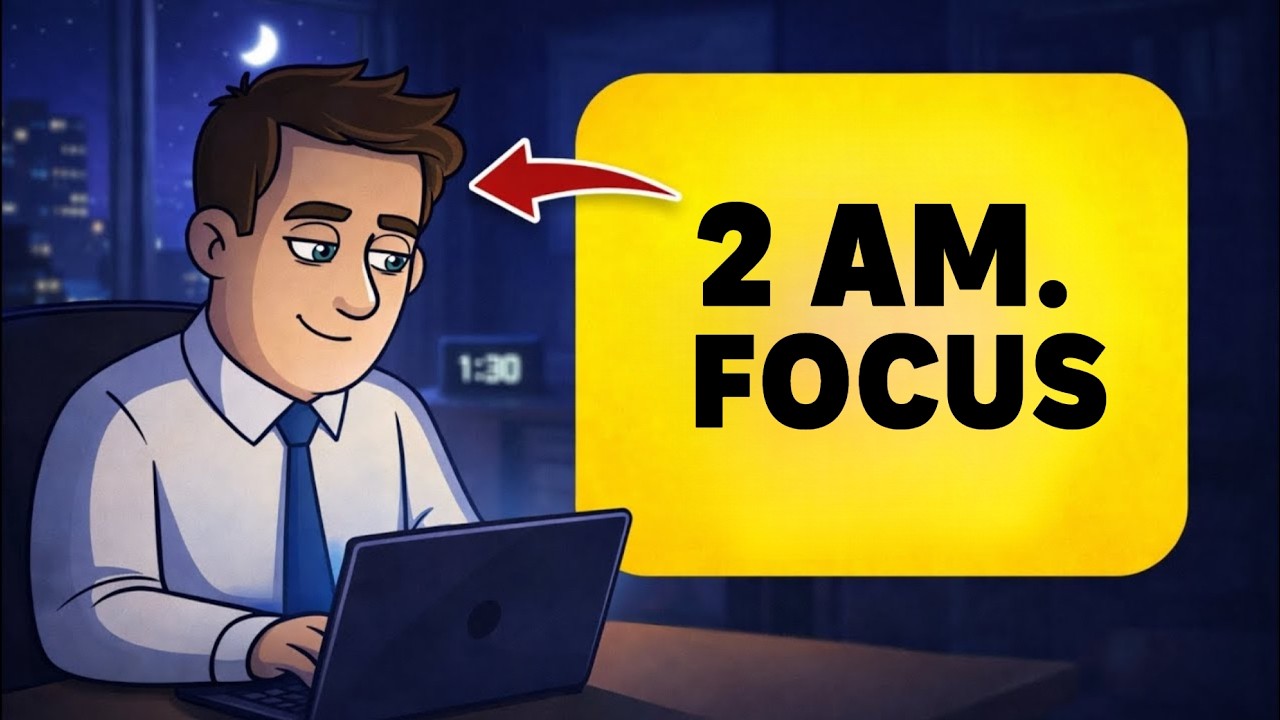
You know that feeling when everyone tells you to wake up at 5 AM to be successful, and your brain just laughs? Because your best work happens when the rest of the world is asleep, the office is empty, and the only light in the room is your screen glowing at 2 AM. You're not lazy. You're not undisciplined. And you're definitely not broken. Your brain is just wired to a different clock—one that society decided wasn't acceptable.
In this video, we dive deep into topics such as:
Chronotype is genetic, not a choice: The PER3 gene and how 10-20% of the population are natural night owls
How your body produces melatonin later, cortisol peaks later, and temperature rhythm follows a delayed pattern
Why forcing yourself to wake at 7 AM is like asking a left-handed person to use their right hand
The truth about daytime: Constant notifications, meetings, emails—your brain can't enter deep work
University of Chicago research: Night owls show greater cognitive performance during evening hours on sustained attention tasks
Why nighttime reduces external stimulation (noise, clutter, social demands) and allows inward focus
The inhibition hypothesis: Lower cognitive filtering at night = better creative thinking and unconventional solutions
Why many artists, writers, programmers work at night—their brain becomes a supercomputer
Social jet lag: Forcing night owls onto morning schedules causes chronic fatigue and decreased well-being
The 9-to-5 schedule was invented for Industrial Revolution factory workers, not knowledge work
Why morning people perform productivity (5 AM selfies, sunrise photos) while you get actual results
How working at your natural peak time is actual discipline, not laziness
Why society mistakes early rising for virtue when it's just an arbitrary construct
The system is broken, not you: Peak performance is when YOUR brain works, not when society says
If you've ever been told to "just become a morning person," or felt judged for sleeping late, or wondered why your brain wakes up at 10 PM while everyone else is shutting down—this video explains it with clarity and evidence-based psychology. You're not lazy. You're aligned with your natural rhythm.
👇 Comment below: Team Early Bird Gets the Worm? Or Team Night Owl Gets the Work Done?
👍 Like & Subscribe ➡️ @9to5Psych for more workplace psychology, chronotype science, and circadian rhythm insights.
🔔 Hit the bell so you never miss a video on work psychology, sleep science, and productivity optimization.
Check out the full playlist on workplace and behavioral psychology here:
🎬 • Psychology of Work Habits
References:
Chronotype genetics and PER3 gene: Archer, S. N., et al. (2003). "A length polymorphism in the circadian clock gene Per3 is linked to delayed sleep phase syndrome and extreme diurnal preference." Sleep, 26(4), 413-415.
Night owl prevalence and circadian biology: Roenneberg, T., et al. (2007). "Epidemiology of the human circadian clock." Sleep Medicine Reviews, 11(6), 429-438.
Cognitive performance and chronotype: Goldstein, D., et al. (2007). "The role of time of day and chronotype in cognitive performance." Journal of Biological Rhythms, 22(4), 334-345.
Creative thinking in night owls: Wieth, M. B., & Zacks, R. T. (2011). "Time of day effects on problem solving: When the non-optimal is optimal." Thinking & Reasoning, 17(4), 387-401.
Social jet lag and health: Wittmann, M., et al. (2006). "Social jetlag: Misalignment of biological and social time." Chronobiology International, 23(1-2), 497-509.
Inhibition hypothesis and creativity: Hasher, L., Zacks, R. T., & May, C. P. (1999). "Inhibitory control, circadian arousal, and age." In Attention and Performance XVII, 653-675.
9-to-5 schedule history and knowledge work: Newport, C. (2016). "Deep Work: Rules for Focused Success in a Distracted World." Grand Central Publishing.
Melatonin and cortisol patterns in chronotypes: Bailey, S. L., & Heitkemper, M. M. (2001). "Circadian rhythmicity of cortisol and body temperature: Morningness-eveningness effects." Chronobiology International, 18(2), 249-261.
Disclaimer: This channel is created for educational and informational purposes only. It is not intended to replace professional medical advice. If you're experiencing chronic sleep problems, extreme difficulty with daytime functioning, or health issues related to your sleep schedule, please consult a sleep specialist or medical professional.
#WorkplacePsychology













Информация по комментариям в разработке