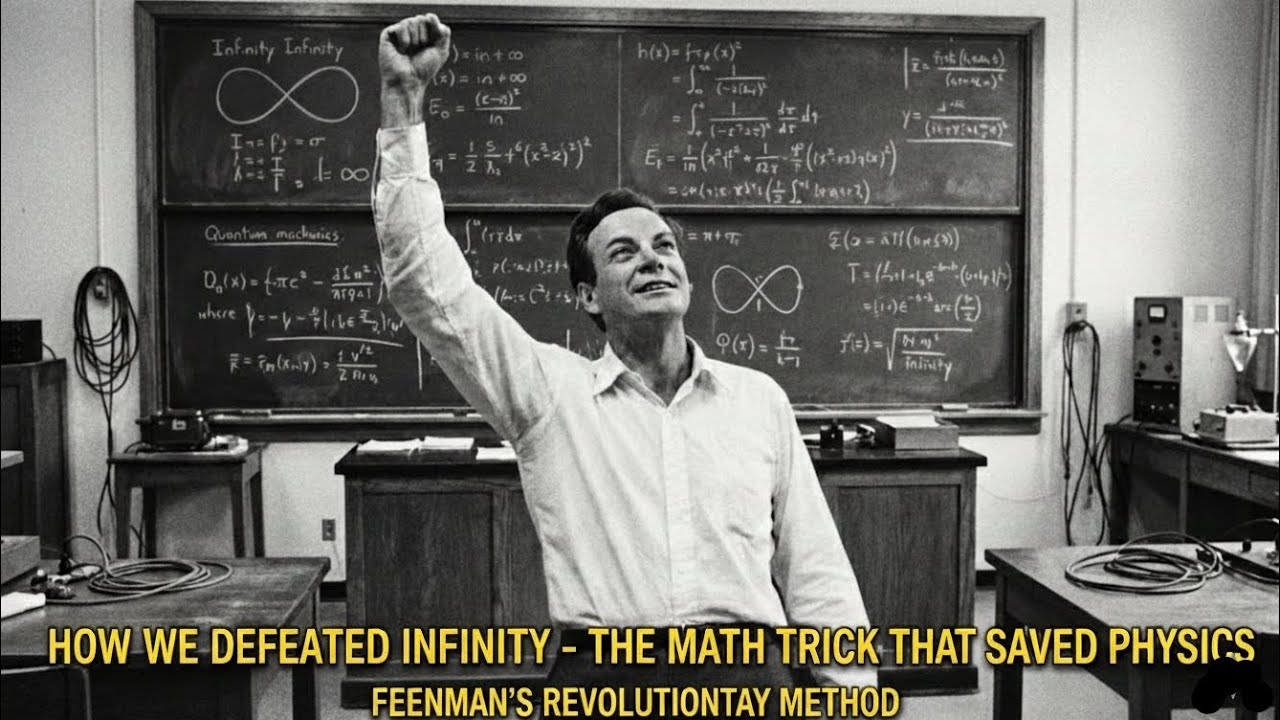
How We Defeated Infinity - The Math Trick That Saved Physics - Feynman
This video is inspired by Richard Feynman's work on quantum electrodynamics and renormalization, presented from his perspective.
Quantum physics had a problem. A catastrophic problem. Every calculation gave infinity. Not "very large." Infinity. Meaningless. Useless.
The magnetic moment of an electron? Infinity. Electron scattering? Infinity. Everything beyond the simplest process? Infinity.
Some physicists wanted to abandon quantum field theory. Start over. New physics. New principles.
But we didn't give up. We developed renormalization. And we defeated infinity.
In this video:
→ Why quantum calculations give infinity (virtual particles, loop diagrams)
→ The 1940s crisis that nearly killed quantum field theory
→ What a cutoff is and why it's not enough
→ How renormalization actually works (bare vs renormalized quantities)
→ Why "infinity minus infinity" isn't cheating
→ The 12 decimal place proof (electron magnetic moment)
→ Why some theories are non-renormalizable (and what that means)
→ The renormalization group and scale dependence
→ How this won 3 Nobel Prizes (Feynman, Schwinger, Tomonaga 1965; Wilson 1982; Gross, Wilczek, Politzer 2004)
Here's how it works: Virtual particles create infinite contributions. But you also have counter-terms. Infinite corrections to your theory. Infinity from loops. Infinity from counter-terms. Opposite signs. They cancel.
Infinity minus infinity equals... a finite number. A measurable number. A number that matches experiment to twelve decimal places.
The electron's magnetic moment. Predicted: 1.00115965218073. Measured: 1.00115965218091. Agreement to 12 decimal places. That's like measuring LA to NY within a hair's width.
Is this cheating? No. Here's why: You measure one thing. Fix your parameters. Then you predict everything else. No adjustments. No free parameters. Pure prediction. And it works. To absurd precision.
Renormalization isn't about removing infinities. It's about understanding that "bare" quantities (bare mass, bare charge) aren't physical. You never measure them. You always measure renormalized quantities. The effective values including all virtual particle effects.
This is how nature works. At every scale, you have an effective description. High-energy details are absorbed into your parameters. This is the renormalization group. How physics changes with scale.
And it's everywhere. Not just particle physics. Statistical mechanics. Condensed matter. Cosmology. It's a universal principle.
The content is inspired by Feynman's work on QED and presented for educational purposes.
⚠️ DISCLAIMER:
This channel has no official affiliation with Richard Feynman or his estate. The content is inspired by his work on quantum electrodynamics and renormalization, created solely for educational purposes. This is not Richard Feynman's voice. No impersonation is intended. Our goal is to respectfully share insights from physics in an inspiring way.
→ All content is carefully researched original educational material based on extensive study of quantum field theory, renormalization theory, and the history of QED. Created independently for science education and inspiring curiosity.
→ Our mission is to educate a NEW GENERATION about the profound ideas in modern physics. This is our way of keeping scientific understanding alive.
🔔 Subscribe for deep physics insights
👍 Like if infinity minus infinity blew your mind
💬 Comment: Did you think renormalization was cheating?
Richard Feynman, renormalization, quantum field theory, QED, infinity problem, loop diagrams, virtual particles, counter-terms, bare mass, renormalized charge, electron magnetic moment, 12 decimal places, Ken Wilson, renormalization group, Nobel Prize physics, Schwinger Tomonaga, asymptotic freedom, quantum chromodynamics, effective field theory, scale dependence, physics explained, theoretical physics, Feynman diagrams, quantum electrodynamics

Информация по комментариям в разработке