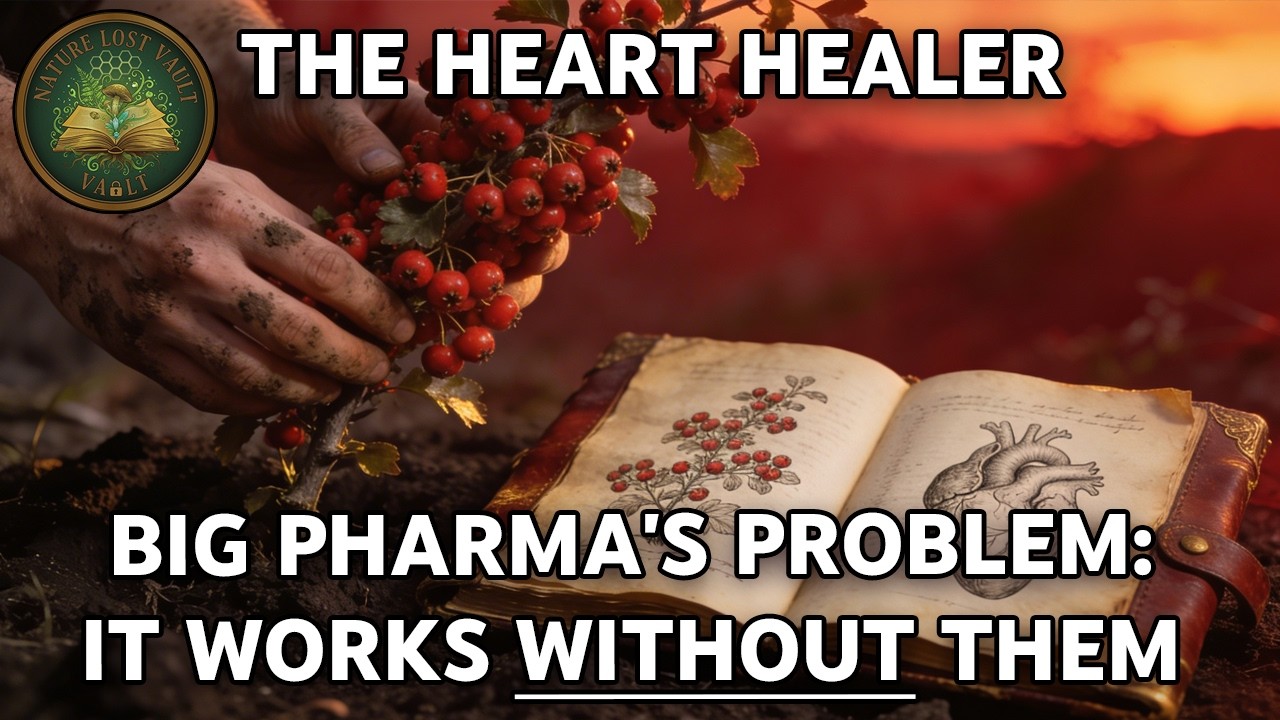
Heals Hearts Without Toxicity: Why Did Scientists Design a Study to Make It Fail?
For two thousand years, hawthorn strengthened hearts across civilizations. Greek physicians in the first century AD recorded its cardiovascular power. By the 1890s, it had entered American clinical practice with documented success. Then it vanished from medical textbooks in the 1930s—not because it failed, but because the pharmaceutical industry was building an empire on patentable molecules.
In 2009, researchers finally tested hawthorn against modern heart drugs. The study was designed to add hawthorn on top of five other medications patients were already taking. When early complications appeared—likely from drug interactions, the conclusion was clear: hawthorn doesn't work. That single study buried decades of successful European use and centuries of traditional knowledge.
⚠️ This video is for educational and historical purposes only. It does not constitute medical advice. Do not stop prescription heart medications without physician guidance. Hawthorn should not be used as a replacement for emergency cardiac care or treatment of acute heart conditions. Always consult qualified healthcare providers before using herbal remedies, especially if you have diagnosed heart disease or take prescription medications.
📚 Sources:
Zick SM, Gillespie B, Aaronson KD. "Hawthorn Extract Randomized Blinded Chronic Heart Failure (HERB CHF) Trial." European Journal of Heart Failure, 2009; 11(10):990-999.
Zick SM, Gillespie B, Aaronson KD. "The Effect of Crataegus oxycantha Special Extract WS 1442 on Clinical Progression in Patients with Mild to Moderate Symptoms of Heart Failure." European Journal of Heart Failure, 2008; 10:587-593.
Pittler MH, Schmidt K, Ernst E. "Hawthorn Extract for Treating Chronic Heart Failure." Cochrane Database of Systematic Reviews, 2008; (1):CD005312.
Holubarsch CJF, Colucci WS, et al. "Survival and Prognosis: Investigation of Crataegus Extract WS 1442 in CHF (SPICE)." European Journal of Heart Failure, 2008; 10(12):1255-1263.
Chang Q, Zuo Z, Harrison F, Chow MSS. "Hawthorn." Journal of Clinical Pharmacology, 2002; 42:605-612.
Tauchert M. "Efficacy and Safety of Crataegus Extract WS 1442 in Comparison with Placebo in Patients with Chronic Stable New York Heart Association Class-III Heart Failure." American Heart Journal, 2002; 143(5):910-915.
Walker AF, Marakis G, Simpson E, et al. "Hypotensive Effects of Hawthorn for Patients with Diabetes Taking Prescription Drugs: A Randomised Controlled Trial." British Journal of General Practice, 2006; 56:437-443.
Tassell MC, Kingston R, Gilroy D, Lehane M, Furey A. "Hawthorn (Crataegus spp.) in the Treatment of Cardiovascular Disease." Pharmacognosy Reviews, 2010; 4(7):32-41.
Hobbs C, Foster S. "Hawthorn: A Literature Review." HerbalGram, 1994; 32:33-48.
Edwards JE, Brown PN, Talent N, Dickinson TA, Shipley PR. "A Review of the Chemistry of the Genus Crataegus." Phytochemistry, 2012; 79:5-26.
American Chemical Society. "Emergence of Pharmaceutical Science and Industry: 1870-1930" and "The Pharmaceutical Golden Era: 1930-60." Chemical & Engineering News, 2005; 83(25).
Petrovska BB. "Historical Review of Medicinal Plants' Usage." Pharmacognosy Reviews, 2012; 6(11):1-5.
#heartdisease #herbalmedicine #naturalremedies #cardiovascularhealth #plantmedicine #medicinalplants #traditionalknowledge #ancientwisdom

Информация по комментариям в разработке