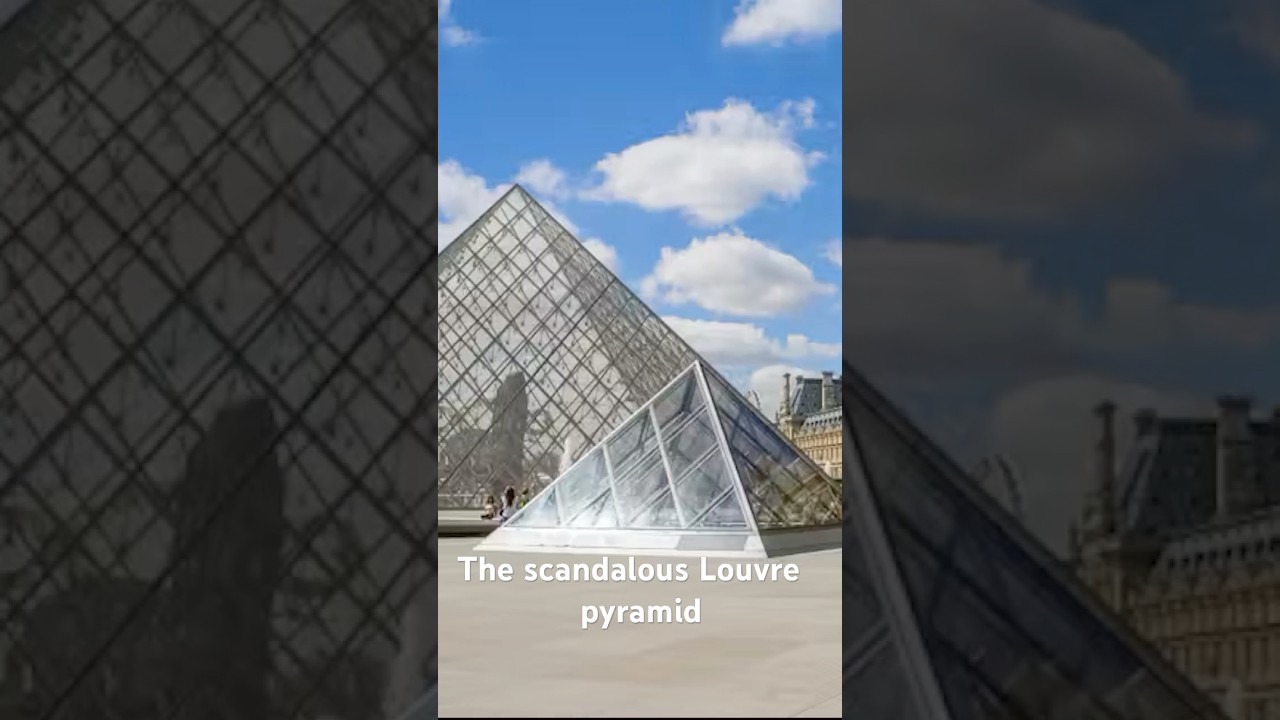
Paris hadn't seen such heated debate since the "useless and monstrous" Eiffel Tower. The pyramid was compared to a "wart on a noble face," fast food and Disneyland. In 1983, a project called the "Grand Louvre" was launched, envisioning a comprehensive reconstruction of the complex. The Louvre dates back to 1793, when the Convention decreed the creation of a National Museum in the palace. French kings eagerly displayed their collections to the public. During the Revolution and the Napoleonic Wars, the Louvre collection rapidly expanded and became the most famous museum in the world. The reconstruction plan envisioned 2 major stages. 1- the transfer of the Ministry of Finance to a new building. 2-the creation of an underground vestibule that would unite all 3 parts of the museum, as well as the construction of a futuristic glass pyramid over the entrance. A scandal erupted immediately after the project was unveiled. The French were choked with indignation: in the very heart of Paris, near the residence of the French monarchs, they were planning to erect "some kind of glass thing," "a new trinket!" The director of the Louvre resigned in protest. And when they learned that the architect was "not local" but an American of Chinese descent, they began talking about "an outrage on French history.Amid the barrage of criticism, the voice of the museum's new director was barely audible, trying to convince them that the Louvre had long since become an old-fashioned gallery, out of touch with the spirit of the times and that its capabilities were at their limits! A wall of backs, a crush of people in front of every painting, it was easy to get lost.In 1985 bulldozers, excavators and concrete mixers moved toward the Louvre. Parisians watched in horror as historic paving stones were torn up and centuries-old trees were uprooted. As the pit for the future pyramid deepened, a public outcry grew. Newspapers continued to heap curses and experts were outraged. Architect Pei graduated from a prestigious school in Shanghai and having received a student visa, emigrated to the US in 1935. There he enrolled in architecture school, but quickly became disillusioned with traditional architectural education: he raved about modernism. Pei transferred to the Institute of Technology, where he began studying design. His engineering background later proved invaluable in his work..The young specialist gained his first experience working for US construction firms and then he opened his own firm. Among his early works was the Luce Memorial Chapel. When John F. Kennedy was assassinated in 1963, it was decided to perpetuate his memory by creating a library-museum named after him. For this project Pei received the American Institute of Architects' Gold Medal. When Pei was invited to undertake the grand renovation of the Louvre, he initially declined, but then changed his mind. The vast space of the Napoleonic Court allows for vast underground spaces for public reception without encroaching on or damaging the historic building. Pei asked for time to study French history. He explored the Louvre,then unexpectedly traveled to North Africa, from where he returned with a proposal to build a glass pyramid over the entrance to the museum's underground vestibule—a miniature replica of the Great Pyramid of Giza. The reconstruction lasted 5 years. Throughout this time, the pyramid continued to be criticized and ridiculed.
In 1989, the extravagant structure was officially opened. Contrary to the fears of Parisians, the new "face of the Louvre" not only didn’t spoil the beauty of the ancient complex, but on the contrary, enhanced its magnificence. What was the secret? Most likely, the glass. Pei believed that architecture should reflect the beauty of the world and began using transparent atriums. Regular glass has a greenish tint, but he strove to achieve a colorless glass that wouldn’t yellow with sun or time. It was reproduced using an ancient recipe. This resulted in perfectly transparent facets. The Great Pyramid is not alone – it is surrounded by triangular pools with fountains and 3 "little sisters" that illuminate the galleries leading to the museum's halls. In 1993 he added an inverted pyramid to the central one, hanging from the ceiling and placed another, smaller one beneath its apex, like a reflection. This structure appears in Dan Brown's famous novel “The Da Vinci Code." Supposedly, the Holy Grail is kept beneath it..The reconstruction, which ended with much fighting, resolved many of the Louvre's problems and breathed new life into the historical monument. The renovation provided the museum with additional space, making it possible to house an entire city underground! But most importantly, convenient entrances to all 3 parts of the museum were created, making navigation easy and clear. The controversial pyramid has become an iconic Parisian landmark. And now it is perceived as a symbol of Paris, just like the Louvre itself or the Eiffel Tower.

Информация по комментариям в разработке