Michał Józefowicz - Sonata Skrzypcowa D-moll
Published in 1902
Violin: Wojciech Szlachcikowski
Piano: Bogumiła Weretka-Bajdor
0:00 - I: Con molto passione
9:20 - II: Andante maestoso e molto espressivo
16:22 - III: Allegro (Krakowiak)
Biography
Michał Józefowicz (1860-1941) was a Polish pianist, choral director, conductor, pedagogue, and a music critic [1]. He was born in Lithuania to a Polish family. His exact birthplace was the Daugirdavos dvaras manor (pictured in the title cards) in the Daugirdai village, which is about 7 km from Ariogala, Lithuania [2].
Józefowicz studied music at the St. Petersburg conservatory, where he befriended Emil Młynarski [1]. He and Młynarski travelled to Liepāja, Latvia for the first time in 1891. A few years later in 1895, Józefowicz would move there more permanently. Due to his health, he needed to be close to a health resort on the Baltic [1]. While he was there, he introduced the locals to Polish classical music. He gave the local orchestra director sheet music and pointers for understanding the character of Polish music.
During World War I, he spent most of his time in Germany [1]. After Poland gained independence, he settled in Vilnius, where he worked as a clerk for the Bank of Cooperative Societies and lectured at the conservatory [3]. He was killed during the 2nd World War by a bomb that exploded where he was living [2].
While he was in Liepāja, he quickly became a valuable member of the musical society there. He taught piano performance and music theory from his apartment. What would bring him fame and recognition, however, were his compositions [1]. This work, the Violin Sonata in D-Minor, won an award at the Konstanty Lubomirski competition. In addition, it received glowing reviews from Latvia and Poland [3]. One reviewer praised the "freshness" of its ideas, its form, and its national character [4]. Józefowicz's achievements won him recognition and respect in Latvia, Poland, and Lithuania as a talented musician who could teach, compose, conduct, and even review music with tremendous fluency.
Analysis
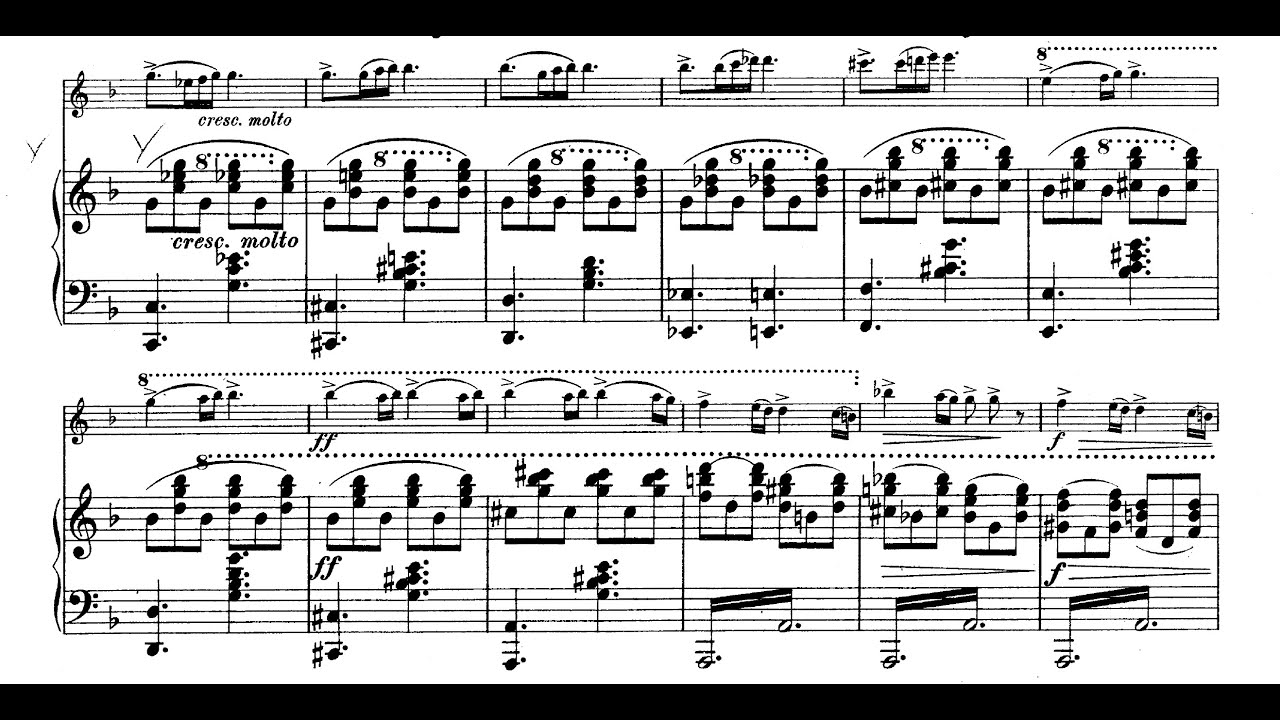
I: Con molto passione - The first movement is in sonata form. Maryla Renat indicates that the themes in this movement are "symmetrically constructed and undergo evolutionary development" [3]. The first theme is very stately but it conveys a kind of restlessness thanks to the dotted rhythm. The second theme contrasts the first theme's rhythmic motion with a more consistent and elegiac character [3]. Both of these themes are recapitulated later on as is standard in sonata form. The ending gives the impression that the elegiac theme wins out at the movement's close, which transitions smoothly into the second movement.
II: Andante maestoso e molto espressivo - The form of this movement is standard ABA, but the treatment of the theme and the texture suggests a continuation of the elegaic atmosphere of the 2nd theme in the 1st movement [3]. Renat adds that the soundscape of this movement has "a wavy character" and points out the melodic focus along with the movement's stateliness and its "gentle chromaticism" [3]. She also points out the textual complexity of the piano part throughout this movement and in the sonata as a whole [3]. The atmosphere is preserved throughout the movement, which ends quietly.
III: Allegro (Krakowiak) - This movement is atypical because the Krakowiak plays out in sonata form, which is exceedingly rare [3]. In terms of the soundscape, the krakowiak is an almost jarring departure from the material in the previous movements. The energy that pervades the krakowiak jolts one out of the serious, mournful state left by the previous movement and invites one into a sunlit Cracovian day full of colorful figures and without a care in the world. The second theme, however threatens to break one out of the bliss, but the energetic first theme always interrupts to stop it.
Bibliography
[1] M. Gluszko. Polacy w życiu artystycznym Lipawy Część I. Polacy w Lipawie. polonika.lv. http://polonika.lv/polacy-w-zyciu-art..., 2015.
[2] Anon. Michał Józefowicz h. Leliwa. Geni.com. https://www.geni.com/people/Micha%C5%..., 2021.
[3] M. Renat. "Elementy rodzimego folkloru w polskich sonatach skrzypcowych XX wieku", Edukacja Muzyczna, no. 10, p. 59-92. 2015.
[4] W. Poźniak, Muzyka kameralna i skrzypcowa, [w:] Z dziejów polskiej kultury muzycznej, t. 2: Od Oświecenia do Młodej Polski, PWM, Kraków 1966, s. 501.
Original Video: • II Międzynarodowa Sesja Artystyczno-Naukow...
IMSLP: https://imslp.org/wiki/Category:J%C3%...

Информация по комментариям в разработке