📖 The Nature’s Lost Vault Book Is Now Available. Learn more: https://naturelostvault.com/book.html
⚠️ This documentary is for educational and historical purposes only and does not constitute medical advice.
The Compound in 2,800 Studies That Your Doctor Never Mentioned. Why Did They Erase It?
For thousands of years, physicians on opposite sides of the planet, in China and in India, documented the same plant, the same brilliant yellow root, and the same result: the wasting patient who grew thin despite eating, whose thirst no water could satisfy, restored to health. Two civilizations. Two independent archives. One molecule.
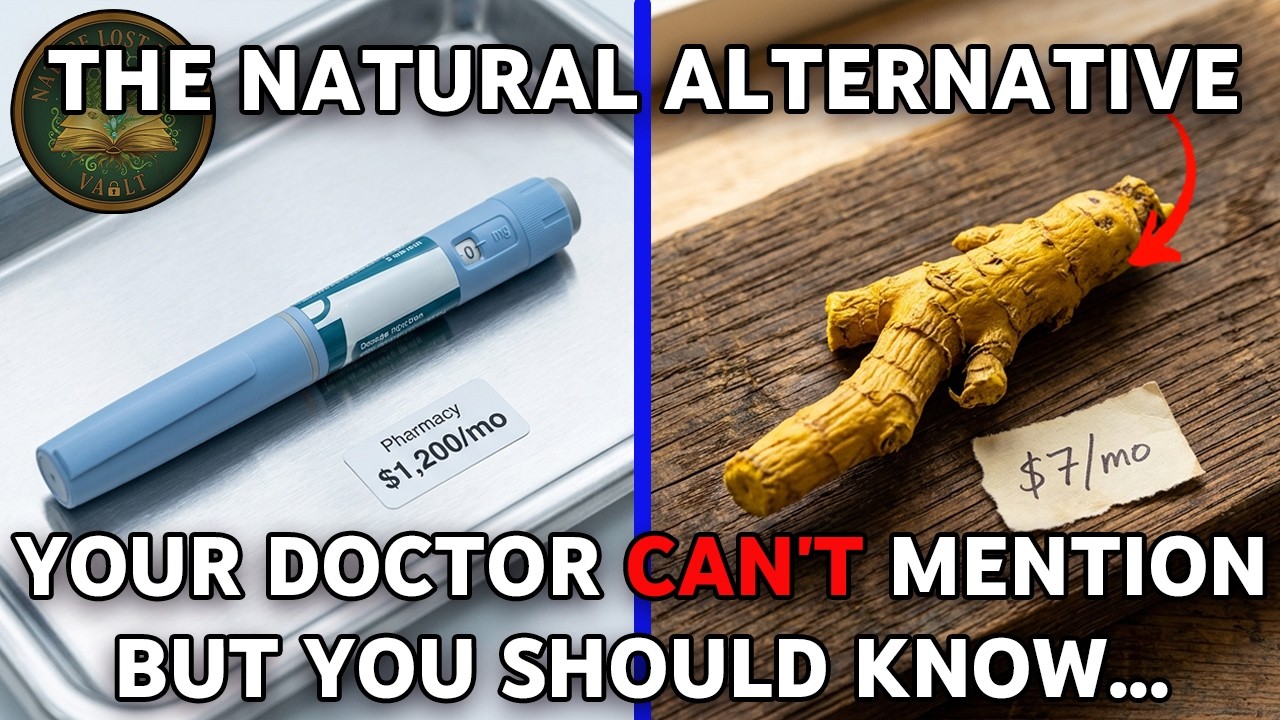
Today, 537 million people live with type 2 diabetes. The flagship pharmaceutical treatment costs up to $1,200 a month. The yellow root costs $7. And over 2,800 peer-reviewed studies have confirmed what ancient physicians already knew.
In 2008, researchers published a direct clinical comparison: berberine versus metformin, the most prescribed diabetes drug on Earth. The results were statistically equivalent across every measured marker — fasting blood sugar, post-meal glucose, and HbA1c. A subsequent meta-analysis of 27 randomized clinical trials confirmed it. Then came the comparison no pharmaceutical company wanted made public, berberine and GLP-1 elevation, the same downstream mechanism as Ozempic, at a fraction of the cost. It accumulated over 100 million views online.
Pharmaceutical patent attorneys noticed. Dozens of applications followed. All rejected. The molecule belonged to humanity. So the regulatory machinery moved instead.
📚 Sources:
Yin, J., et al. "Efficacy of Berberine in Patients with Type 2 Diabetes Mellitus." Metabolism, 57.5 (2008): 712–717.
Zhang, H., et al. "Berberine Lowers Blood Glucose in Type 2 Diabetes Mellitus Patients Through Increasing Insulin Receptor Expression." Metabolism, 59.2 (2010): 285–292.
Dong, H., et al. "Berberine in the Treatment of Type 2 Diabetes Mellitus: A Systemic Review and Meta-Analysis." Evidence-Based Complementary and Alternative Medicine (2012).
Lan, J., et al. "Meta-Analysis of the Effect and Safety of Berberine in the Treatment of Type 2 Diabetes Mellitus, Hyperlipemia and Hypertension." Journal of Ethnopharmacology, 161 (2015): 69–81.
Xia, X., et al. "Berberine Improves Glucose Metabolism in Diabetic Rats by Inhibition of Hepatic Gluconeogenesis." PLOS ONE, 6.2 (2011): e16556.
Liu, L., et al. "Berberine Suppresses Intestinal Disaccharidases with Beneficial Metabolic Effects in Diabetic States." FEBS Letters, 582.28 (2008): 4085–4091.
Lee, Y.S., et al. "Berberine, a Natural Plant Product, Activates AMP-Activated Protein Kinase with Beneficial Metabolic Effects in Diabetic and Insulin-Resistant States." Diabetes, 55.8 (2006): 2256–2264.
Affuso, F., et al. "Effects of a Nutraceutical Combination (Berberine, Red Yeast Rice and Policosanols) on Lipid Levels and Endothelial Function." Nutrition, Metabolism and Cardiovascular Diseases, 20.9 (2010): 656–661.
Shennong Bencao Jing [Divine Farmer's Materia Medica]. Eastern Han dynasty, China, circa 200 AD.
Sushruta Samhita. Ancient Ayurvedic medical compendium, India, circa 6th century BCE.
#ForgottenMedicine #BloodSugar #AncientHealing #berberine #foraging








Информация по комментариям в разработке