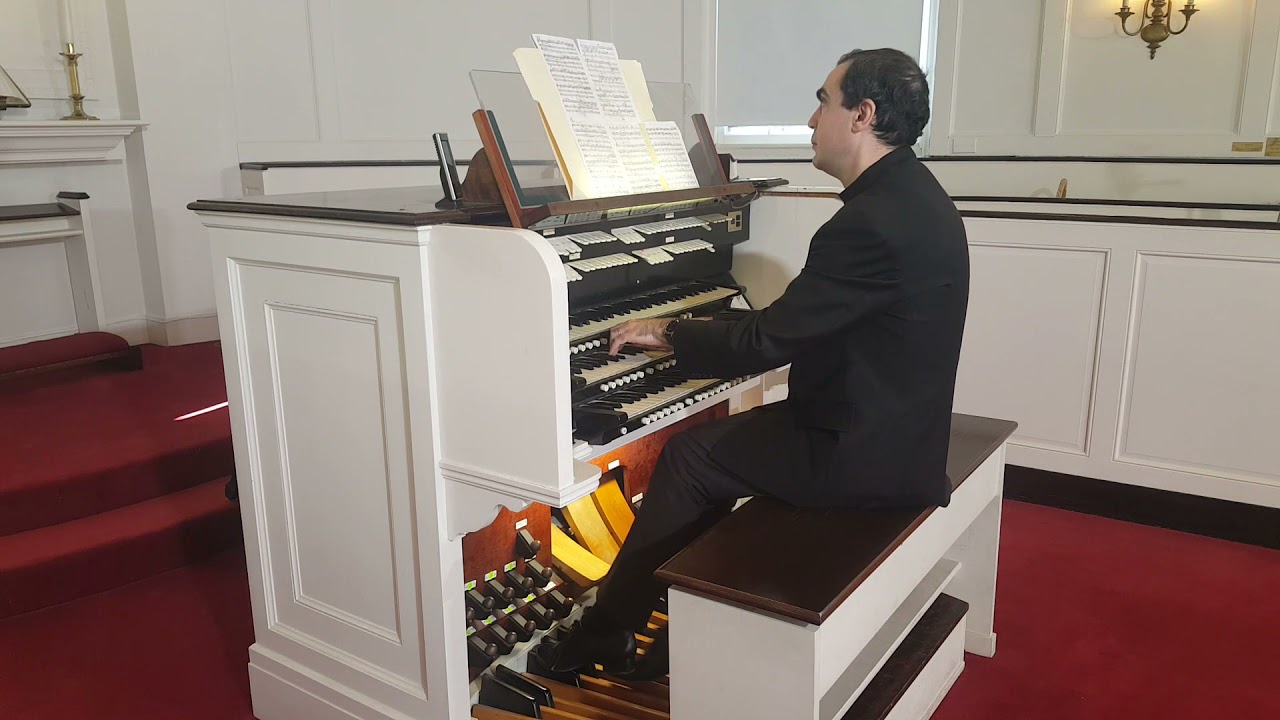
Jean Langlais: Les Rameaux (from 3 Poèmes Évangeliques) - Recorded at the Scarsdale Congregational Church, NY (March 2021)
#JeanLanglais #LesRameaux #PalmSunday
The third and final section of the Poèmes évangéliques departs entirely from the two
preceding ones. While they were in short contrasting sections, this one adopts a totally
unified construction and ambiance, concentrating on a central theme: JOY.
Jean Langlais explained:
It’s the only episode in Christ’s life that was joyful and triumphant, and I just had
to use it to conclude this triptych, evoking the rare happy moments in Christ’s life.
Therefore I captioned “Les Rameaux” with these words: “Entry of Jesus into
Jerusalem,” and I added in the score: Jesus, in all his majesty, returns to Jerusalem,
where the enthusiastic crowds welcomed him, crying “Hosanna to the son of
David! Blessed is he who comes in the name of the Lord, the king of Israel!
Hosanna in the highest.”15
The genre chosen here is that of a big toccata based on the Palm
Sunday antiphon, “Hosanna filio David.” The entries of the voices
follow the classic pattern of the scholastic fugue (fugue d’école), with an
exposition of the principal motive in the order of soprano-alto-tenorbass in short note values, while the same theme makes a majestic entry,
fortissimo, in the pedals in long notes. This was an exercise that was
much practiced in Marcel Dupré’s improvisation class, and
undoubtedly Langlais remembered it at just this moment. Then the
composer uses multiple techniques: superimposition of motives, strettos
more or less tight, modulations, movement of the theme from one voice
to another, making contrapuntal fireworks that give way to a powerful
coda with sixteenth-note octaves between the manuals and pedals, a
style frequently used by French improvisers since Widor. It concludes
over a long pedal tone in C major with the ostinato presence of F-sharp
(a tritone), once again one of the signatures dear to Messiaen.
As much as one could label his first works (Prelude and Fugue, Six Preludes) as youthful
works, or school assignments, here in the Poèmes évangéliques we can equally see the
composer demonstrating a masterful personal style, technique, and aesthetic. Jean Langlais,
though influenced by Messiaen, has found his language; when you hear this music, you say,
“That’s by Langlais.”
Having perfectly assimilated the characteristics of the composers who preceded him, he
had already chosen his path, refusing simple tonality as well as atonality, preferring modality,
Gregorian or not, which would become his favored language, often accompanied by chromaticism, a marvelous expressive tool in his understanding of it. Further, his
predilections were for religious music, especially that which was Marian inspired, and the
powerful heritage of his childhood in La Fontenelle.
(© 2016 by Marie-Louise Langlais)

Информация по комментариям в разработке