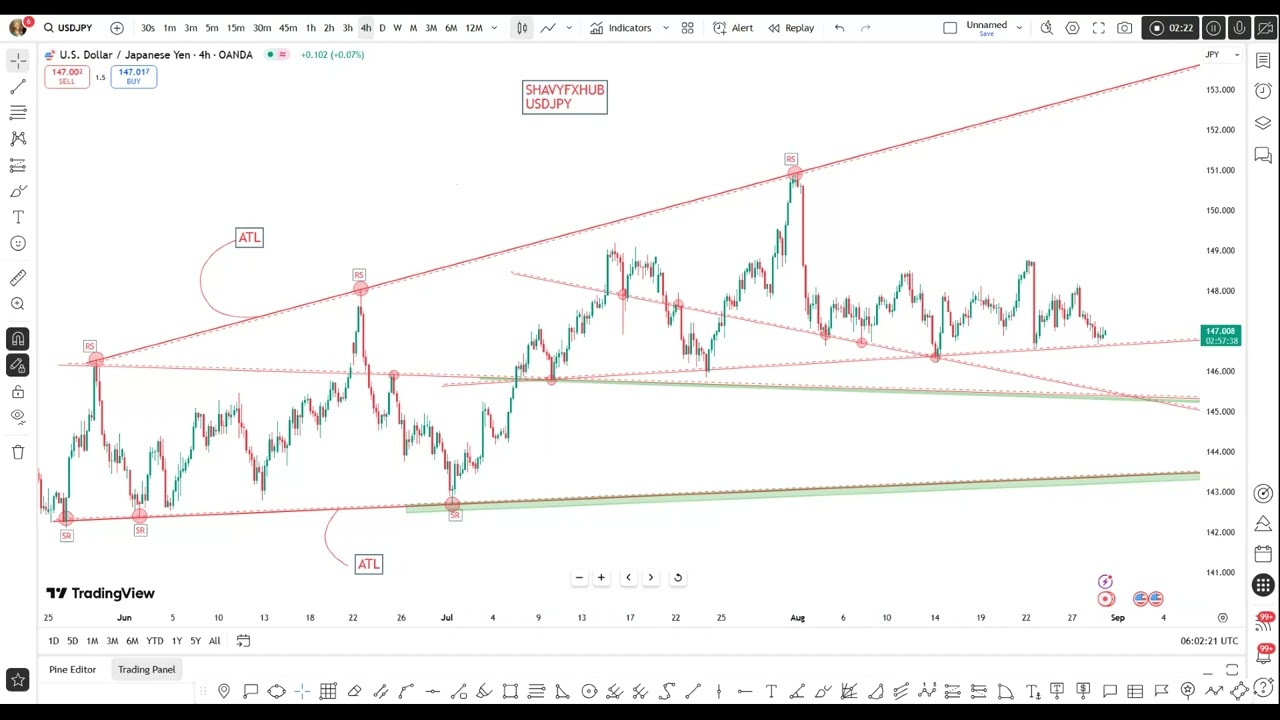
USDJPY recent strength is largely driven by the significant interest rate differential and divergent monetary policies between the US Federal Reserve and the Bank of Japan. The carry trade remains a vital market driver, and future movements will closely track shifts in Fed/BoJ policy signals and economic data.
THE USDJPY trade directional bias wont be complete without the understanding of the US10Y AND JB10Y,the central banks interest rate and the differentials on both the bond yield and interest rate.
Federal fund rate is 4.25-4.5%
united state government 10 year bondyield is 4.213%
BANK OF JAPAN (BOJ RATE 0.5%
JP10Y 1.601%
INTEREST RATE DIFFERENTAL WILL BE 4.25%-0.5%= 3.75%
BOND YIELD 4.213%-1.601%= 2.612%
UNITED STATES ECONOMIC DATA REPORT TODAY AND DIRECTIONAL BIAS.
Fed Interpretation of Economic Data (Greater vs. Lower Than Forecast)
Core PCE Price Index (inflation measure):Personal Consumption Expenditures (PCE) is an economic measure of the total value of goods and services purchased by or for U.S. consumers, including households and nonprofit institutions serving households. It covers spending on durable goods (like vehicles and appliances), nondurable goods (like food and clothing), and services (like healthcare and transportation).
The U.S. Bureau of Economic Analysis (BEA), a department within the U.S. Commerce Department, is responsible for collecting, compiling, and reporting PCE data. They release the data monthly in their Personal Income and Outlays report, providing detailed information on consumer spending and income trends.
Why PCE Matters to the Federal Reserve (Fed):
PCE is critical because it represents about two-thirds of the U.S. Gross Domestic Product (GDP), making it a primary driver of economic activity and growth.
The Fed closely monitors the PCE Price Index (PCEPI) or PCE inflation gauge, which tracks changes in consumer prices. The core PCE (excluding volatile food and energy prices) is the Fed's preferred inflation measure.
By assessing PCE data, the Fed gauges inflationary pressures and consumer spending behavior, which are vital for setting appropriate monetary policy such as adjusting interest rates.
Accurate PCE data helps the Fed balance its dual mandate to promote maximum employment and maintain stable prices, thereby influencing decisions that affect the U.S. economy's health and financial markets.
Greater than forecast: Signals stronger inflationary pressures, increasing the likelihood the Fed will maintain or raise interest rates to contain inflation.
Lower than forecast: Implies inflation is easing, which could encourage the Fed to pause rate hikes or consider rate cuts to support growth.
Goods Trade Balance (deficit):
Worse (larger deficit) than forecast: May indicate weaker domestic production and demand, potentially signaling slower economic growth.
Better (smaller deficit) than forecast: Suggests stronger domestic manufacturing and trade balance, which can support rate stability or tightening.
Personal Income & Spending:
Higher than forecast: Reflects robust consumer demand and income growth, supporting economic expansion and upward pressure on inflation — possibly endorsing higher rates.
Lower than forecast: Suggests softer consumer demand that may reduce inflation risks, supporting a more cautious or dovish Fed stance.
Prelim Wholesale Inventories:
Reflects business stock levels; significant deviations can signal changing demand expectations. Higher inventories might suggest slowing demand.
Chicago PMI (manufacturing activity):
Above forecast: Signifies stronger manufacturing sector, possibly bolstering rate hikes.
Below forecast: Points to cooling manufacturing, possibly tempering Fed tightening plans.
University of Michigan Consumer Sentiment & Inflation Expectations:
Influences Fed’s view on future consumer behavior and inflation psychology. Higher inflation expectations may push for tighter policy.
Core PCE Effect on FOMC Rate Decision
The Core PCE Price Index is the Fed’s preferred inflation gauge, excluding volatile food and energy prices.
The Fed targets roughly 2% inflation; sustained readings above target pressure the Fed to raise or hold interest rates higher to rein in inflation.
Conversely, Core PCE below or moving toward the target may allow the Fed to pause or ease rates
Even small monthly changes (like the forecast of 0.3%) are scrutinized for trend direction to guide future policy.
If Core PCE grows faster than forecast consistently, the Fed is more likely to signal tighter monetary policy in upcoming meetings.
Summary:
The Fed interprets stronger-than-expected inflation, income, and spending data as a green light to maintain or increase rates.
Weaker data than forecasts could tilt the Fed toward a more accommodative stance.
Core PCE, as the inflation benchmark, is the overriding influence on FOMC decisions.
Market participants watch Core PCE closely as a key signal for rate hikes, holds, or cuts.
TRADING IS 100% PROBABILTY
#SHAVYFXHUB #USDJPY

Информация по комментариям в разработке