This is the second instalment of the series (video 2/5).
Here, we are going to look into research about plurilingual pedagogies.
Key points (with references):
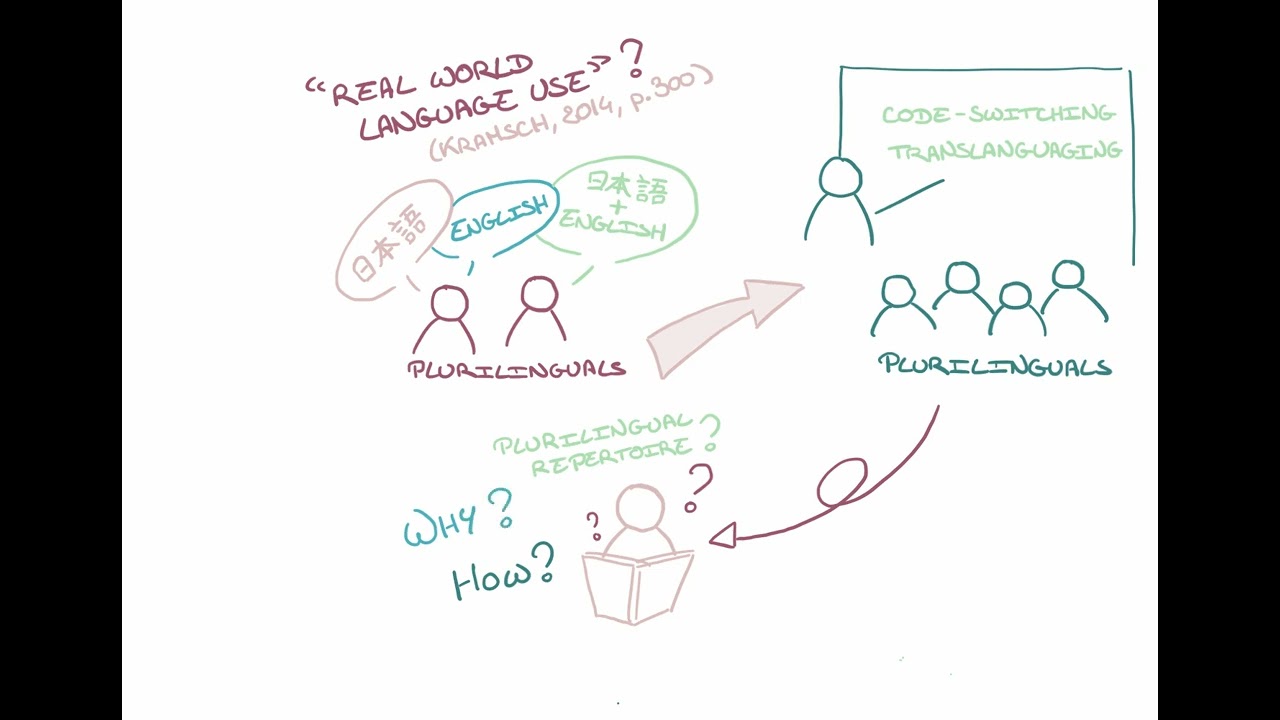
We need “real world language use” in FL classrooms (Kramsch, 2014, p. 300).
Plurilinguals often use a combination of different languages in the same conversation (or even utterance) depending on the situation (Coste et al., 2009; Galante, 2020; Van Herk, 2021).
Code-switching and translanguaging are strategies and linguistic resources often used by plurilinguals and they could be Integrated in the classroom as part of “real world language use” (Kramsch, 2014; Van Herk, 2021).
Language teaching could focus on learners becoming plurilinguals using their plurilingual resources to communicate instead of trying (and often failing) to make them become monolingual in all their languages (Cenoz & Gorter, 2013).
Learners are often unaware that they can use all their languages as learning tools. Even when the teachers allow those practices, students are often at a loss in how to actually do such a thing (Payant & Maatouk, 2022).
Because of their monolingual views of teaching, teachers rarely use their students’ plurilingual repertoire and practices as pedagogical tools (Galante et al., 2019).
Despite multiple languages being an important part of their students’ lives, teachers are sometimes completely unaware that they have plurilingual students in their classrooms (Dressler, 2014).
Teachers valuing their students’ plurilingual competences foster a greatly beneficial learning environment (Galante et al., 2019).
Plurilingual education benefit students by valuing their identities and encouraging them to draw on previous linguistic knowledge from other languages. It is also a link between home and school learning for students speaking another language with family (Dressler, 2014).
References (in APA 7th, or as close as YouTube allows):
Cenoz, J., & Gorter, D. (2013). Towards a plurilingual approach in English language teaching: Softening the boundaries between languages. TESOL Quarterly, 47(3), 591-599.
Coste, D., Moore, D., & Zarate, G. (2009). Plurilingual and pluricultural competence. Strasbourg: Council of Europe, Language Policy Division, 2-44.
Dressler, R. (2014). Exploring linguistic identity in young multilingual learners. TESL Canada Journal, 32(1), 42-52. https://doi.org/10.18806/tesl.v32i1.1198
Galante, A. (2020). Plurilingual and pluricultural competence (PPC) scale: The inseparability of language and culture. International Journal of Multilingualism, 19(4), 477-498. https://doi.org/10.1080/14790718.2020.1753747
Galante, A., Okubo, K., Cole, C., Elkader, N. A., Carozza, N., Wilkinson, C., Wotton, C., & Vasic, J. (2019). Plurilingualism in higher education: A collaborative initiative for the implementation of plurilingual pedagogy in an English for Academic Purposes program at a Canadian university. TESL Canada Journal, 36(1), 121-133. https://doi.org/10.18806/tesl.v36i1.1305
Kramsch, C. (2014). Teaching foreign languages in an era of globalization: An introduction. The Modern Language Journal, 98(1), 296–311. https://doi.org/10.1111/j.1540-4781.2014.1...
Payant, C., & Maatouk, Z. (2022). Collaborative writing in a third language: How writers use and view their plurilingual repertoire during collaborative writing tasks. The Canadian Journal of Applied Linguistics, 25(1), 127-151.
Van Herk, G. (2021). Language in social contexts. In W. O’Grady & J. Archibald (Eds). Contemporary linguistic analysis: An introduction (9th ed.) (pp. 453-484). Pearson.

Информация по комментариям в разработке