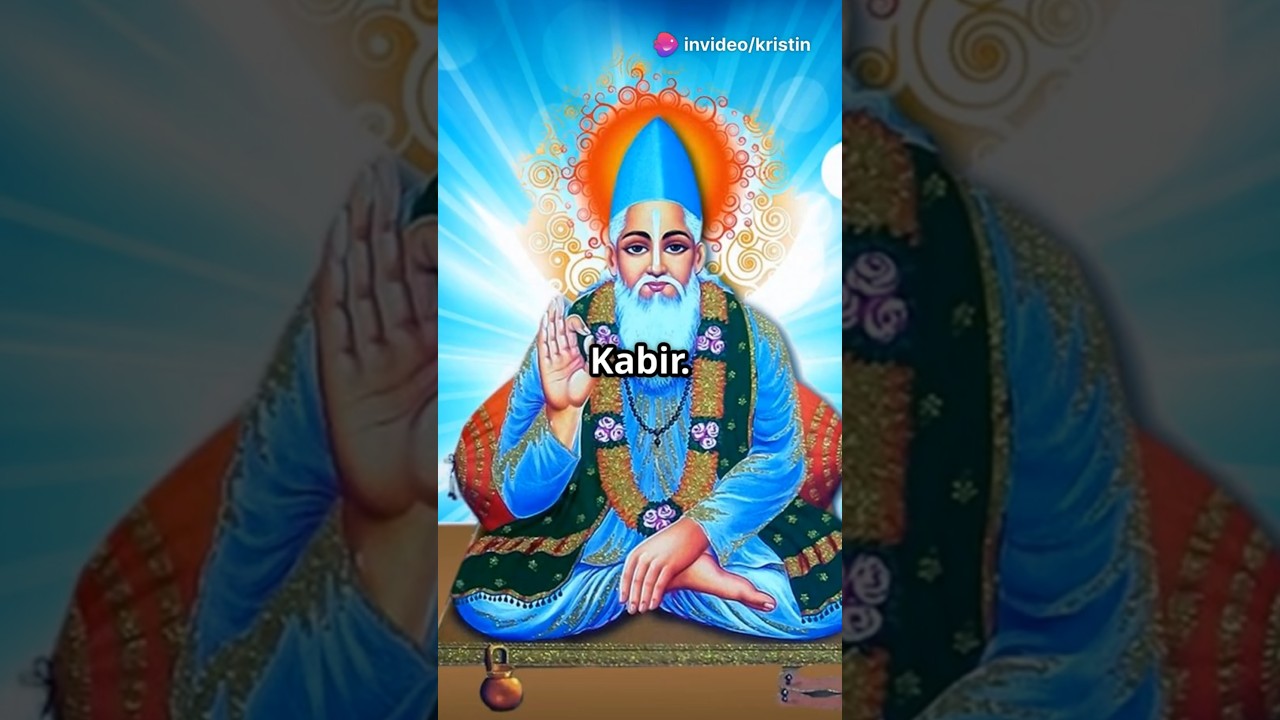
Imagine a time in India, the 15th century, where different religions often stood apart, sometimes even in conflict. In this world lived a simple man, a weaver by profession, whose songs and poems would bridge divides and resonate with truth that went beyond temples, mosques, or churches. His name was Kabir.
Kabir was a mystic poet and a saint whose exact life story is often mixed with legends. He was likely born near Varanasi (Kashi), a holy city, around 1440. What makes Kabir so unique is that he was raised by a Muslim family, but his teachings drew from both Hindu and Islamic traditions, creating a beautiful blend that focused on one universal God.
Kabir didn't go to big schools or religious academies. He was a self-taught philosopher whose wisdom came from deep spiritual experience and observing everyday life. He spoke in the language of the common people, simple Hindi, which made his message easily understood by everyone, not just scholars or priests.
His main idea was that God is one, no matter what name you call Him – whether Allah, Ram, Rahim, or Hari. He believed that true devotion wasn't about rituals, idols, or outward religious displays, but about a pure heart, love, and a direct, personal connection with the Divine. He often criticized the empty rituals and the divisions created by religious leaders.
Kabir's poetry, known as "Kabir Vani" (Kabir's sayings), includes "Dohas" (two-line couplets) and "Sakhis" (witnesses). These poems are filled with deep meaning, yet they use simple images from daily life. For example, he once said, "Bura jo dekhan main chala, bura na milya koi; Jo dil khoja aapna, mujhse bura na koi." This means, "I went to find the bad, but I found no one bad; When I searched my own heart, no one was worse than me." He always pointed back to the self, encouraging introspection and humility.
Another famous saying of his: "Moko kahan dhoondhe re bande, main to tere paas mein; Na main mandir mein, na main masjid mein, na Kaabe Kailas mein." This translates to, "Where do you search for me, O servant, I am right here with you; Neither in temple, nor in mosque, nor in Kaaba or Kailash." He taught that God resides within every individual, not in distant holy places.
Kabir didn't start a new religion in the way we think of it today. Instead, he started a path for people to find truth directly. He taught about the importance of a Guru (spiritual teacher) who could guide one on this path, but stressed that the ultimate journey was internal. His followers are known as the Kabir Panthis.
His teachings promoted equality among all people, regardless of their caste, religion, or social status. He saw humanity as one, united by the presence of the divine within each soul. His message of universal love, simplicity, and inner spirituality continues to inspire millions in India and around the world, reminding us that true faith is about connecting with the divine within and seeing God in everyone.

Информация по комментариям в разработке