What if an entire city could float on the ocean — and rise with the sea?
That’s exactly what’s happening in the Maldives, where the world’s first true floating city is under construction. Designed to withstand rising sea levels and redefine coastal living, the Maldives Floating City (MFC) is one of the most innovative urban projects of our time.
🌊 A Nation Running Out of Land
The Maldives is the world’s lowest-lying nation, with an average elevation of just 1.5 meters above sea level. According to the UN Environment Programme, nearly 80% of its islands could become uninhabitable by 2050 if current sea-level trends continue.
Faced with this existential crisis, the Maldivian government turned to an extraordinary solution — a city that can float, move, and adapt with the ocean.
🏗️ The Vision Behind the Project
The Maldives Floating City (MFC) is being developed through a partnership between the Government of the Maldives and Dutch Docklands, a Netherlands-based company specializing in floating architecture. The design was created by the award-winning firm Waterstudio.nl, known for pioneering resilient floating urban systems.
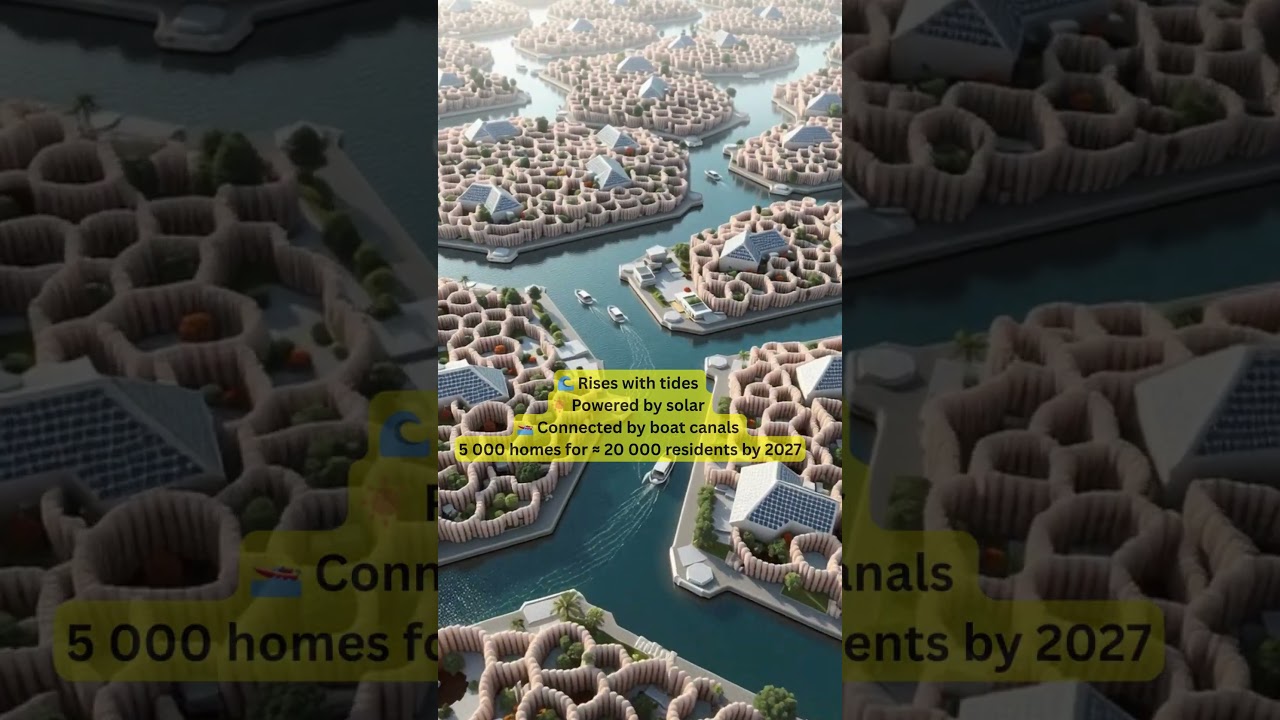
The project is located in a 200-hectare lagoon, about 10 minutes by boat from Malé, the capital city. Once completed, MFC will host around 20,000 residents across 5,000 floating homes, connected through a network of canals instead of roads.
⚙️ How It Works: The Technology of Floating Cities
The city is built on hexagonal floating platforms, inspired by brain coral patterns. Each platform rests on buoyant concrete and foam structures anchored to the seabed with flexible moorings.
This innovative engineering allows the city to rise and fall naturally with the tides and adapt to storms — a key resilience feature for climate-affected nations.
Mobility will be entirely eco-friendly: residents will move around on boats, bicycles, and electric buggies. Power will come primarily from solar energy, and wastewater will be treated locally for reuse.
🏠 A Real City, Not a Prototype
Unlike small floating prototypes in South Korea or the Netherlands, MFC aims to be the world’s first city-scale floating community — a functioning urban space with homes, schools, hospitals, shops, and a marina. Construction began in 2022, with initial residential modules showcased publicly. The full city is planned to be operational around 2027.
🌏 Why It Matters
This project could serve as a model for climate-resilient living in coastal and island nations worldwide. If successful, it may redefine how humanity builds future waterfront cities, combining sustainability, innovation, and survival.
The Maldives Floating City is more than just architecture — it’s a symbol of hope for nations fighting to stay above water.
📚 Sources
1. Waterstudio.nl – Maldives Floating City Project Overview
(Design, engineering details, and official renders)
2. Dutch Docklands Official Site – Maldives Floating City Partnership
(Development agreement and scale)
3. Reuters (Oct 2025) – Project update and completion timeline
4. UN Environment Programme – Maldives sea-level vulnerability data
5. Dezeen / CNN / World Economic Forum Reports – Progress insights, climate adaptation context
All data above verified from reputable international organizations and official developer statements (as of Oct 2025).
⸻
#MaldivesFloatingCity #FloatingCity #ClimateChange #Innovation #Sustainability #GazettEU #FutureCities #UrbanDevelopment #Maldives #Waterstudio #DutchDocklands #SmartCity #Architecture #Engineering #OceanCities #ClimateAction #SeaLevelRise #BlueEconomy #ResilientDesign #FutureLiving

Информация по комментариям в разработке