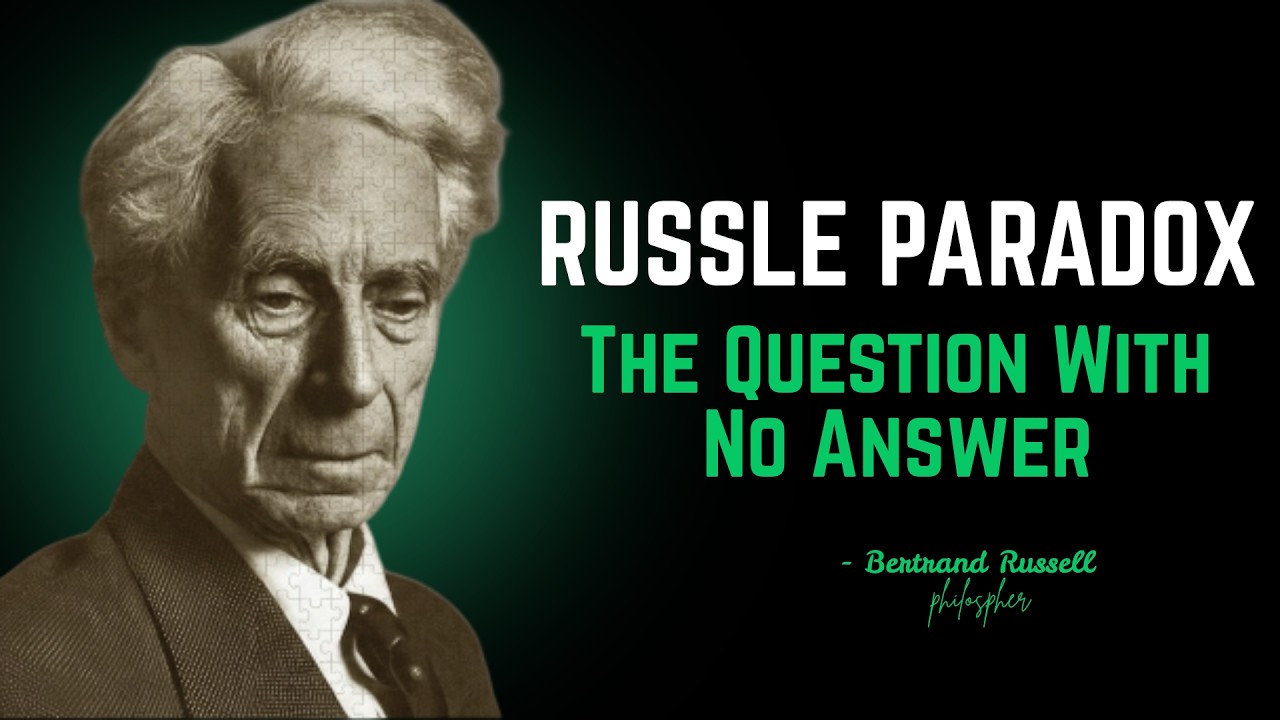
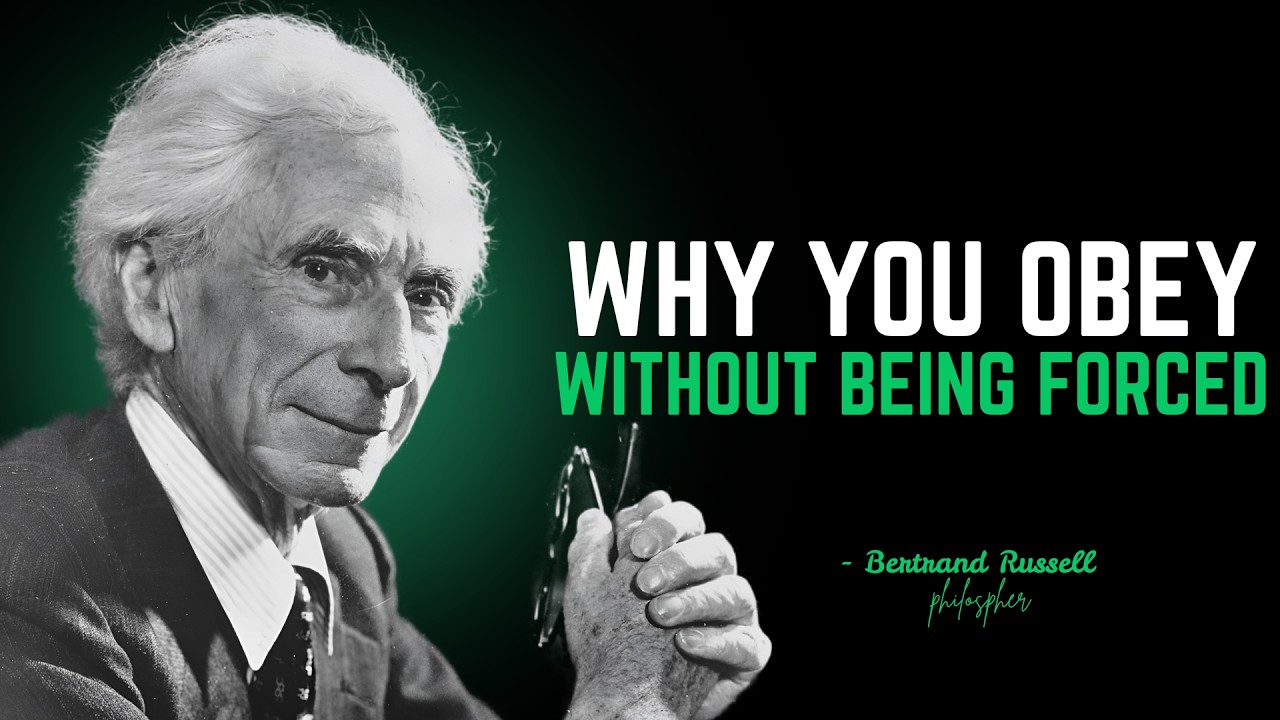
Join us for an in-depth philosophical exploration of one of the most important discoveries in the history of logic and mathematics. In this lecture, delivered in the style of Bertrand Russell himself, we examine the paradox that bears his name—a deceptively simple problem that shattered the foundations of mathematics and revealed fundamental limits in human reasoning.
Key Themes:
Most human certainty rests on unexamined assumptions
Self-reference creates logical instabilities that can spiral into paradox
Perfect generality and perfect consistency may be incompatible
Mathematical truth requires coherence, not absolute certainty
Intellectual progress comes from discovering and correcting errors
Rigorous criticism, not comfortable dogma, advances knowledge
Ideal for:
Students of philosophy, logic, and mathematics
Anyone interested in the foundations of knowledge
Those curious about how brilliant minds respond to intellectual crisis
Viewers who appreciate careful reasoning and conceptual clarity
⚠️ *Important Disclaimer*
*This channel is not officially connected to Bertrand Russell or his estate.* All content is AI-generated and created to inspire, educate, and encourage philosophical reflection in the spirit of Russell's work. The voice, writing style, and presentation are synthetic recreations designed to make complex philosophical ideas accessible to modern audiences.
This channel fully complies with YouTube's monetization policies, including clear labeling of synthetic media. All videos are clearly identified as AI-generated content created for educational purposes.
---
📚 *Sources & References*
Primary Works by Bertrand Russell:
The Principles of Mathematics (1903) - Contains Russell's first published account of the paradox
Principia Mathematica (with Alfred North Whitehead, 1910-1913) - Attempt to derive mathematics from logic using type theory
Introduction to Mathematical Philosophy (1919) - Accessible explanation of logical foundations and the paradox
My Philosophical Development (1959) - Russell's own account of discovering the paradox and its impact
The Problems of Philosophy (1912) - Broader philosophical context for epistemological issues raised by the paradox
Historical and Technical Background:
Gottlob Frege, Grundgesetze der Arithmetik (*Basic Laws of Arithmetic*, 1893-1903) - The work Russell's paradox undermined
Georg Cantor, Contributions to the Founding of the Theory of Transfinite Numbers (1915) - Earlier work on infinite sets that influenced Russell
Ernst Zermelo, "Investigations in the Foundations of Set Theory I" (1908) - First axiomatic set theory avoiding the paradox
David Hilbert, "On the Infinite" (1926) - Formalist response to foundational crisis
Kurt Gödel, "The Consistency of the Axiom of Choice and of the Generalized Continuum Hypothesis" (1940) - Further developments in set theory
Secondary Literature and Analysis:
Irving Copi, The Theory of Logical Types (1971) - Detailed examination of Russell's solution
Nicholas Griffin (ed.), The Cambridge Companion to Bertrand Russell (2003) - Scholarly overview of Russell's philosophy
Graham Priest, In Contradiction: A Study of the Transconsistent (2006) - Alternative approaches to paradox using paraconsistent logic
A.D. Irvine, "Russell's Paradox," Stanford Encyclopedia of Philosophy - Comprehensive contemporary analysis
Michael Potter, Set Theory and Its Philosophy (2004) - Modern perspective on foundational issues
Philosophical Context:
Aristotle, Metaphysics - Classical account of the law of non-contradiction
Immanuel Kant, Critique of Pure Reason (1781) - Earlier examination of the limits of reason
L.E.J. Brouwer, "Intuitionism and Formalism" (1913) - Constructivist alternative to classical foundations
W.V.O. Quine, "New Foundations for Mathematical Logic" (1937) - Alternative set theory avoiding the paradox
Willard Van Orman Quine, "On What There Is" (1948) - Ontological implications of logical systems
Modern Developments:
Abraham Fraenkel, Yehoshua Bar-Hillel, and Azriel Levy, Foundations of Set Theory (1973)
Solomon Feferman, In the Light of Logic (1998) - Contemporary philosophy of mathematics
Stewart Shapiro, Thinking About Mathematics (2000) - Survey of philosophical positions on mathematical foundations













Информация по комментариям в разработке