The ecliptic is the apparent trajectory described each year by the Sun around the Earth. By definition, the Sun is always exactly on the ecliptic.
The 12 Signs of the astronomical zodiac are defined by their ecliptic longitudes, measured with respect to the axes of the equinoxes and solstices. Each Sign occupies a width (W) of exactly 30° in ecliptic longitude:
Aries♈️ (Sign): W = 30°, from 0° (March equinox) to 30°
Taurus♉️ (Sign): W = 30°, from 30° to 60°
Gemini♊️ (Sign): W = 30°, from 60° to 90° (June solstice)
Cancer♋️ (Sign): W = 30°, from 90° (June solstice) to 120°
Leo♌️ (Sign): W = 30°, from 120° to 150°
Virgo♍️ (Sign): W = 30°, from 150° to 180° (September equinox)
Libra♎️ (Sign): W = 30°, from 180° (September equinox) to 210°
Scorpio♏️ (Sign): W = 30°, from 210° to 240°
Sagittarius♐️ (Sign): W = 30°, from 240° to 270° (December solstice)
Capricorn♑️ (Sign): W = 30°, from 270° (December solstice) to 300°
Aquarius♒️ (Sign): W = 30°, from 300° to 330°
Pisces♓️ (Sign): W = 30°, from 330° to 0° (March equinox)
Due to the phenomenon of precession, the ecliptic and the astronomical zodiac are drawn into a slow cycle of 26,000 years of rotation relative to the stellar background. As a result, the equinoxes, solstices, and ecliptic sectors of the astronomical zodiac are in constant motion relative to the Milky Way, the stars, and the constellations that lie in the background.
There are 13 constellations that lie in the background of the ecliptic. Due to the phenomenon of precession, none of these constellations remain in the same position with respect to the astronomical zodiac Signs. Furthermore, each of these constellations has a different shape and therefore occupies a different width (W) in ecliptic longitude:
Aries (constellation): W ≈ 29.2°
Taurus (constellation): W ≈ 42.2°
Gemini (constellation): W ≈ 28.2°
Cancer (constellation): W ≈ 24.1°
Leo (constellation): W ≈ 44.8°
Virgo (constellation): W ≈ 54.8°
Libra (constellation): W ≈ 26.6°
Scorpius (constellation): W ≈ 30.7°
Ophiuchus (constellation): W ≈ 44.6°
Sagittarius (constellation): W ≈ 36.6°
Capricornus (constellation): W ≈ 30.6°
Aquarius (constellation): W ≈ 49.5°
Pisces (constellation): W ≈ 52.3°
While the 12 Signs of the astronomical zodiac cover all the possible positions of the Planets in ecliptic longitude and latitude, the 13 constellations in the background of the ecliptic cover only a part of the possible positions of the Planets. Indeed, with the exception of the Sun and the Earth, none of the solar system bodies orbits exactly within the ecliptic plane: some Planets can sometimes cross significant ecliptic latitudes (e.g. Moon ±5°, Mercury ±5°, Venus ±8°, Pluto ±17°) and escape from the belt of the 13 ecliptic constellations.
There are 28 constellations located north or south of the ecliptic constellations and likely to be crossed by Planets (in particular by the Moon, Mercury, Venus, Mars or Pluto):
14 constellations north of the ecliptic: Triangulum, Perseus, Auriga, Lynx, Leo Minor, Coma Berenices, Boötes, Serpens Caput, Serpens Cauda, Scutum, Aquila, Equuleus, Pegasus, Andromeda.
14 constellations south of the ecliptic: Eridanus, Orion, Monoceros, Canis Minor, Hydra, Sextans, Crater, Corvus, Centaurus, Lupus, Corona Australis, Microscopium, Piscis Austrinus, Cetus.
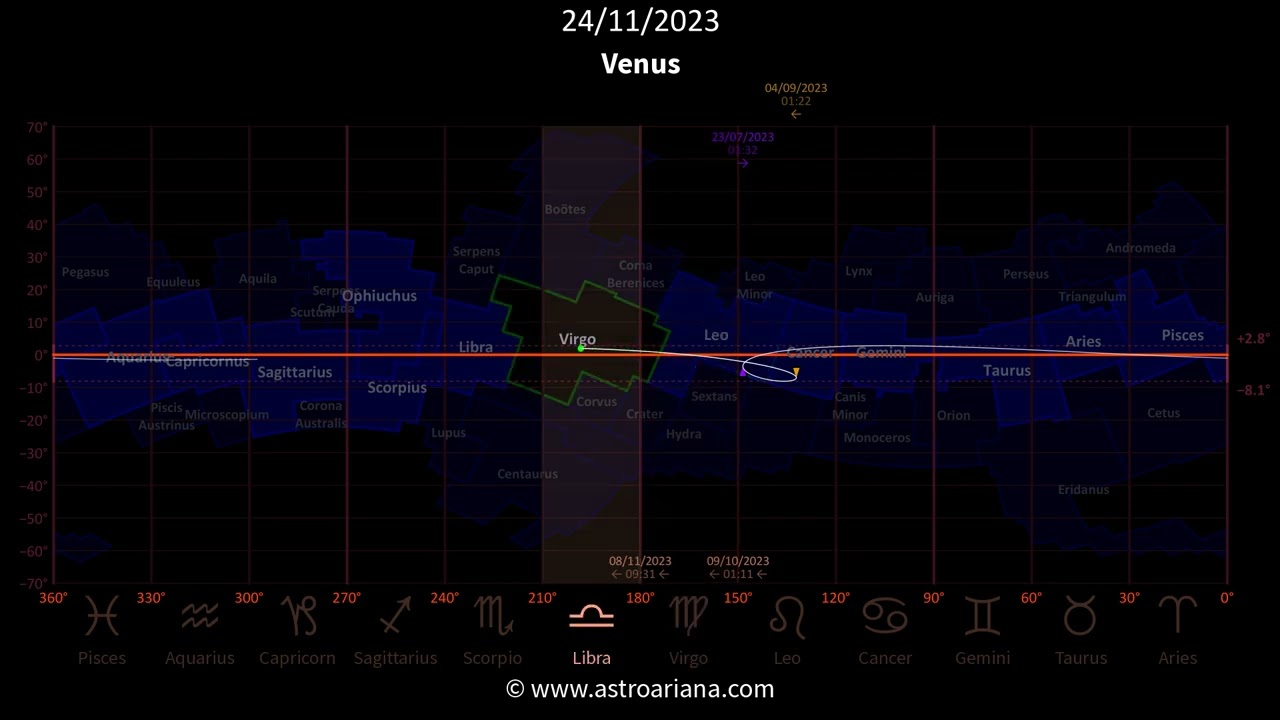
Video caption:
ecliptic plane: red horizontal axis
ecliptic longitudes: horizontal graduations
ecliptic latitudes: vertical graduations
minimum and maximum ecliptic latitudes: horizontal dashed lines
start of the retrograde motion: purple triangle
end of the retrograde motion: orange triangle
IAU constellation boundaries: blue outlines
Simulation created with data from the Stellarium freeware (https://stellarium.org/). One second of video corresponds to six days in real time: the video therefore shows time accelerated by a factor of around 500,000.

Информация по комментариям в разработке