🕰️ Join us on a journey through time as we explore the lives and legacies of remarkable historical figures. From legendary leaders to pioneering innovators, these individuals have left an indelible mark on history. Discover the fascinating stories that shaped our world.
►Tiye (also known as Tiy, 1398-1338 BCE) : was a queen of Egypt of the 18th dynasty, wife of the pharaoh Amenhotep III, mother of Akhenaten, and grandmother of both Tutankhamun and Ankhsenamun. She exerted an enormous influence at the courts of both her husband and son and is known to have communicated directly with rulers of foreign nations.
The Amarna letters also show that she was highly regarded by these rulers, especially during the reign of her son. Although she believed in the traditional polytheistic religion of Egypt, she supported Akhenaten's monotheistic reforms, most likely because she recognized them as important political stratagems to increase the power of the throne at the expense of the priesthood of Amun.
She died in her early sixties and was buried in the Valley of the Kings. Her mummy has positively been identified as that known as the 'Elder Lady', and a lock of her hair, possibly a keepsake of the young king's, was found in Tutankhamun's tomb.
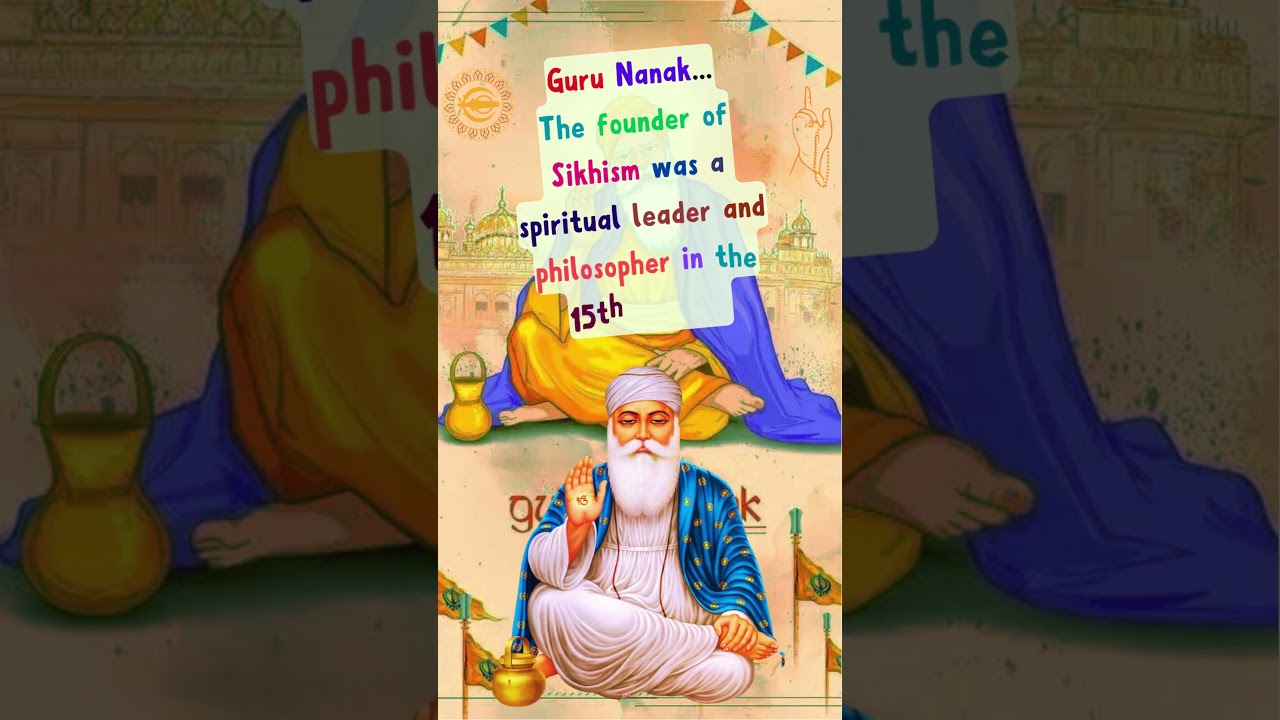
► Guru Nanak (1469 - 1539) : The founder of the Sikh religion, Guru Nanak was born on April 15, 1469 in the Western Punjab village of Talwandi. He was born to a simple Hindu family. His father Mehta Kalian Das was an accountant in the employment of the local Muslim authorities. From an early age Guru Nanak made friends with both Hindu and Muslim children and was very inquisitive about the meaning of life. At the age of six he was sent to the village school teacher for schooling in reading and writing in Hindi and mathematics. He was then schooled in the study of Muslim literature and learned Persian and Arabic. He was an unusually gifted child who learned quickly and often question his teachers. At age 13 it was time for Guru Nanak to be invested with the sacred thread according to the traditional Hindu custom. At the ceremony which was attended by family and friends and to the disappointment of his family Guru Nanak refused to accept the sacred cotton thread from the Hindu priest. He sang the following poem;
"Let mercy be the cotton, contentment the thread, Continence the knot and truth the twist. O priest! If you have such a thread, Do give it to me. It'll not wear out, nor get soiled, nor burnt, nor lost. Says Nanak, blessed are those who go about wearing such a thread" (Rag Asa)
As a young man herding the family cattle, Guru Nanak would spend long hours absorbed in meditation and in religious discussions with Muslim and Hindu holy men who lived in the forests surrounding the village. Thinking that if bound in marriage Guru Nanak might start taking interest in household affairs a suitable match was found for him. At age 16 he was married to Sulakhani daughter of a pious merchant. Guru Nanak did not object as he felt that married life did not conflict with spiritual pursuits. Guru Nanak was happily married, he loved his wife and eventually had two sons Sri Chand in 1494 and Lakshmi Chand three years later. Now that he had a family of his own Guru Nanak was persuaded by his parents to take a job as an accountant in charge of the stores of the Muslim governor of Sultanpur Daulat Khan Lodi. Guru Nanak agreed and was joined by his family and an old Muslim childhood friend Mardana, a musician by profession. Guru Nanak would work during the days, but early in the mornings and late at nights, he would meditate and sing hymns accompanied by Mardana on the rabab ( a string instrument). These sessions attracted a lot of attention and many people started joining the two.
► Mencius, : (born c. 371, ancient state of Zou, China—died c. 289 bce, China), early Chinese philosopher whose development of orthodox Confucianism earned him the title “second sage.” Chief among his basic tenets was an emphasis on the obligation of rulers to provide for the common people. The book Mencius records his doings and sayings and contains statements on the goodness of human nature, a topic warmly debated by Confucianists up to modern times.
Mencius had worked out a definite program to attain economic sufficiency for the common people. He also advocated light taxes, free trade, conservation of natural resources, welfare measures for the old and disadvantaged, and more nearly equal sharing of wealth. It was his fundamental belief that “only when the people had a steady livelihood would they have a steady heart.”
While Mencius has always been regarded as a major philosopher, special importance was attributed to him and his work by the neo-Confucians of the Song dynasty (960–1279). For the last 1,000 years, Mencius has been revered among the Chinese people as the cofounder of Confucianism, second only to Confucius himself.
🗺️► @ZenSnap_Muse

Информация по комментариям в разработке