Pompeii, Italian Pompei, preserved ancient Roman city in Campania, Italy, 14 miles (23 km) southeast of Naples, near Mount Vesuvius's southeastern base.
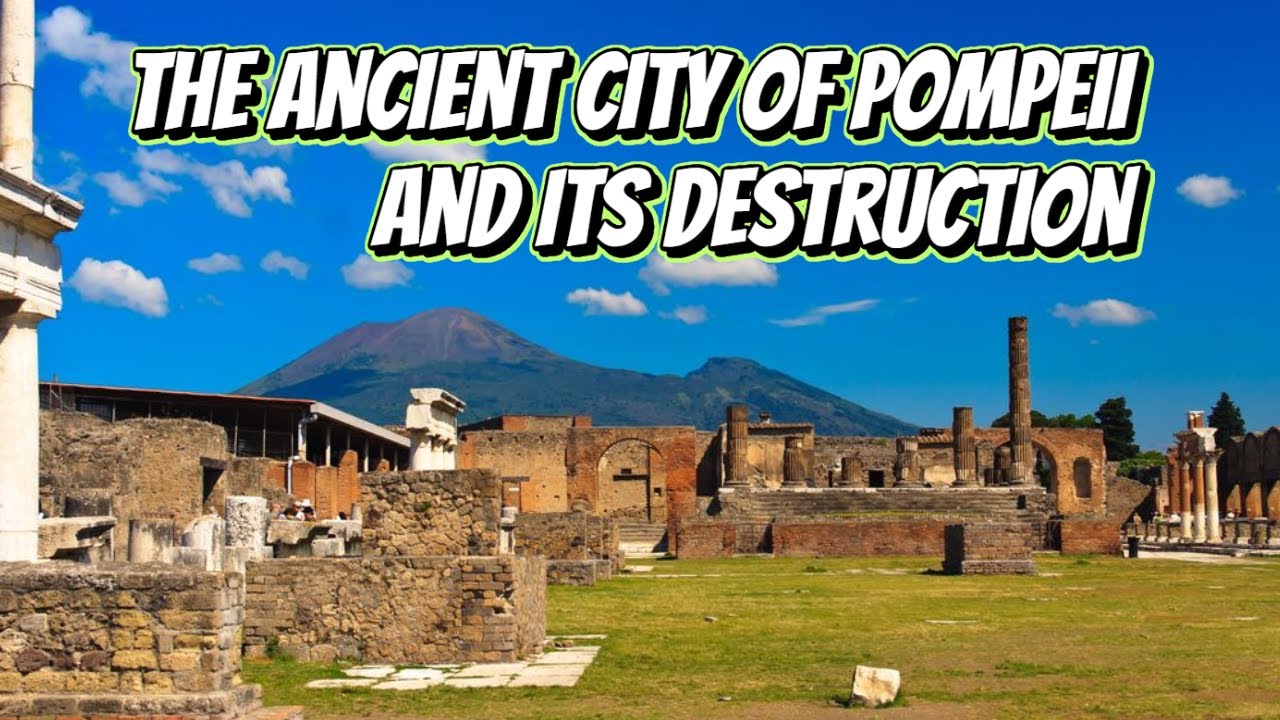
We are going to talk about The ancient city of Pompeii and its destruction in our today’s video. Before starting this video, like it and subscribe to our youtube channel. Let’s begin.
A massive explosion from Mount Vesuvius spewed volcanic debris over Pompeii about midday on August 24, 79 CE, followed the following day by clouds of blisteringly hot gases. Buildings were destroyed, individuals were crushed or asphyxiated, and the city was buried behind a layer of ash and pumice.
Pompeii was constructed on an ancient lava flow spur north of the Sarnus (modern Sarno) River's mouth.
Pompeii had a population of 10,000 to 20,000 people at the time of its collapse. To the east is the contemporary town (comune) of Pompei, which has the pilgrimage Basilica of Santa Maria del Rosario.
It seems that Pompeii, Herculaneum, and adjacent cities were initially occupied by Oscan-speaking ancestors of Campania's Neolithic population.
Pompeii was first referenced in history in 310 BCE, when a Roman fleet arrived at the Sarnus port of Pompeii and launched an unsuccessful assault on the neighboring city of Nuceria during the Second Samnite War.
Tacitus, the Roman historian, reports a disturbance at Pompeii's amphitheatre in 59 CE between the Pompeians and the Nucerians. Both Pompeii and Herculaneum were severely damaged by an earthquake in 62 CE. When the towns were finally destroyed 17 years later, they had not yet recovered from the disaster.
Pliny the Elder had gone from Misenum to assist the afflicted inhabitants and to see the volcanic activity up close, and he perished near Stabiae. Excavations and volcanological research, particularly in the late twentieth century, have revealed new information. On August 24, just after lunchtime, ash, pumice, and other volcanic material started raining down on Pompeii, soon burying the city to a depth of more than 9 feet (3 meters) and forcing the roofs of many buildings to collapse.
The architect Domenico Fontana found the Pompeii remains late in the 16th century.
Herculaneum was found in 1709, and excavations started in 1738. Work on Pompeii did not commence until 1748, and an inscription ("Rei publicae Pompeianorum") was discovered in 1763, identifying the location as Pompeii.
From 1750 until 1764, the military engineer Karl Weber worked under the auspices of Don Carlos, King of Naples, but other early digging was sometimes unplanned and irresponsible, carried out by treasure hunters or other inexperienced employees.
Following the halt caused by World War II, extensive excavation was restarted in 1951 under the direction of Amedeo Maiuri, who was in charge of the excavations from 1924 to 1961.
Excavations undertaken by Don Carlos of Naples in the environs of Stabiae and Gragnano found 12 residences between 1749 and 1782.
Because Pompeii was constructed atop an ancient lava flow, its form was uneven. Excavations show that the southwestern half of town is the earliest, although academics disagree on the phases by which the walls were constructed or on who built them.
The public structures are largely split into three areas: the Forum, located on a broad level space to the southwest; the Triangular Forum, located on a height at the tip of the south wall facing the bay; and the Amphitheatre and Palaestra, located to the east.
The Forum, a wide rectangular square encircled by a two-story colonnaded portico, was the center of the city's religious, commercial, and civic life. The temple devoted to the Capitoline trio of deities, Jupiter, Juno, and Minerva, dominated the Forum to the north.
The Doric Temple, Pompeii's earliest temple, is located in the Triangular Forum. A theatre, palaestra (sports area), and a small covered theatre were erected to the east of the Triangular Forum during the third and first centuries BCE.
The hundreds of private residences are more important than the public structures, some of which have been unearthed at other locations. These are unusual in that only in Pompeii can the history of Italic and Roman household architecture be traced back at least four centuries. The first dwellings were built during the early Samnite era (4th-3rd century BCE). The Home of the Surgeon is the most well-known example of an early atrium house constructed during this time period.
Well that is it for today. Thank you for watching. Hope you find this video informative. Please subscribe to our channel and hit the bell icon for future video notifications.

Информация по комментариям в разработке