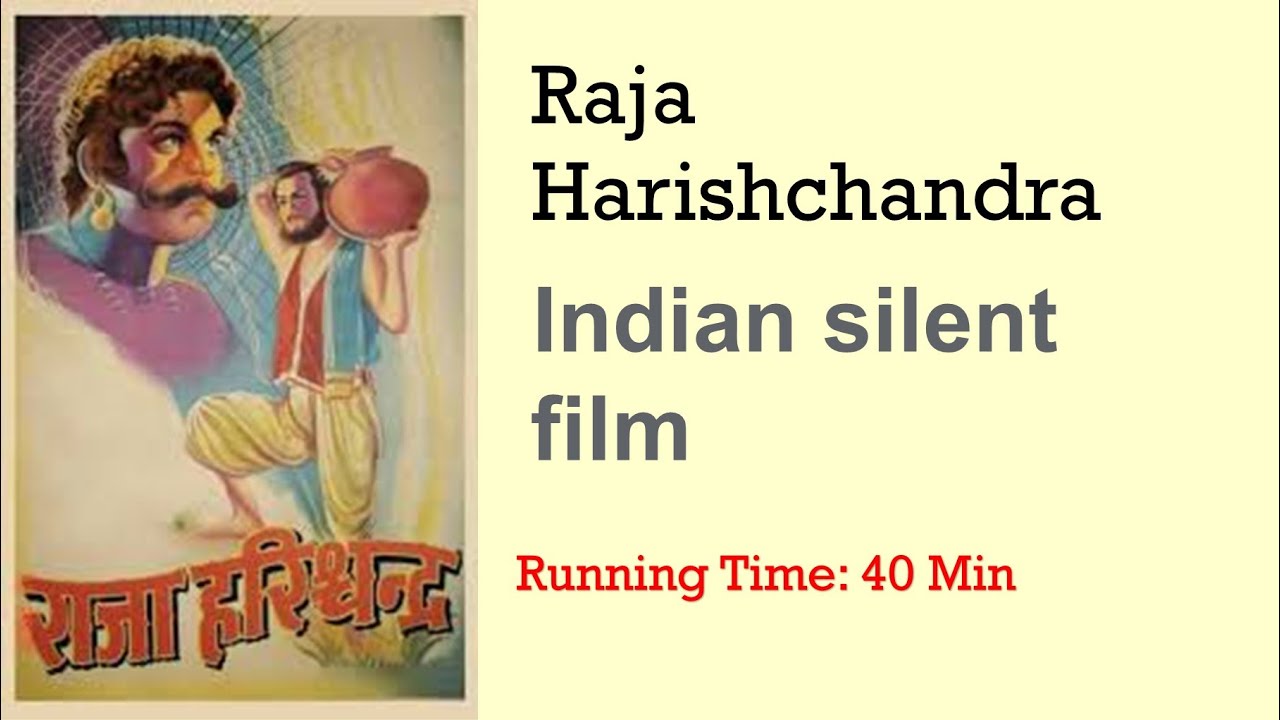
Raja Harishchandra (transl. King Harishchandra) is a 1913 Indian silent film directed and produced by Dadasaheb Phalke
It is often considered the first full-length Indian feature film. Raja Harishchandra features Dattatraya Damodar Dabke, Anna Salunke, Bhalchandra Phalke and Gajanan Vasudev Sane. It is based on the legend of Harishchandra, with Dabke portraying the title character. The film, being silent, had English, Marathi, and Hindi-language intertitles.
Phalke decided to make a feature film after watching The Life of Christ (1906) at a theatre in Bombay in April 1911. In February 1912, he went to London for two weeks to learn filmmaking techniques and upon return founded Phalke Films Company. He imported the hardware required for filmmaking and exhibition from England, France, Germany, and the United States. Phalke shot a short film Ankurachi Wadh (Growth of a Pea Plant) to attract investors for his venture. He published advertisements in various newspapers calling for the cast and crew. As no women were available to play female roles, male actors performed the female roles. Phalke was in charge of scriptment, direction, production design, make-up, film editing, along with film processing. Trymbak B. Telang handled the camera. Phalke completed filming in six months and 27 days producing a film of 3,700 feet (1,100 m), about four reels.
The film premiered at the Olympia Theatre, Bombay, on 21 April 1913, and had its theatrical release on 3 May 1913 at the Coronation Cinematograph and Variety Hall, Girgaon. It was a commercial success and laid the foundation for the film industry in the country. The film is partially lost; only the first and last reels of the film are preserved at the National Film Archive of India. Some film historians believe these belong to a 1917 remake of the film by Phalke titled Satyavadi Raja Harishchandra.
The status of Raja Harishchandra as the first full-length Indian feature film has been debated. Some film historians consider Dadasaheb Torne's silent film Shree Pundalik, released on 18 May 1912, the maiden Indian film. The Government of India, however, recognises Raja Harishchandra as the first Indian feature film.
Plot
Duration: 32 minutes and 20 seconds.32:20
Raja Harishchandra
King Harishchandra (D. D. Dabke) is shown teaching his son, Rohitashva (Bhalchandra Phalke), how to shoot with a bow and arrow in the presence of Queen Taramati (Anna Salunke). His citizens ask him to go on a hunting expedition. While on the hunt, Harishchandra hears the cries of some women. He reaches a place where the sage Vishvamitra (Gajanan Sane) is performing a yajna to get help from Triguna Shakti (three powers) against their will.[a] Harishchandra unwittingly interrupts Vishvamitra in the midst of his yajna by releasing the three powers. To appease Vishvamitra's wrath, Harishchandra offers his kingdom. Returning to the royal palace, he informs Taramati of the happenings. Vishvamitra sends Harishchandra, Taramati, and Rohitashva into exile and asks them to arrange for dakshina. While in exile, Rohitashva dies and Harishchandra sends Taramati to ask the Dom king for arranging a free cremation. While Taramati is on her way to meet the Dom king, Vishvamitra frames her for the murder of the prince of Kashi. Taramati faces trial, pleads guilty and is ordered to be beheaded by Harishchandra. When he raises his sword to complete his task, a pleased Lord Shiva appears. Vishvamitra reveals that he was examining Harishchandra's integrity, returns the crown to him and brings Rohitashva back to life.[3][4]
Cast
Dattatraya Damodar Dabke as Harishchandra
Anna Salunke as Taramati, Harishchandra's wife
Bhalchandra Phalke as Rohitashva, son of Harishchandra and Taramati
Gajanan Vasudev Sane as Vishvamitra
Other artists in the film were Dattatreya Kshirsagar, Dattatreya Telang, Ganpat G. Shinde, Vishnu Hari Aundhkar, and Nath T. Telang.[5]
Production
Development
"While The Life of Christ was rolling fast before my physical eyes, I was mentally visualising the Gods, Shri Krishna, Shri Ramachandra, their Gokul and their Ayodhya. I was gripped by a strange spell. I bought another ticket and saw the film again. This time I felt my imagination taking shape on the screen. Could this really happen? Could we, the sons of India, ever be able to see the Indian images on the screen?"
– Phalke on watching Jesus on the screen[6]
On 14 April 1911, Dadasaheb Phalke with his elder son Bhalchandra went to see a film, Amazing Animals, at the America India Picture Palace,[7]

Информация по комментариям в разработке