The Humber Residence, a project by Batay-Csorba Architects, is the latest addition to the charming Baby Point neighborhood in Toronto. Bounded to the west by the winding Humber River, many homes in this region enjoy coveted views of the river valley. The acquisition of this view and the advantage of the small 65'x20' triangular lot were determining factors that influenced the spatial organization and hierarchy of the residence.
Unlike typical narrow lots in Toronto, the corner lot location provided much greater freedom to bring natural light into the various living spaces. In this case, the longer side of the plot also coincidentally faced the distant Humber River, offering the opportunity to create a dynamic space that not only illuminated the house but also rose to a vantage point for contemplating beyond the adjacent buildings to the river.
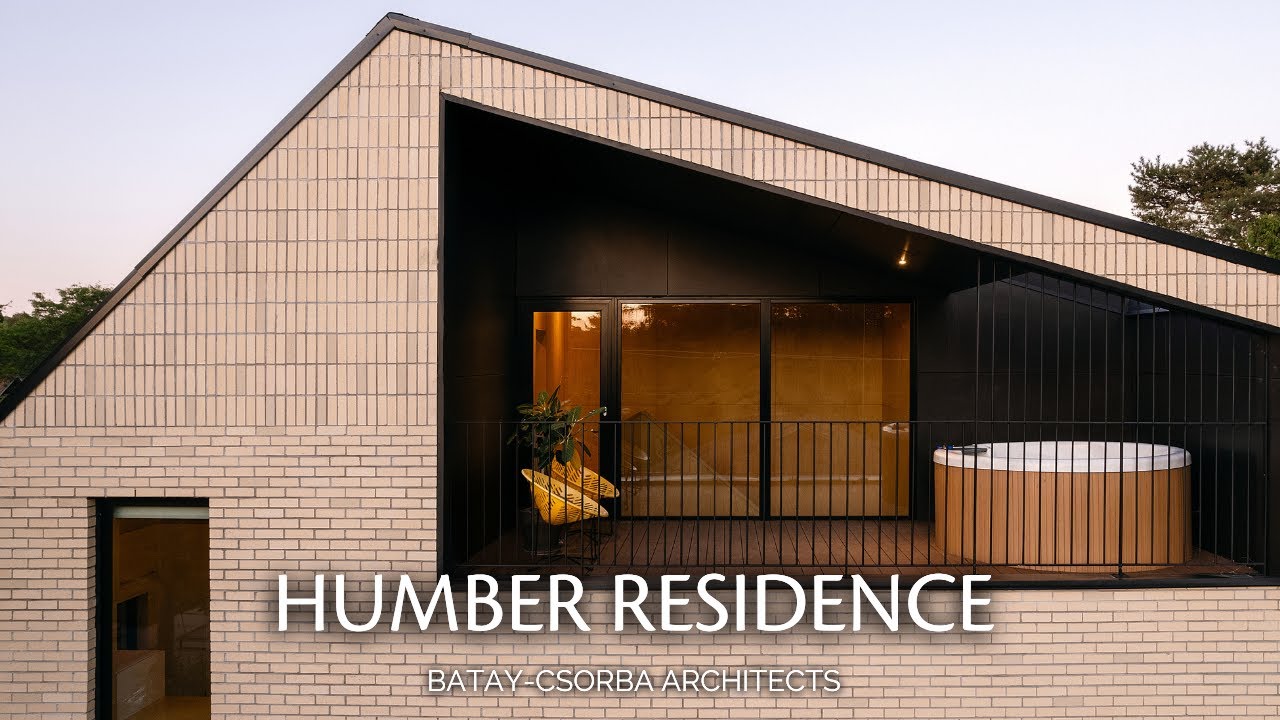
In this space, instead of using punctual light wells, as is common in narrow lots, the circulation of three floors is isolated and left open, extending through a large three-story atrium to a sheltered external balcony carved under the sloping roof. A transition of materials marks the importance of this space within the house, while highlighting the visual connectivity between it and the other main public spaces.
The Humber Residence is a modest three-bedroom home, resolutely designed to be well-proportioned and comfortable, without excesses. Corridors and staircases are minimized, there are no large closets, pantries, or unused extra rooms. The rooms are compact, with built-in furniture and space-saving cabinets, the laundry is integrated into the circulation corridor, and every square inch is carefully planned and utilized to meet the compact circumstances of the site. And yet, there are beautifully thought-out architectural details that convey quality, attention, and care.
A monumental and voluminous sense of space is created not with large rooms or uninhabited spaces, but by exploring verticality as its central principle of organization, where spaces intertwine and combine to generate programmed spaces in multiple layers, resembling a stacked treehouse. Hidden at the peak of the roof, above the children's rooms, are concealed reading lofts accessed by custom stairs.
Above the master bedroom, there is a small office and music studio. The residence is focused around a dramatic three-story central wood-clad space, functioning both as a light monitor and as a ventilation chimney that cools the house and as vertical circulation. At the top, large south-facing doors open onto a rooftop deck with panoramic views of the Humber River, and a Japanese soaking tub to take in the whole view. Southern light is captured by the wood cladding, illuminating the interior with a warm, comforting amber glow.
The exterior reflects the context, clad in historic old yellow bricks in varied stripe patterns along the facades and an accentuated sloping roof. The front entrance and the third-floor deck are carved in contrasting black sintered stone panel bricks. The interior features a casual and approachable palette of natural materials for an anti-museum aesthetic, with recycled wood plank flooring, Baltic birch panels, terrazzo, and concrete.
Credits:
Name: Humber Residence
Location: Toronto Ontario, Canada
Area: 2,000 sft
Architecture: Batay-Csorba Architects
Photography: Doublespace Photography
Status: Completed, 2023
Source: v2com newswire
0:00 - Humber Residence
4:36 - Drawings



Информация по комментариям в разработке