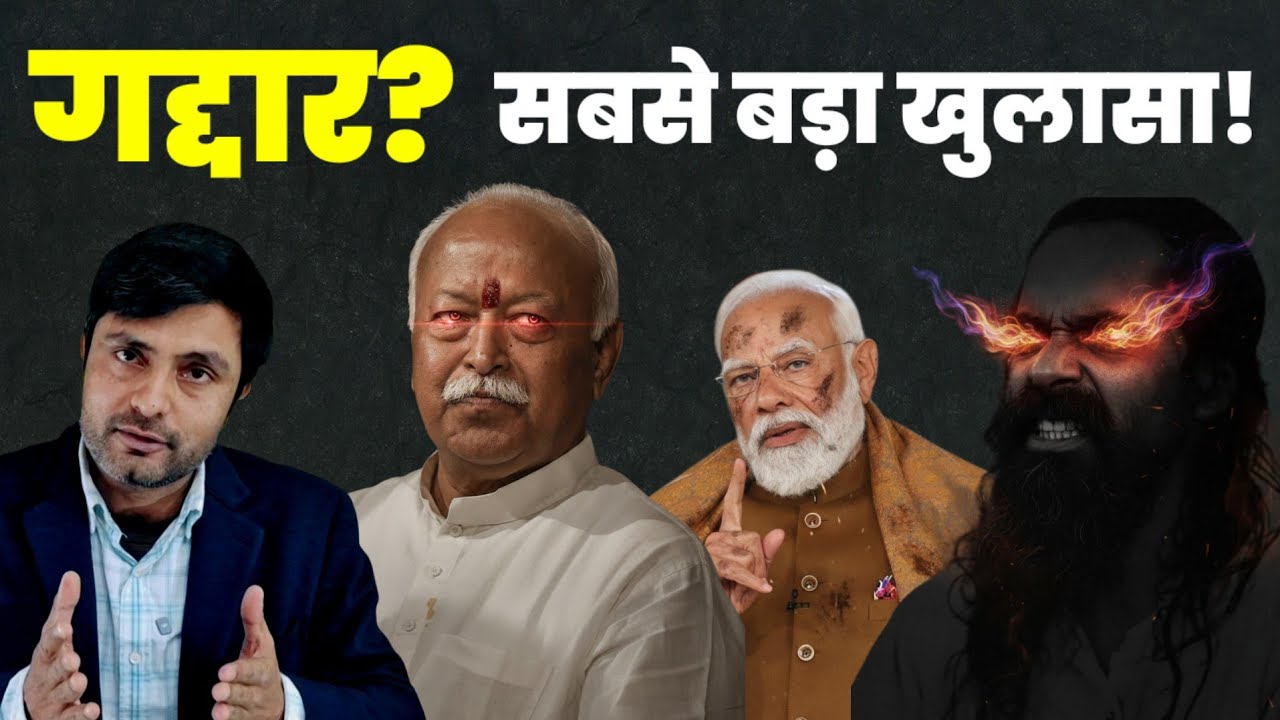
RSS पर सबसे बड़ा खुलासा: आपके होश उड़ जाएंगे | RSS : Exposed | Alok Tripathi
What does nationalism really mean? Is it blind loyalty to an organization, or courage to question power using history and facts? This video raises one of the most uncomfortable yet necessary questions of our time: Is the Rashtriya Swayamsevak Sangh (RSS) truly nationalist, or has it historically functioned as a dangerous and exclusionary force within India’s democracy? This is not a hate-driven argument. This is a fact-driven examination based on books, letters, historical records, and statements by RSS leaders themselves.
In this video, we examine the complete absence of RSS from India’s freedom struggle. Founded in 1925, the RSS existed during the most decisive phases of the anti-British movement—Non-Cooperation, Civil Disobedience, and Quit India. Yet, as an organization, it did not participate in any mass movement against British rule. While Congress leaders went to jail, revolutionaries were executed, and socialists worked underground, RSS continued its daily shakhas without confronting colonial power. Even RSS ideologue M.S. Golwalkar admitted in Bunch of Thoughts that the organization stayed away from politics. In a colonial context, this “apolitical” stance directly benefited the British.
We also discuss how RSS maintained a cooperative posture toward British authorities. British intelligence reports from the 1940s noted that RSS avoided activities that could disturb colonial governance. During the Quit India Movement of 1942, when almost all nationalist organizations were banned, RSS was not. This silence and discipline were not acts of nationalism; they were acts of accommodation. Empires survive not only through force, but also through the non-resistance of those who claim neutrality.
The video then explores the ideological foundations of RSS, particularly its admiration for European fascism. Golwalkar’s book We, or Our Nationhood Defined openly praised Nazi Germany’s handling of minorities and argued that non-Hindus in India must either assimilate or live as subordinate citizens. This vision directly contradicts the Indian Constitution, which is based on equality, citizenship, and individual rights—not cultural or religious dominance.
A major focus of the video is the RSS’s relationship with Dalits and caste. Despite claiming to oppose caste discrimination, RSS leadership has remained overwhelmingly upper-caste. There has never been a Dalit Sarsanghchalak. Dalits may be included at the grassroots level, but real power and ideological control remain inaccessible. Dr. B.R. Ambedkar’s warning against Hindu majoritarianism and his demand for annihilation of caste stand in direct opposition to RSS’s idea of social harmony built on hierarchy.
We also critically examine the position of women within RSS ideology. Women are excluded from the core organization and placed in a separate body, the Rashtra Sevika Samiti. They are praised as mothers and cultural symbols, but denied equal leadership and autonomy. Respect without equality is not empowerment—it is control. This patriarchal structure reflects a broader resistance to feminist and egalitarian reforms.
The video further discusses RSS’s rejection of the Indian Constitution. Golwalkar openly criticized the Constitution and expressed preference for Manusmriti, a text that legitimizes caste and gender inequality. Ambedkar burned Manusmriti because it represented centuries of oppression; RSS reveres it because it preserves hierarchy. This ideological conflict goes to the heart of India’s democratic crisis.
Finally, we analyze why RSS, with its growing influence over institutions, education, and narratives, poses a serious danger to constitutional democracy today. Nationalism rooted in obedience, uniformity, and exclusion is not nationalism at all—it is authoritarianism in cultural disguise.
This video is an invitation to think, question, and engage with history honestly. India belongs to its Constitution, not to any organization.
#RSS #HinduNationalism #IndianPolitics #IndianHistory #Ambedkar #ConstitutionOfIndia #DalitRights #WomenRights #Fascism #Democracy #Secularism #FreedomStruggle #Gandhi #IndianDemocracy #PoliticalAnalysis

Информация по комментариям в разработке