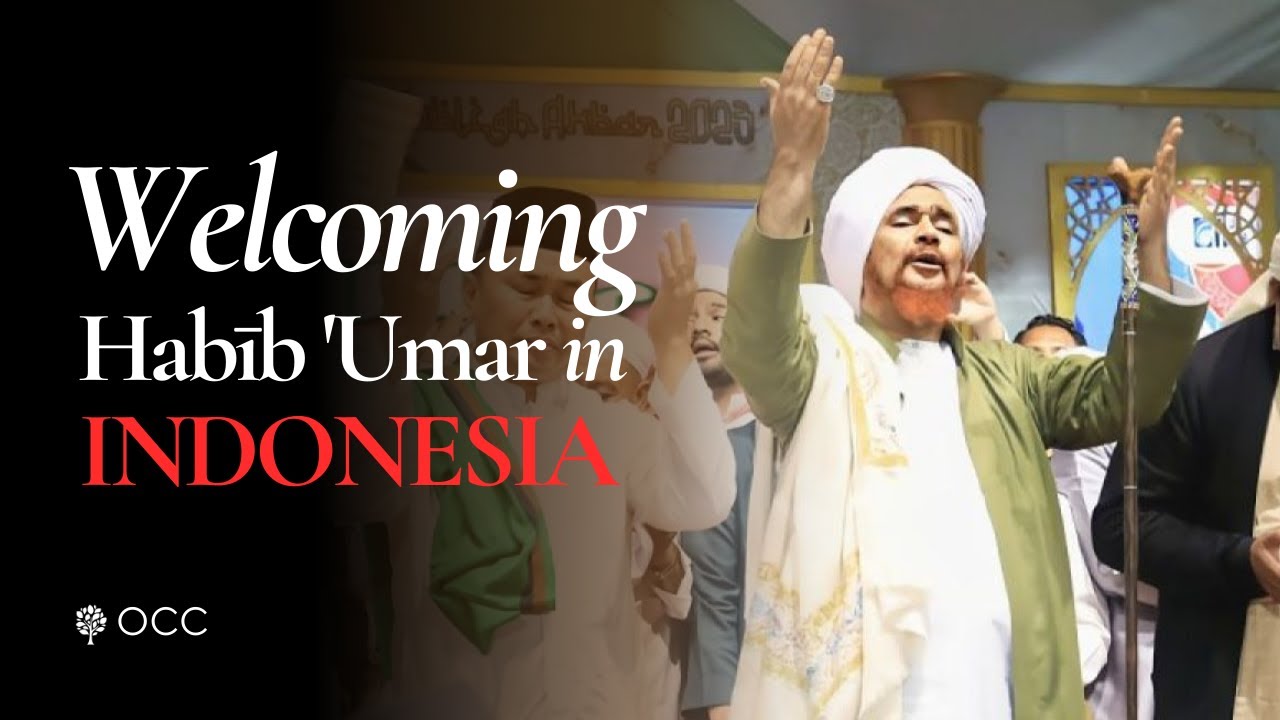
Awe-inspiring scenes of hundreds of thousands that gathered at the Tuah Pahoe Stadium in the Indonesian province of Central Kalimantan in order to welcome the 39th great-grandson and complete heir of the Prophet Muhammad ﷺ, Habīb 'Umar bin Hafīḍh on the 8th Safar 1445AH, a repeat of historic scenes that had been witnessed in the early generations of the Ummah wherein hundreds of thousands or even millions would flock to gaze upon the countenance of one of the Imāms of the Ahl al-Bayt, the Prophetic Household, if they descended upon a certain land. We ask Allah to revive and stir such love of the beloved ones to Allah and His Prophet ﷺ within the hearts of the Muslims.
Who is Habīb 'Umar bin Hafīḍh?
HE Sheikh Al-Habib Umar bin Hafiz, a 39th-generation direct descendant of the Prophet ﷺ, stands as one of the foremost scholars, spiritual guides, and preachers within the Islamic tradition today. His prominent position in the Ba Alawi Tariqa further extends his influence over hundreds of millions of Muslims around the globe.
The Bā 'Alawi : The Bā 'Alawi, derived from “Banū 'Alawi” or “the clan of Alawi”, have called the Hadramawt region in Yemen their home since 4th century Hijri (930CE) when a member of the Prophet’s ﷺ family emigrated there. The Bā 'Alawi lineage has since produced exceptional scholars and devout individuals, celebrated for their efforts in propagating and revitalizing Islamic teachings, anchoring their approach in Imam Al-Ghazali’s renowned work, the Ihya Ulum Al-Din . They have played a pivotal role in spreading and reviving Islam in various regions, including the Malay Archipelago (Malaysia and Indonesia) through the revered Wali Sanga (the Nine Saints—eight of whom were from the Bā 'Alawi), in various regions of India such as Kerala and Gujarat, in East Africa in the 20th century through figures like Habīb 'Umar bin Sumayt and Habīb Ahmad Mashhūr Al-Haddād and in general with Habīb 'Abdul Qādir Al-Saqqāf. Habīb 'Umar continues this legacy on a global scale, with tours that extend to the USA, Australia and Europe.
Dār al-Musṭafā : Following the unification of Yemen, Habīb 'Umar founded Dār al-Musṭafā in 1993—a centre dedicated to traditional Islamic scholarship. It is grounded in three fundamental principles: acquiring knowledge from qualified sources through an authentic chain of transmission; purifying the soul and refining character; and engaging in da'wah, the call to faith through the dissemination of beneficial knowledge. This institute started with 30 hand-picked students by Habīb 'Umar and thousands have now graduated from it. Students from all corners of the world enrol in the institute, and upon their return to their home countries, they take the role of influential educators, often by establishing their own educational institutions. In 2001, a sister institution, Dār al-Zahrā, was inaugurated, expanding religious instruction to females. Since then, additional branches have been established not only across various parts of Yemen but also in Southeast Asia. Two other nearby religious institutions which are closely linked to Dār al-Musṭafā are the Ribāṭ Tarīm (est.1886) and Al-Ahgāf University (est.1995).
Scholarship : Habīb 'Umar ranks among the world’s preeminent Muslim academics and scholars. His role as a signatory of “A Common Word Between Us and You” has helped to foster understanding between Muslims and Christians. He has authored a number of works that have been translated into several languages. They include Al-Dhakhirah Al-Musharrafah , a compendium of essential knowledge for every Muslim, three concise hadith collections, and a summary of the third quarter of Imām al-Ghazzāli’s Ihya Ulum Al-Din . Furthermore, his compositions for the mawlid, Al-Diya’ Al-Lāmi’ and Al-Sharab Al-Tahūr are recited at gatherings worldwide. He is the recipient of the King Faisal International Prize for Islamic Studies (2016) and the Sheikh Zayed Award for Human Fraternity (2021), but worth far more than any award is the testimony of many that Habīb 'Umar precisely emulates the character of the Prophet ﷺ, both in religious practice ('ibādah) and human interaction (mu’āmalah).
Source: https://themuslim500.com/profiles/hab...
#tarim #habib #habibumarbinhafidz #indonesia #habibumar #habibumarindonesia #hadhramout #yemen #mawlid #islam #muslim









Информация по комментариям в разработке