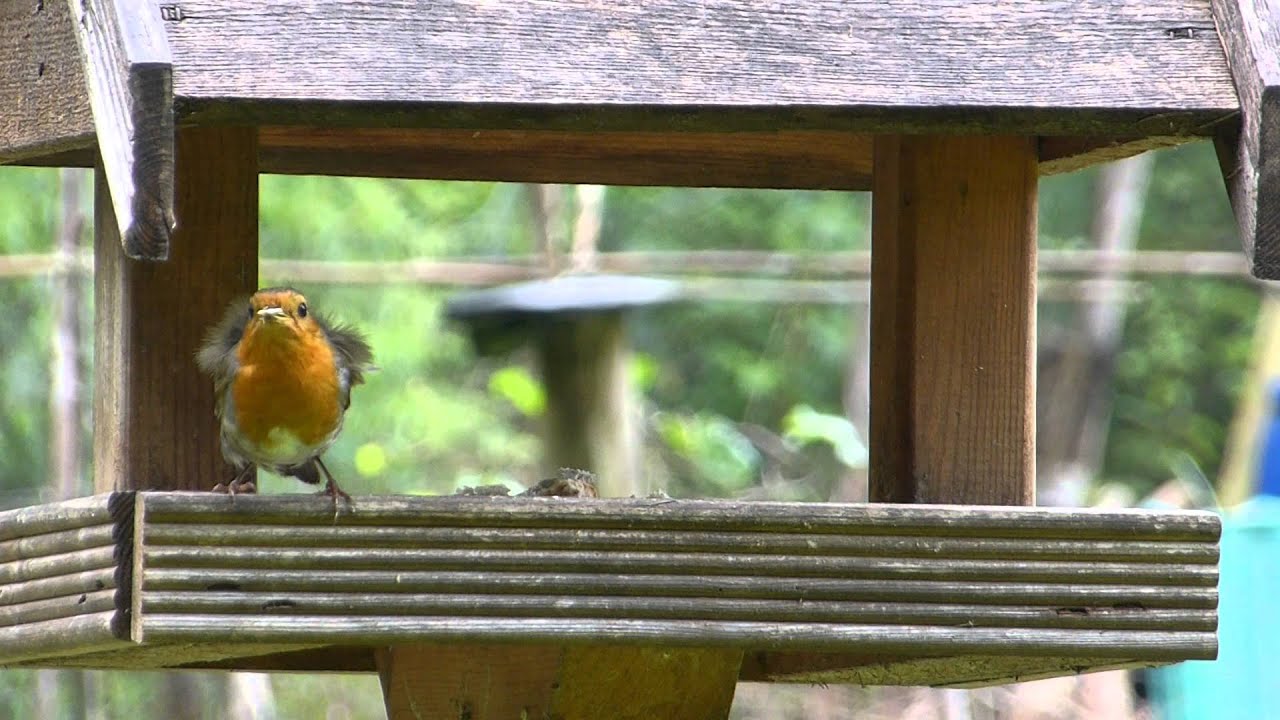
European robin - Erithacus rubecula - Glóbrystingur - Rødstrupe - Raudstrupe - Fleygur ungi að fá sér í svanginn. Robins are fiercely territorial over food supply. Not more than one robin will occupy a small garden, unless it is his mate. When their food source becomes scarce in winter they will eat just about anything put out for them on a bird table, especially fatty foods such as bacon rind and cheese.
The Robin is one of the most distinct and popular British birds, and was voted as the national bird of Great Britain in a ballot nearly 40 years ago. See more: http://www.gardenbird.co.uk/robin.html
Glóbrystingur - Erithacus rubecula - er fugl í grípaættinni. Sjá meira: http://is.wikipedia.org/wiki/Gl%C3%B3...
The European robin was one of the many species originally described by Linnaeus in his 18th century work, Systema Naturae, under the name of Motacilla rubecula. Its specific epithet rubecula is a diminutive derived from the Latin ruber 'red'. The genus Erithacus was created by French naturalist Georges Cuvier in 1800, giving the bird its current binomial name of E. rubecula. The distinctive orange breast of both sexes contributed to the European robin's original name of redbreast (orange as the name of a colour was unknown in English until the sixteenth century, by which time the fruit of that name had been introduced). In the fifteenth century, when it became popular to give human names to familiar species, the bird came to be known as robin redbreast, which was eventually shortened to robin. Other older English names for the bird include ruddock and robinet. In American literature of the late 19th century, this robin was frequently called the English robin. The Frisian robyntsje or robynderke is similar to the English name, while Dutch roodborstje and French rouge-gorge both refer to the distinctively coloured front.In German the bird is called "Rotkehlchen", literally a diminutive of "Red Throat". the robin has become strongly associated with Christmas, taking a starring role on many Christmas cards since the mid 19th century. The robin has appeared on many Christmas postage stamps. An old British folk tale seeks to explain the robin's distinctive breast. Legend has it that when Jesus was dying on the cross, the robin, then simply brown in colour, flew to his side and sang into his ear in order to comfort him in his pain. The blood from his wounds stained the robin's breast, and thereafter all robins got the mark of Christ's blood upon them. An alternative legend has it that its breast was scorched fetching water for souls in Purgatory. The association with Christmas, however, more probably arises from the fact that postmen in Victorian Britain wore red jackets and were nicknamed "Robins"; the robin featured on the Christmas card is an emblem of the postman delivering the card. See more: http://en.wikipedia.org/wiki/European...
The sexes are very similar, if not identical, though some texts suggest that the brown forehead is "V" shaped in females, and "U" shaped in males, though even this is not always apparent. They have a brown bill and legs. See more: http://www.garden-birds.co.uk/birds/r...
Fuglar eru innbyrðis ólíkir og nærast ýmist á blómasafa, jurtum, fræjum, skordýrum, fiski, hræjum eða öðrum fuglum. Flestir fuglar eru dagdýr, en sumir, eins og uglan, eru næturdýr eða rökkurdýr. Margar tegundir fugla eru farfuglar og ferðast eftir árstíðum langan veg milli ólíkra heimkynna meðan aðrir eyða nær öllum tíma sínum á hafi úti. Sumir geta haldist á flugi dögum saman og jafnvel sofið á flugi. Sjá meira: http://is.wikipedia.org/wiki/Fugl
Útbreiðsla varpfulga á Suðvesturlandi: könnun 1987-1992. Fjölrit Náttúrufræðistofnunar nr. 25. Identifier: Glóbrystingur 128 - Sjá meira: http://www.europeana.eu/portal/record...


![[4K FULL HD] Relaxing Water Background | 1 HOUR | Calm Water Wallpaper (No Sound)](https://i.ytimg.com/vi/y9PTNTSpGJs/maxresdefault.jpg)










Информация по комментариям в разработке