Presentation from The Campus Alliance for Advanced Visualization 2019 (CAAV19) held at Indiana University (IU) in Bloomington, Indiana.
Founded 22 years ago, the Indiana University Advanced Visualization Lab had a CAVE and an ImmersaDesk on its two main research campuses. While extremely powerful and inspiring, these systems suffered from complex development methods, high costs of acquisition and support, and limited accessibility. Thus, they only impacted a relatively small number of expert users and high-profile projects. As the mission of the AVL expanded to support the full range of research, creative activities, education, and outreach across all campuses and departments of the eight-campus system, the AVL strived to develop a strategy that improved accessibility, ease-of-use, and overall impact to a much larger segment of the university community, while not losing support for the higher-end technologies and users that made the lab successful in the first place. What evolved over the past 15 years is a hybrid model for planning and supporting visualization systems and services. These systems supported by a set of software tools, resources, workflows, and distribution platforms that make visualization accessible to the entire university community. The major components include research-oriented, flagship facilities on both major research campuses. These facilities enable vis researchers and advanced practitioners to work with leading edge technologies and expert vis staff to help explore and define the next generation of advanced vis methods and applications.
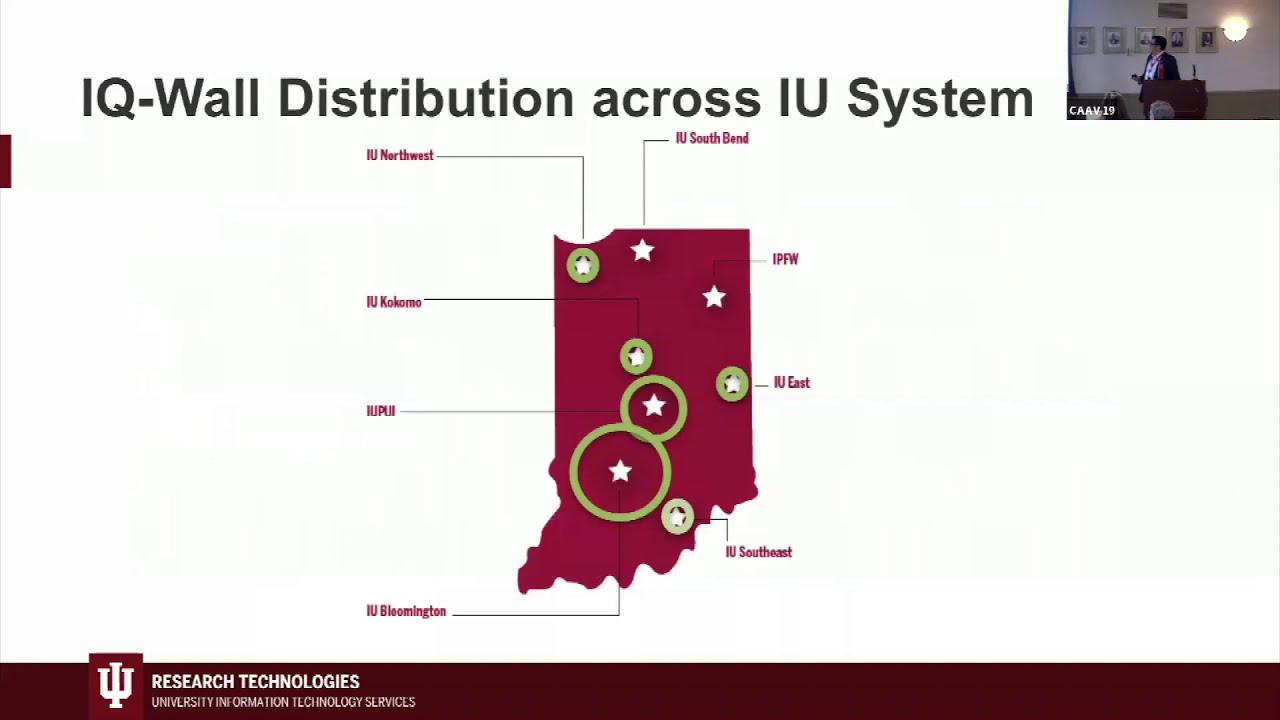
Broad-use, distributed vis systems, including 13 ultra-resolution tiled display walls (IQ- Walls) distributed across six campuses, and 70 virtual reality stations in 16 different classrooms and labs (Reality Labs) across five campuses. These systems feature current generations of technologies and come with supporting software tools, digital content, and documented development workflows to get beginning users up-to-speed quickly, while allowing intermediate users to explore extended-use scenarios and development options. Access to these systems are limited only by facility availability, and a university-managed authentication system. Every faculty and staff member, and all students already have an account on each of these distributed visualization systems.
Research Desktop is a centrally-managed, high-performance cluster that provides a powerful, on-demand, virtual desktop interface to all requesting users. This system leverages the same hardware, software, and file systems that support the university’s largest and most advanced HPC users, and allows users to migrate from small-scale interactive jobs to very large-scale batch jobs within the same general environment. AVL manages a collection of scientific and information visualization software, modeling and animation tools, 3D photogrammetry and mesh modification packages, and advanced media authoring tools for users of Research Desktop, thereby providing real-time, on-demand access to the most popular vis workflows to users anywhere on the network.
IU’s AVL believe this hybrid approach provides the “best of all worlds”, expanding the number and types of users of production visualization technologies, while continuing to support leading edge researchers and next-generation technologies, thereby leading to significantly larger impact and a greater overall return on investment. In this presentation, Dr. Eric Wernert will share useful details and lessons learned from our hybrid strategy, looking to provide practical guidance that can apply to other support groups looking to increase the use and impact of their vis technologies.
Wernert serves as the director of vis and analytics, and associate director of the Data to Insight Center, and is senior manager and scientist for Visualization Technologies and Futures for the Research Technologies Division of IU. Wernert is responsible for providing strategic leadership for the IU system in advanced vis, including setting university-wide strategy for vis and strategic management of visualization facilities. Wernert is also responsible for UITS research services in the emerging area of analytics - including the UITS Center for Statistical and Mathematical Computing. He has led visualization initiatives for the IU School of Medicine and has held leadership roles in the visualization components of funded research projects from the National Institutes of Health and National Science Foundation. He holds a B.A. in Mathematics from Bellarmine College, and an M.S. and Ph.D. in Computer Science from Indiana University.
Session link: https://thecaav19.sched.com/event/WPc...
CAAV19 was held at Indiana University by the Research Technologies (RT) division of University Information Technology Services (UITS). RT is a center in the Pervasive Technology Institute (PTI). https://pti.iu.edu

Информация по комментариям в разработке